 Seller OS
How to get Fiverr orders without reviews
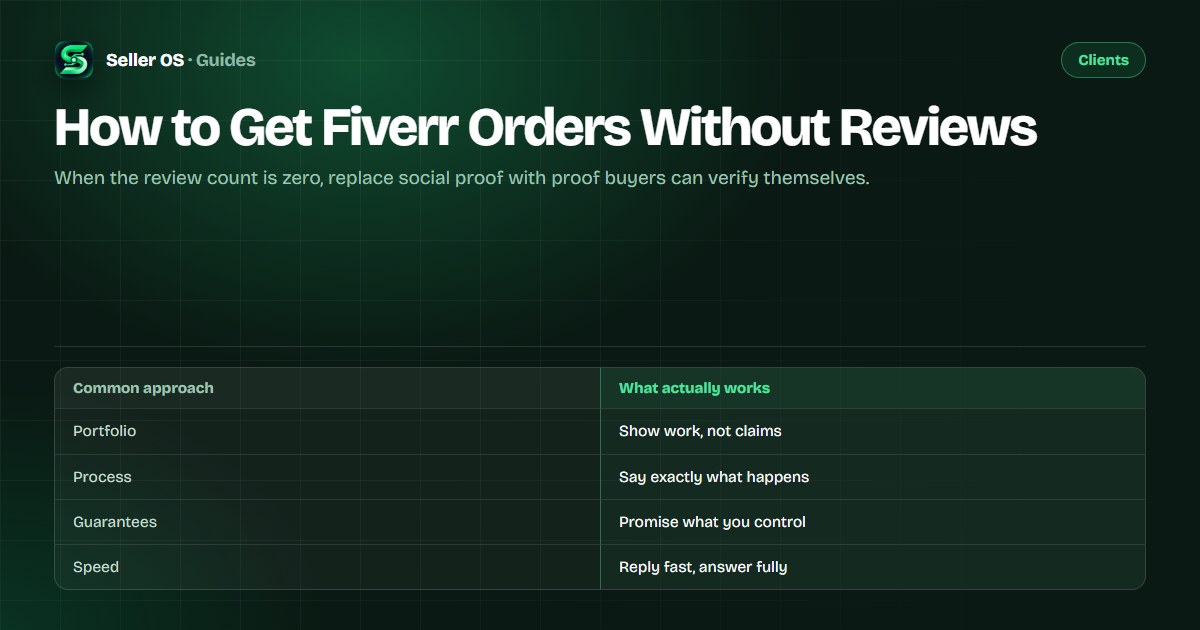
A profile with no reviews is not a dead end; it is a page where the usual shortcut is missing. Reviews are secondhand proof, and when you have none, you substitute proof the buyer can check directly: sample work, a stated process, small commitments you control, and a response speed that feels professional from the first message.
This guide covers the trust substitutes that work before order number one, and the ones that backfire. It is written for sellers with zero public feedback, not as a way to manufacture credibility.
Free plan available. Local-first data. Human review on every change.
What reviews really do for a buyer
A review is a compressed answer to two questions: did this seller deliver, and how did the buyer feel about the process? Star ratings summarize outcomes, and written feedback describes experience. Fiverr publishes reviews only after both parties submit or the review window closes, which is why a completed order can exist with no public text visible yet.
Without that compression, a first-time buyer does the work themselves. Your job is to make the work easy: give them evidence to check, a process to picture, and several small risks instead of one big one. Every substitute below is doing part of the job a review would normally do.
That is also why review count matters less than sellers assume. A buyer is not counting proof points; they are estimating risk. Several substitutes that each remove a specific worry do more for that estimate than any single signal, which is why this guide is organized around worries rather than features.
Make portfolio proof do the heavy lifting
Portfolio is where a zero-review seller can outwork a review count. Fiverr hosts between one and 20 projects per profile, each with one to five files, titled 15 to 50 characters and described in 120 to 1,400. Recommended image dimensions are 1,280 by 769 pixels, and accepted formats include JPEG, PNG, GIF, MP4, AVI, and PDF.
The common mistake is showing a gallery instead of an argument. Three annotated pieces beat ten unexplained ones: for each, write what the client needed, what you chose, and what the result was. Hypothetical example: a logo designer posts one finished mark, one rejected direction with the reason it failed, and the grid behind the mark. The rejected direction is the piece that proves judgment.
Your first delivery adds automatic proof: Fiverr's Live Portfolio shows recent delivery files from completed orders and tags them as made on Fiverr, so the system starts collecting evidence for you as soon as order one ships.
Order the projects deliberately. The first two pinned projects are shown first, so put the pieces that match your main gig promise there and let process pieces support them. Fiverr displays pinned projects first, then recent delivery files, then the remaining projects in the order you choose.
- One project per promise the gig makes.
- Captions that explain decisions, not just files.
- A before-and-after for invisible work.
- A process piece showing the messy middle.
Offer guarantees you actually control
Cautious buyers want risk reduced, which is different from being promised a perfect outcome. Promise process commitments — a delivery window you can beat, a stated revision count, a defined finish line — and never promise results you cannot control, like rankings, sales numbers, or how a client will feel about a draft.
Fiverr requires each package to offer at least one revision option, so a clear revision policy costs nothing extra to state. What matters is that the guarantee is narrow enough to be real. A small promise you keep builds more trust than a large one you cannot, and it protects you from a buyer who reads the widest possible interpretation.
State the guarantees where buyers meet them, not only in the FAQ. The package description and the gig description both get read before the order button, and a promise buried three clicks deep cannot reduce the risk a buyer feels while deciding.
| Buyer worry | Safe promise | Avoid promising |
|---|---|---|
| Will it be late? | Delivery in 2 days, early when possible | An exact hour in every time zone |
| Will revisions cost more? | Two rounds of revisions included | Unlimited changes, forever |
| Will it match my brand? | A style check before full production | Results that raise your sales |
| What if I dislike it? | A finish line we agree on up front | A refund of platform fees |
Show the process in the gig itself
The gig description and FAQ are where a buyer rehearses the experience before paying. Walk through the order from their side: what they send you, what happens first, when they see a draft, what the revision step looks like, and what arrives at delivery. Fiverr allows up to 10 FAQ entries, which is enough room for the questions that stop first orders.
Worked example, hypothetical. A voice-over gig's FAQ answers four questions in plain language: How do you handle pronunciation of names? A short sample is recorded before the full script. What formats are delivered? WAV and MP3, both included. What if the read is wrong? Two revision rounds are included, and most fixes ship the same day. Can you match an existing recording? Send a reference clip with the script, and feasibility is confirmed before ordering.
Screenshots or a short screen recording of the actual workflow carry more weight than any paragraph. Thirty seconds of watching you work shows competence the description can only claim, and it is the closest thing to a live review a new seller can offer.
Response speed is visible proof
Fiverr shows your average response time to clients, and response rate tracks the share of first replies sent within 24 hours over the last 90 days. A question answered within the hour demonstrates what working with you feels like, which is exactly the evidence a review would have supplied secondhand.
Worked scenario, hypothetical. A buyer messages at 9 a.m. asking whether a 90-second script is feasible by Thursday. You reply by 10 a.m. with a yes, the delivery moment, and one question about tone. No review count could say more about responsiveness than that exchange already did, and the answer gave the buyer something concrete to weigh.
Trust substitutes that backfire
Deep discounts are the most common false substitute; they signal that the work is worth less and attract buyers who negotiate every step. Over-guaranteeing is the second: unlimited revisions and impossible deadlines read as inexperience to an experienced buyer, and they cost real money when someone takes them literally.
The third has real consequences: buying, swapping, or requesting reviews in exchange for anything. That manipulates the review system and puts the account itself at risk. And do not pad the portfolio with other people's work; the moment a buyer recognizes one borrowed piece, every other piece becomes suspect too. Honest substitutes compound; invented ones collapse.
Where Seller OS helps
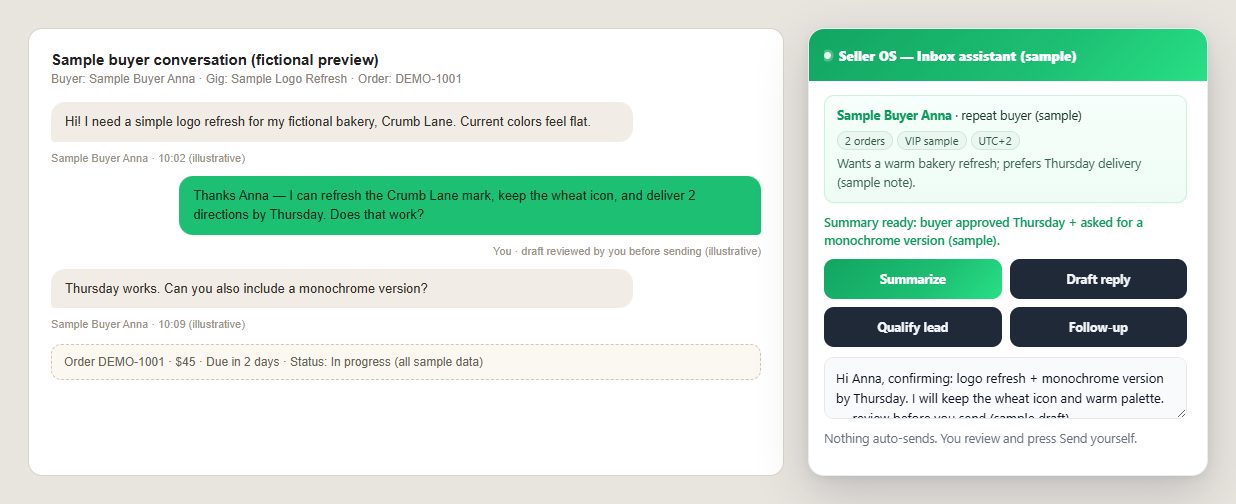
Seller OS is built for the stretch where trust is still being earned. Reply drafts for briefs and buyer messages give you a fast starting point that you edit before sending, which keeps early response times low while you stay in control of every word.
Local client records keep each early conversation and preference together, so the second message to a cautious buyer is more specific than the first. Drafts are drafts: nothing sends automatically, and all of it stays in Chrome local storage.
How to Get Fiverr Orders Without Reviews questions
Can I get Fiverr orders with no reviews?
Yes, sellers do it regularly. Buyers weigh several signals: portfolio work, gig clarity, package structure, profile completeness, response time, and price. With no review history, those become the whole decision. Strengthen each one instead of waiting for a first review that requires a first order.
What do buyers look at when a seller has no reviews?
They look for evidence they can verify: sample work that matches the gig's promise, a clear description of what happens after ordering, consistent packages, and how fast and thoroughly you answer questions. Fiverr shows your average response time to clients, so your reply speed is part of that picture.
Should I give a big discount to get my first review?
A discount buys an order, not trust. A first order that arrives through a steep discount often arrives with higher demands and a lower sense of value. Price a small, well-defined scope fairly instead, deliver it early, and let the review speak about quality rather than about price.
How can I build trust without client work?
Show process, not just outcomes. Annotated samples, a spec sheet, a short screen recording of how you work, and a clear FAQ all demonstrate competence before any client work exists. Label personal projects honestly, and never present someone else's work as a client delivery.
Replace the missing proof.
Use verifiable portfolio work, honest guarantees, and fast replies while the reviews are still ahead of you.