 Seller OS
Fiverr buyer ghosted me: should I follow up?
Sometimes yes, once, briefly. The right answer depends on which silence you have. A buyer who went quiet before ordering is a conversation problem. A buyer who went quiet after ordering is an order problem with defined clocks, and those clocks decide what you can do and when.
This guide separates the two moments, covers what the platform does at each stage, gives the follow-up limit, and explains when letting it go is the professional move rather than the defeated one.
Free plan available. Local-first data. Human review on every change.
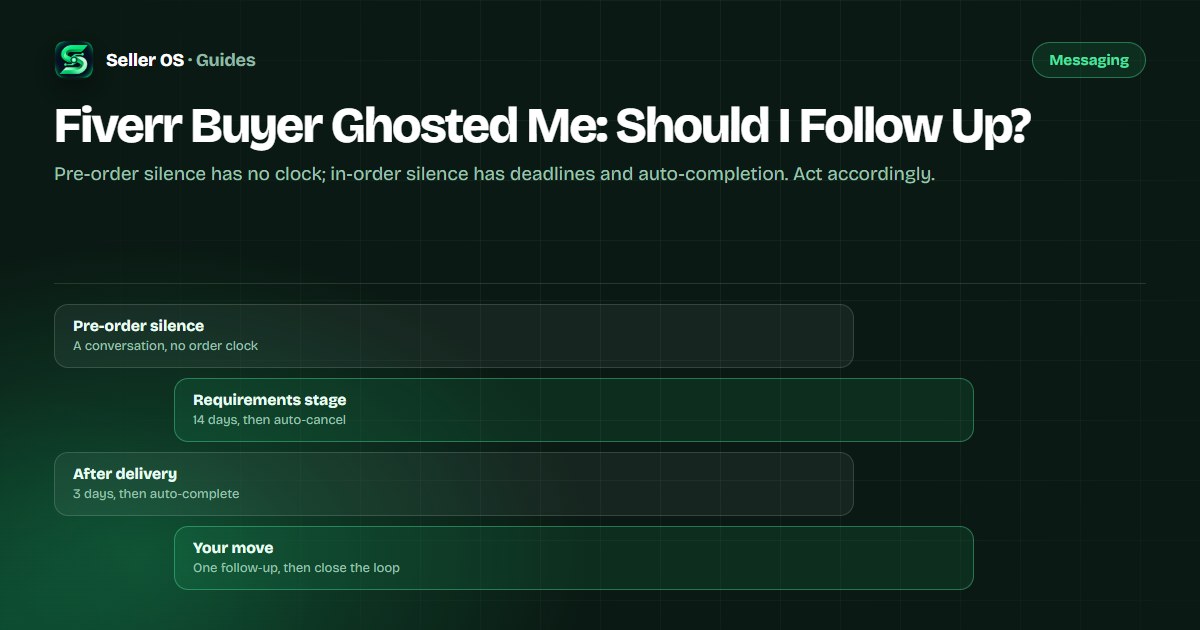
Which silence do you actually have?
Ghosting looks the same from the inbox and behaves differently on the platform. Before an order exists, nothing is running: no deadline, no auto-completion, no obligation on either side. After an order exists, the platform runs clocks of its own, and your follow-up has to work with them rather than against them.
So sort your case first. Was there an order? If yes, which stage is it in: waiting for requirements, in progress, delivered, or in revision? The stage decides what happens if nobody acts, and that answer tells you whether a follow-up is useful, urgent, or unnecessary.
Check for an order - no order means no platform clock is running.
Find the stage - requirements, in progress, delivered, or in revision.
Read the clock - each stage has its own auto-action if nobody moves.
Decide once - follow up inside the window, then stop.
Pre-order silence: one message, then let go
A buyer who messaged you and then went quiet is not a lead you can chase forever. Fiverr's rule is explicit: freelancers cannot initiate contact with new clients, and the client has to reach out first, whether by ordering or by sending a message. Inside a conversation the buyer already started, one short follow-up is fair game.
The common mistake is treating pre-order silence as a sales problem and stacking a second and third message. Wait two or three days, not two or three hours, and send one message with one new thing: a question about the deadline, a note that your calendar is filling, or a smaller option that fits a lower budget. If the reply never comes, leave the thread open and move on; another follow-up rarely changes the outcome.
Requirements stage: the 14-day clock
When a buyer orders and then stops responding before submitting requirements, the order sits in Requirements Needed, and the clock is longer than most sellers expect. Fiverr's freelancer guide states that if the client does not submit requirements within 14 days and you do not skip them, the order is automatically canceled and the client is refunded to their Fiverr balance.
Your move is a message on day two or three offering to help: a checklist of what you need, an offer to work from material that already exists, or a proposal to skip the requirements if the brief is clear enough. Do not wait until day 13 to discover the buyer is gone. If silence started before requirements and never breaks, a mutual cancellation is the clean exit, and Fiverr states that unresponsive clients do not negatively impact your Success Score.
“If the client doesn't submit the requirements within 14 days of the order creation date and you don't skip them, the order will be automatically canceled.”
— Fiverr Help Center, Managing your orders: A freelancer's guide, September 2026
After delivery: the 3-day clock
Once you deliver, the clock is short and in your favor. Fiverr's order guides state that a standard or hourly order completes automatically three days after delivery if the client does not accept, request revisions, or extend the review period; milestone orders take eight days and shipping gigs fourteen. The client can extend review by up to five days, more than once, and that is not a revision request.
What to do: deliver the work on time either way, with a short message noting where the files are and what to check. What not to do: keep sending reminders, revise nothing, cancel nothing. If the buyer stays silent, the order completes on its own, and Fiverr states that unresponsive clients do not negatively impact your Success Score.
Should you follow up mid-order?
Yes, once. In-progress silence can mean the buyer is busy, not gone, and a single message with a specific ask is reasonable: a file you need, a decision between two options, or a heads-up that a dependency is blocking you. Give them an easy reply and a date to reply by.
Example mid-order follow-up, labeled hypothetical: Hi Maya, the storyboard is ready for your review. I need the final logo file to start rendering, and I have Thursday reserved for it. If I do not hear back by Wednesday, I will use the version in your brand folder and adjust later if needed, so the deadline stays safe. Does that work?
If you need more time because the buyer is blocking you, the extension mechanics belong to you, not them. Only the seller can request a delivery extension from the order page, the client has 48 hours to respond, and a request that goes unanswered is automatically accepted. The extension guide covers the details.
Letting go, and what to do instead
Let go when the stop rule is reached: one pre-order follow-up, one mid-order ask, and nothing after delivery beyond the delivery note itself. Letting go is not losing. Time spent on a silent thread is time not spent on the buyers who are answering.
Then do two things. Close the loop in your own records so a message months later starts from context instead of memory. And if the silence is blocking a live order, use the platform path: mutual cancellation when the buyer was unresponsive from the start, or Customer Support when an active order cannot move.
| Stage | Clock | Outcome if silent |
|---|---|---|
| Waiting for requirements | 14 days | Order auto-cancels; buyer refunded |
| Delivered, standard or hourly | 3 days | Order auto-completes |
| Delivered, milestone | 8 days | Order auto-completes |
| Delivered, shipping gig | 14 days | Order auto-completes |
| Review extension | Up to 5 days each | Stays in Delivered, no re-delivery |
Where Seller OS helps
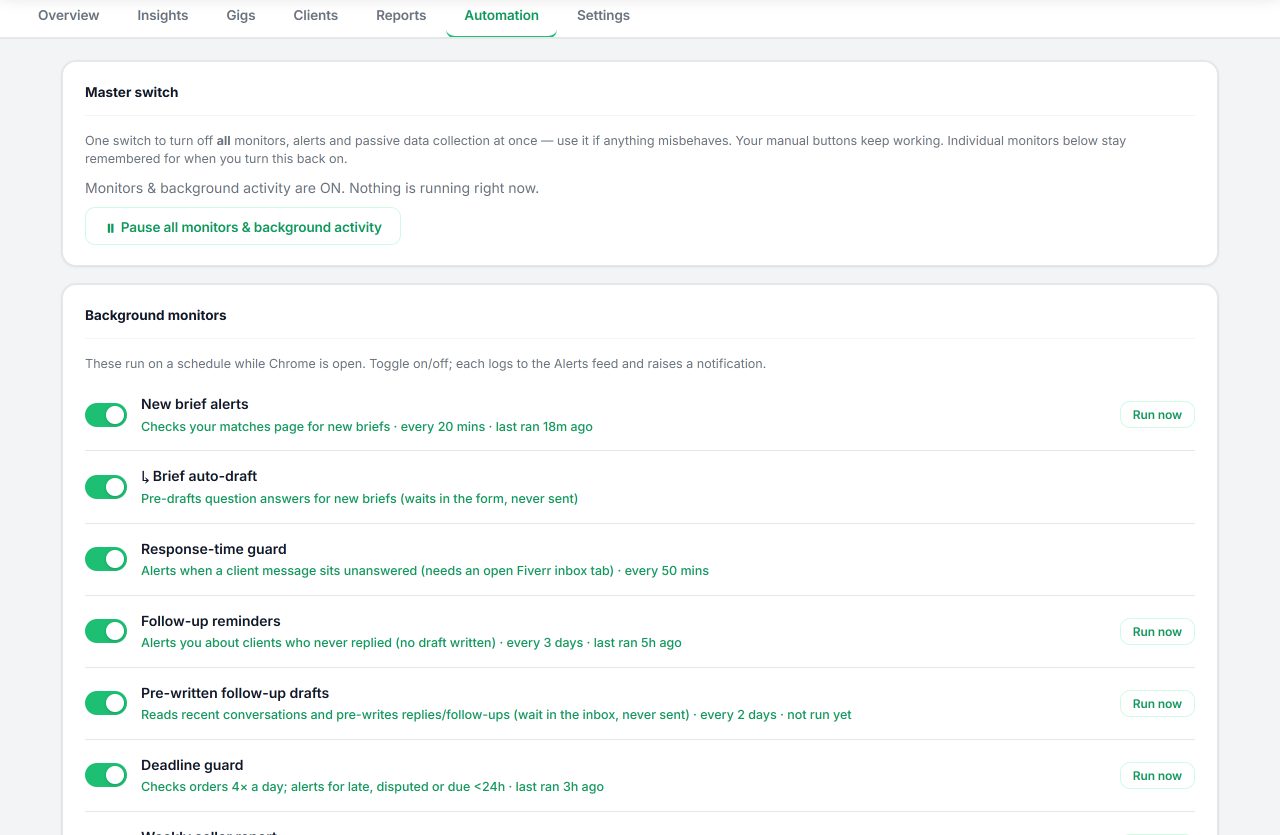
Seller OS cannot make a buyer answer, but it can stop silence from being invisible. On Pro, the unread message monitor flags inbox activity while Chrome is open, and order alerts keep deadlines and pending messages on screen so a quiet thread does not become an expired window.
The client records hold the history locally, so when a buyer resurfaces months later you can see what was promised and what was delivered without scrolling the entire thread. The extension does not send messages, cancel orders, or act on the platform for you; every step stays human.
Fiverr Buyer Ghosted Me questions
Should I follow up if a Fiverr buyer doesn't respond?
Once, and only with something new to say. If there is no order, send one short follow-up two or three days later and then stop. If there is an order, the stage decides: a requirements reminder early in the 14-day window, one mid-order ask, and nothing after delivery beyond the delivery message itself.
How long should I wait for a Fiverr buyer to respond?
Before an order, two or three days is a reasonable wait for one follow-up. Once an order exists, the platform sets the rhythm: requirements auto-cancel after 14 days, and a standard or hourly delivery auto-completes after 3 days, milestone orders after 8, and shipping gigs after 14.
Does an unresponsive buyer affect my Fiverr account?
Fiverr states that unresponsive clients do not negatively impact your Success Score, and the leveling system accounts for those situations. Your own obligations do not disappear, though: you still need to deliver on time and communicate professionally. Keep the order thread and files intact in case support needs context later.
Can I cancel an order if the buyer never responds?
Fiverr's guidance for a client who is unresponsive from the start is to initiate a mutual cancellation. Before requirements are submitted, the client can also cancel without your approval. A completed order cannot be changed through the Resolution Center, so handle silence while the order is still active rather than after it closes.
Know the clock before you send anything.
One follow-up inside the window, then let the order mechanics finish the job.