 Seller OS
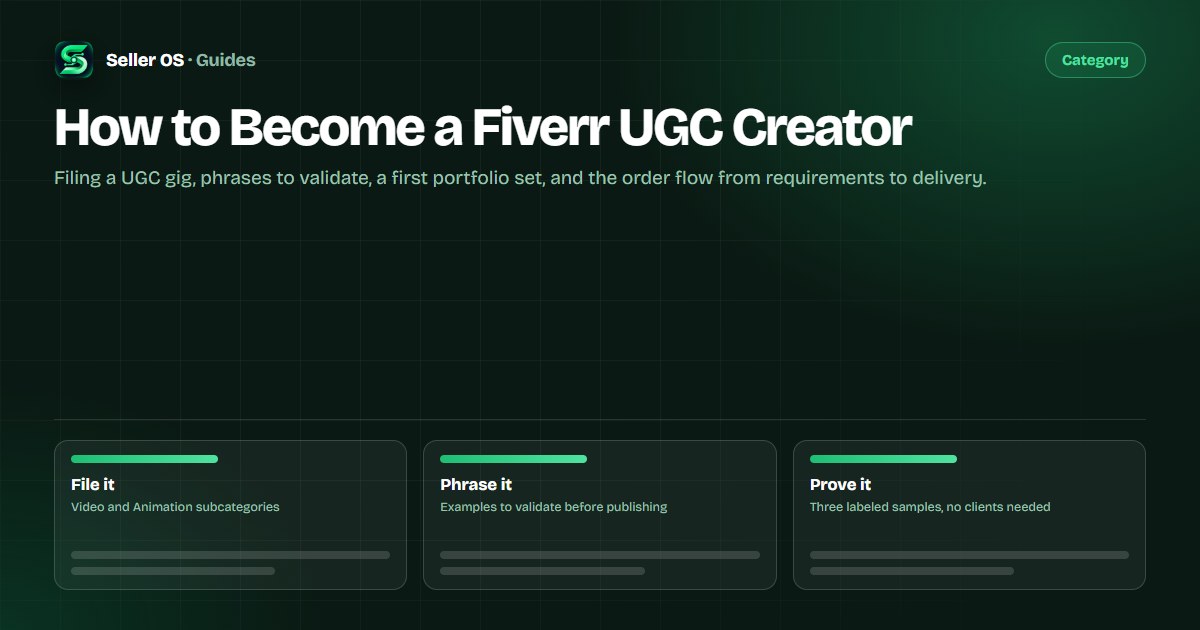
How to become a Fiverr UGC creator
User-generated content is the format brands buy when an ad should look like a person talking to a camera rather than a studio production. On Fiverr it sits inside the video categories, and the sellers who get ordered are the ones whose gig states a format, a platform, and a turnaround instead of a mood.
This page covers what the category needs from you: where the gig files, phrases worth testing, a portfolio you can build without a single client, and the order steps a buyer walks through.
Free plan available. Local-first data. Human review on every change.
What a buyer is actually ordering
A UGC order is a piece of content made to look native to the platform it will run on: a person holding a product, reacting to it, demonstrating it, in a cut that fits a vertical feed. The buyer is not purchasing production value, they are purchasing authenticity plus a usable file, and the brief usually arrives with a product, a claim, and a length.
The line between creator-shot content and generated content matters for how you position. Fiverr runs an AI video hub where brands commission work across categories including UGC content, and the marketplace holds room for both approaches. What separates them is disclosure: whether the buyer is told a face, voice, or scene was generated, which is covered in depth in the AI UGC ads roadmap rather than repeated here.
Read that roadmap before you price or script anything, because it already covers what buyers mean by an AI UGC ad, hook writing, avatars and voice, disclosure rules, and the deliverable ladder. This page handles the marketplace mechanics around it.
Where the gig files and how the title reads
UGC work lives in Video and Animation. Observed subcategory labels on that category page include Short Video Ads and Social Media Videos, either of which is a reasonable home for a vertical ad gig, along with Editing and Post-Production if the service is cut-only. Pick before you write, because Fiverr states the category cannot be changed after the gig is published.
Titles on Fiverr begin with the I will prefix and read as one sentence, so the phrase a buyer types should appear early. A title that names the format and the platform does more work than one that names your personality: a buyer searching for a short ad for a skincare brand needs to see those words in your title, not discover them in paragraph four.
The five search tags and the positive keyword field of up to five words or short phrases are where variations live. Use them for the platform name, the format, and the product angle rather than repeating your title back to the algorithm.
Choose the subcategory first; it is fixed after publishing
Put format plus platform in the title, after the I will prefix
Reserve tags for distinct phrases: platform, format, product angle
Use the keyword field for up to five short phrases
Keep the description for scope, rhythm, and proof
Example phrases worth validating
These are constructed examples for you to test in Fiverr search and in your own analytics, not observed rankings. Type each one into the search bar, see what returns, and keep the phrases that surface gigs you could plausibly outrank with a better package and a better portfolio.
Notice the pattern across the column: format first, then the use case or platform. The pattern is what makes a phrase worth testing, because a buyer scanning results recognizes their own situation in the words.
| Phrase to test | Why it is worth testing |
|---|---|
| ugc video for skincare | Product angle narrows the competition |
| tiktok ugc ads | Platform named the way buyers name it |
| ugc creator for apps | Buyer type is specific and repeatable |
| short form ugc ads | Format matches a subcategory label |
| ugc testimonial video | Deliverable stated as an artifact |
| make ugc ads for my product | Full buyer sentence, useful for a title |
A first portfolio with zero clients
You need three pieces before you publish, and none of them require a paying client. Record one demonstration of a product you own, one testimonial-style piece about a service you actually use, and one hook-only variant that shows you can open a clip in the first two seconds.
Label each piece honestly in the caption: spec work you set yourself, the product used, and the format. Buyers forgive a spec portfolio and distrust a vague one, which is the same argument the portfolio guide makes about proof types — spec work, process pieces, templates, and teardowns all count when they are named for what they are.
Keep the set consistent: same vertical ratio, same caption treatment, same length band. Three pieces that look like one catalog signal a seller who has decided what they sell; three pieces in three styles signal a hobbyist testing the water.
- One product demonstration filmed on a phone
- One testimonial-style piece about something you use
- One hook-first variant under twenty seconds
- Captions that mark each piece as spec work
- Consistent ratio, length band, and caption treatment
How a UGC order runs on the platform
A clean order starts with requirements. Ask for the product name, the single claim to make, the platform it will run on, the length band, and any footage the brand already has. Requirements that arrive vague produce revisions, and the buyer has 14 days to submit what you asked for before the order can be canceled with a refund.
Worked example of a first order: a $60 package for one thirty-second vertical ad with two hook variants. Requirements come in on day one with the product and a claim, you deliver on day four, the order auto-completes three days later if the buyer takes no action, and 80% of the purchase amount lands in your balance for withdrawal after the 14-day clearance.
Put usage terms in your gig description and in the requirements so the buyer agrees before delivery, and state how many rounds of edits each package includes — Fiverr requires at least one revision option per package, and more than the package allows becomes a negotiation mid-order.
Requirements: product, claim, platform, length, existing footage
Confirm the format and the hook direction before recording
Deliver the cut plus the variants the package names
Note the auto-completion date and the clearance window
Ask for nothing off-platform at any point in the thread
The mistakes that keep a UGC gig quiet
The common mistake is a gig that promises everything: ads, reviews, animations, voiceovers, and avatars in one listing. Four active gigs are allowed for new sellers, so split the offers instead of blending them, and let each one name a format a buyer can picture.
The second is publishing generated content without saying so. Disclosure rules for AI-assisted work are covered in the roadmap guide, and a buyer who discovers a generated face after approving a delivery has every reason to cancel and review.
The third is skipping validation. The phrases in the table above are hypotheses; run them through Fiverr search before you commit a title, and compare your choice against what short-form editors and social media managers are ranking for, since those adjacent sellers take the same buyer attention.
Where Seller OS helps
Seller OS keeps the marketplace half of this running: it drafts the title, tags, and description from the format and platform you choose, holds the tracked keywords behind the gig so a phrase change can be read against a baseline, and keeps reply drafts ready for requirements conversations in your Inbox.
It does not record, generate, or publish content, and it does not send messages on your behalf. A person performs every final Save, Continue, or Publish action.
How to Become a Fiverr UGC Creator questions
What is a UGC creator on Fiverr?
A seller who produces content that looks native to the platform it will run on: a person demonstrating a product or telling a short story, shot vertically and cut for a feed. Buyers order it as an alternative to studio advertising, and they usually arrive with a product, a claim, and a length in mind.
Which category should a UGC gig file under?
Video and Animation, where observed subcategory labels include Short Video Ads and Social Media Videos. Choose the subcategory before you publish, because Fiverr states the category cannot be changed afterward, and a gig in the wrong queue competes in a queue it never chose.
How do I get UGC portfolio pieces without clients?
Film three spec pieces yourself: a product you own, a service you use, and a hook-first variant. Mark each one as spec work in the caption with the product named. Buyers forgive honest spec work and discount portfolios that imply client work that does not exist.
Do I need to disclose AI-generated UGC?
Tell the buyer when a face, voice, or scene was generated, and agree on the format before delivery. The disclosure rules and ethics guidance sit in the AI UGC ads roadmap, along with hook writing, avatars, and the pricing ladder for these orders.
Pick one format and file it properly
Validate a phrase, film three spec pieces, and publish a gig that names the format and the platform.