 Seller OS
Most in-demand Fiverr skills in 2026, ranked by demand
Buyer demand on Fiverr moves every year, and 2026 is no exception. Automation requests keep growing, short video keeps absorbing attention, and buyers with larger budgets keep asking for fewer, bigger projects. This guide ranks the skills behind those requests by demand signals you can check yourself, not by hype.
For each skill you get three things: why buyers still pay for it, the visible signal that demand is real, and a rough time to first order if you start from zero. Read it as a shortlist, then validate your pick with the low-competition method before you build anything.
Free plan available. Local-first data. Human review on every change.
Read demand before you pick a skill
A skill is only as good as the orders behind it. On Fiverr you can read demand directly: open the category, count how many gigs serve it, and look at review dates on the top listings. Recent reviews on young accounts mean new sellers are still getting in, which is the strongest signal a beginner can find.
Two background shifts color every pick this year. Fiverr's public results describe softer buyer counts alongside higher spend per buyer, which favors sellers who package larger outcomes. Generative AI has also absorbed the simplest version of several skills, so demand now clusters around work that needs judgment, taste, or access to the buyer's own systems. Treat both as context, not as numbers, and check the current listings before you commit.
- Result depth: dozens of pages of gigs with recent reviews beats a thin category with stale feedback.
- Review velocity: several reviews per month on mid-tier gigs signals steady buyer flow.
- Brief language: repeated buyer questions about one outcome point to unmet demand.
- Your delivery cost: a skill you can fulfill in hours beats one that needs weeks of study first.
Skills with durable buyer demand
The list below is ordered by how readable the demand is and how fast a beginner can reach a sellable standard. Each entry names the signal so you can recheck it yourself in ten minutes.
Time-to-first-order ranges assume a few focused hours per day and a portfolio built from spec work. They are planning estimates, not promises; your pace, prices, and gig quality move them in both directions.
- AI automation (n8n, Zapier, Make): buyers post concrete workflow pains; the signal is detailed briefs naming tools. Rough time to first order: five to eight weeks.
- Short-form video editing: brands need weekly reels; the signal is subscription-style packages on top gigs. Rough time: four to six weeks.
- AI UGC ads: sellers bundle hooks, avatars, and editing; the signal is repeat-buyer language in reviews. Rough time: four to seven weeks.
- Social media design in Canva: steady small-business demand; the signal is high gig counts with fresh reviews. Rough time: three to five weeks.
- Shopify setup and tweaks: store owners pay for done-for-you builds; the signal is high order values on established gigs. Rough time: six to ten weeks.
- Copywriting for landing pages and email: demand concentrates in niches with proof; the signal is premium pricing that holds. Rough time: six to ten weeks.
- Excel and data cleaning: unglamorous, constant demand; the signal is short delivery times with repeat orders. Rough time: three to five weeks.
Where AI changed the brief
Some skills did not lose demand so much as change shape. Buyers now generate first drafts themselves and pay sellers for the parts AI handles badly: accuracy, brand fit, original proof, and accountability for the result.
If you sell in one of these areas, reposition the offer around the gap. Edit and verify AI output, add original research or footage, and show before-and-after proof. The AI survival guide covers this repositioning in depth.
| Skill area | What changed | The answer |
|---|---|---|
| Basic logo and template design | Buyers generate simple marks themselves | Brand kits, guidelines, and applied mockups |
| Generic blog writing | Commodity posts lost value | Niche expertise, interviews, original angles |
| Basic voiceover | Short synthetic reads cover simple cases | Directed reads, character work, sync to picture |
| Simple data entry | Forms and imports cover the basics | Cleaning, deduping, and dashboards with checks |
Match a skill to your timeline
If you need money within a month, pick from the short end of the list: Canva design, data cleaning, or short-form editing if you already cut video. These need proof, not credentials, and buyers judge the sample rather than your history.
If you can invest two months, automation and Shopify pay back the study time with higher order values. Larger projects also fit the platform's upmarket drift, where fewer buyers spend more per order. Either path works; mixing both at the start usually means finishing neither, so pick one and validate it with the niche checklist.
Turn one skill into a first gig
Once the skill is chosen, the sequence is fixed: build three spec pieces, write the gig around one buyer and one outcome, price the first tier to earn reviews, and publish. Fiverr's category pages show how top sellers scope the same work, so mirror their structure with your own samples and words.
Keep the first offer narrow. A gig that promises one outcome to one buyer converts better than a menu of everything you can do, and it gives you cleaner data on what to improve. The low-competition gig list shows how narrow winners look in practice.
Prove it
finish three spec pieces that look like paid work for a specific buyer.
Scope it
write packages around one outcome, with extras for the natural upsells.
Price it
set the entry tier low enough to earn first reviews, with room to raise later.
Ship it
publish, then improve the gig from real impressions and messages.
Where Seller OS helps
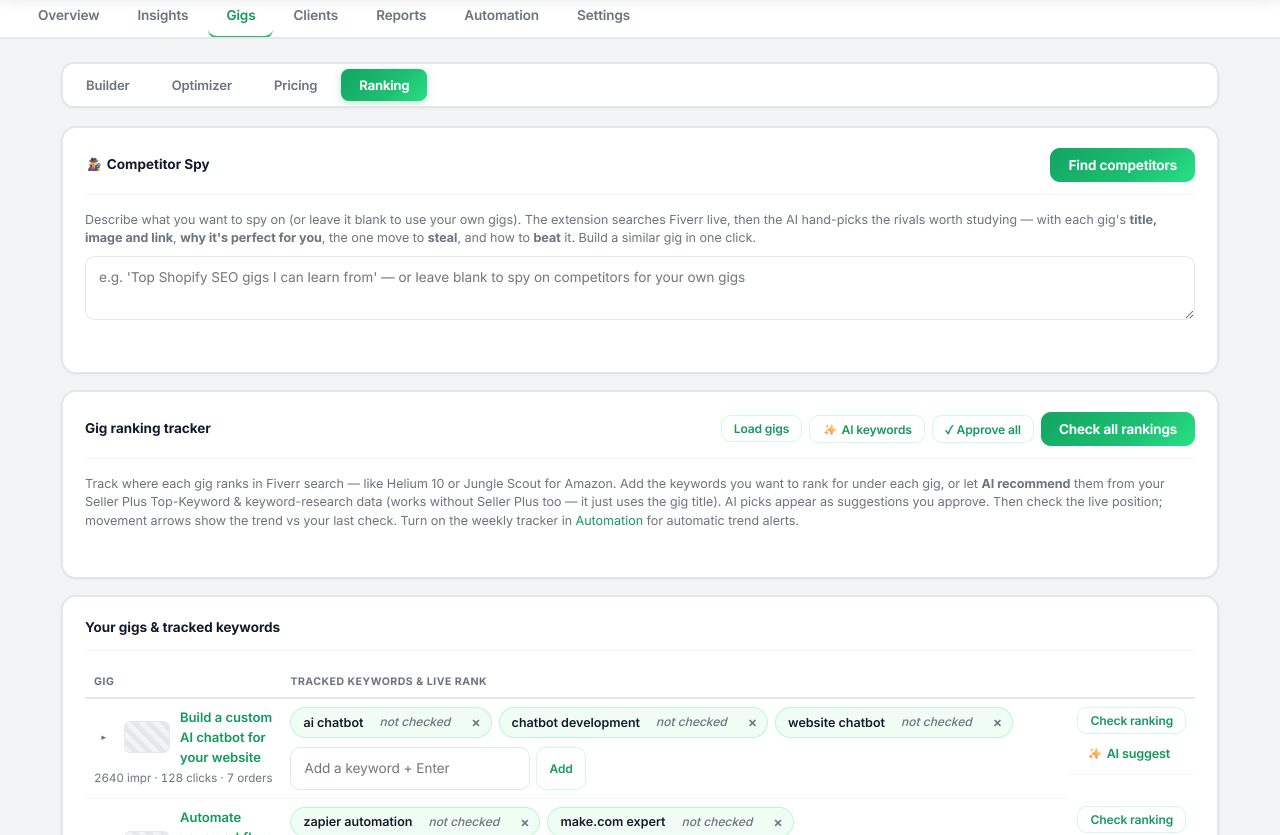
Seller OS cannot learn the skill for you, but it shortens the distance from skill to first order. The gig builder turns your offer idea into a structured draft with packages and FAQ suggestions, and the keyword data shows how buyers phrase the same service.
Everything stays local and review-gated: drafts live in your browser, nothing publishes itself, and a person completes every Save or Publish step. Client notes and order history stay in Chrome local storage.
Most In-Demand Fiverr Skills questions
Which Fiverr skill is best for a complete beginner in 2026?
Canva social design or spreadsheet cleaning are the fastest ramps, because buyers judge samples rather than credentials and both can be practiced daily for free. Pick the one you can stand doing for months, build three spec pieces aimed at one buyer type, and publish a narrow gig. Speed matters less than finishing one offer properly.
Are AI tools killing demand for Fiverr skills?
They absorbed the simplest version of several skills, but demand moved rather than vanished. Buyers now pay for judgment, taste, original proof, and accountability for the result. Sellers who edit AI output, add real research or footage, and show before-and-after proof keep earning, while sellers offering commodity drafts face the most pressure.
How long until a new skill earns its first Fiverr order?
Plan on three to ten weeks depending on the skill, assuming a few focused hours per day and a portfolio of spec work. Design and data cleaning sit at the short end; automation, Shopify, and copywriting take longer but pay more per order. Treat every timeline as a planning estimate, since pricing and gig quality move it both ways.
Should I offer several skills or focus on one?
Focus on one. A gig that promises a single outcome to a single buyer converts better, earns clearer reviews, and gives you cleaner data on what to fix. Splitting study time across three skills usually produces three average gigs instead of one strong one. Expand into a second offer only after the first earns steady orders.
Pick one skill and validate it this week.
Check the demand signals, build three spec pieces, and publish one narrow gig around a single buyer outcome.