 Seller OS
Fiverr Mira: is AI matching good or bad for sellers?
Mira is neither good nor bad for sellers on its own; it changes where a buyer's search starts. When a buyer describes a role and Fiverr's matching proposes talent, the gig that wins is the one that reads like the best fit, not the one that repeats a keyword most often. Here is what Fiverr says Mira does, what shifts on the buyer side, and the positioning moves that keep you in the running.
Free plan available. Local-first data. Human review on every change.
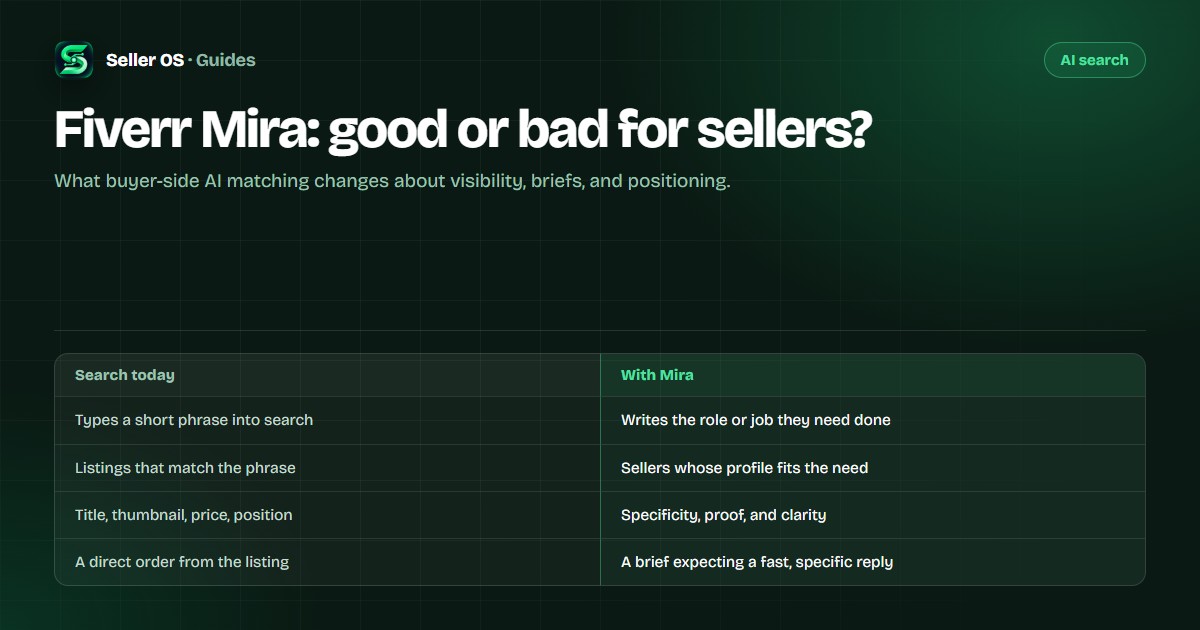
Is Mira good or bad for sellers?
Mira is neutral on its own; what changes is where a buyer's search starts. Buyer-side matching widens the set of sellers a buyer considers, which favors specific, well-documented gigs and squeezes listings that compete only on price. Read it as a new entrance to the same demand, then adjust the parts of your profile that a role description can match.
Fiverr controls what Mira shows, how matches are ordered, and which sellers appear at all. No extension can change that, so the work that pays off is positioning you can verify: a clear offer, current proof, and fast, specific replies.
What Fiverr says Mira is
Mira is Fiverr's buyer-side matching product, and Fiverr describes it in one sentence. A buyer writes a role or job description instead of scanning categories, and the system proposes talent. The line below is quoted exactly from Fiverr's page as it read in September 2026.
“Talent headhunting, reimagined. Describe the role or job you're looking for, and let Mira find the right talent.”
— Fiverr, Mira product page at mira.fiverr.com, September 2026
Two details matter for sellers. The buyer describes the work in their own words, and the system reads that description to propose people. A gig built around a narrow buyer and a clear outcome gives that description something to match; a gig built around a broad service name gives it almost nothing.
What buyer-side matching changes for sellers
A role description replaces some keyword browsing, so the first filter becomes fit rather than phrase match. Search by keyword still exists, but the described-role path rewards gigs that name the buyer, the outcome, and the proof in plain language.
| Stage | Keyword-first search | Role-description matching |
|---|---|---|
| How the buyer starts | Types a short phrase into search | Writes the role or job they need done |
| What surfaces | Listings that match the phrase and rank well | Sellers whose profile fits the described need |
| What earns the click | Title, thumbnail, price, and position | Specificity, comparable proof, and clarity about the outcome |
| How the order often starts | A direct order from the listing | A message or brief that expects a fast, specific reply |
The sales channel moves with it. A brief that arrives in your inbox is a conversation with a budget and a deadline, so your reply is the pitch: what you would do first, what you need to confirm, and when you can deliver. A slow or generic answer rarely beats a specific one.
Where sellers can get squeezed
Commodity gigs feel the pressure first, because matching compares fit across many sellers at once and price stays visible. When two listings promise the same deliverable and neither shows differentiated proof, the cheaper one looks like the safer match.
The second squeeze is invisible copy. A listing that says only "professional service, fast delivery, 100% satisfaction" reads as interchangeable next to one that names a buyer type, a deliverable, and a result. Matching can only work with what your gig says about itself.
Where sellers can win
Matching can surface a best-fit seller who does not hold a top search position, and that is the opening. A narrow offer with clear proof competes on fit instead of on review volume, and the best-fit listing is usually the one a buyer opens first.
Write for the description. A title such as "I will edit a 20-minute SaaS onboarding video with captions" stays inside Fiverr's 80-character limit, which counts the "I will" prefix, and it tells the system and the reader exactly what they get. Keep the outcome in the title, put the proof in the gallery, and make the first description line a sentence a buyer could repeat to a colleague.
What to do this month
Rewrite each gig as an outcome a buyer can match. Lead the title with what the buyer gets, spend the five tags on phrases a buyer would type, staying within 20 characters per tag, and open the description with the result rather than with your tools.
Then refresh one proof item per gig, answer every brief inside your working block, and keep tracking your own keyword positions. Rank history is still the cleanest signal you own while matching develops, and Fiverr shows impressions, clicks, and conversion on your dashboard when you want a second view.
Where Seller OS helps
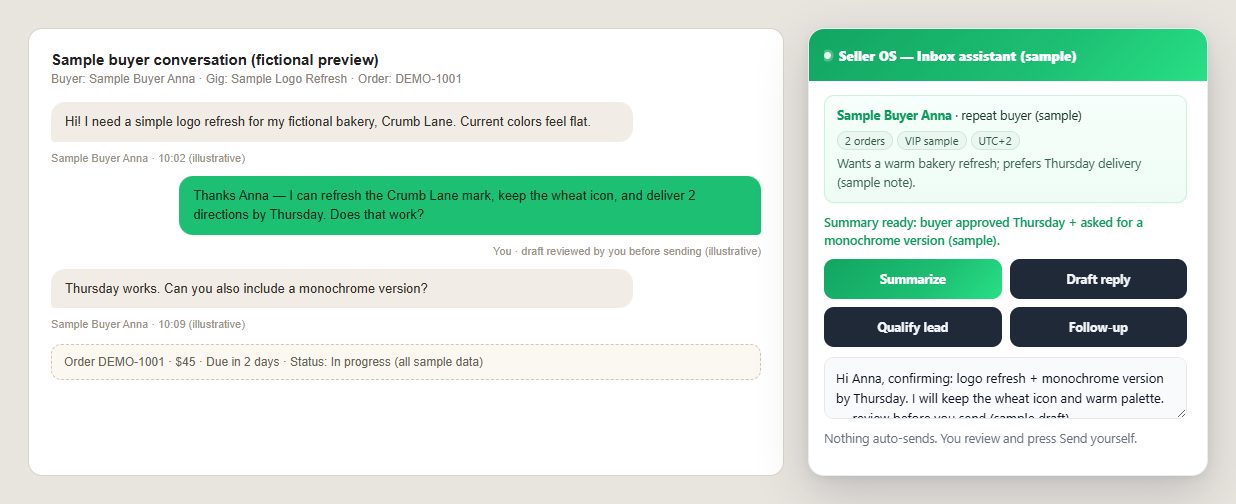
Seller OS drafts the two things matching rewards: gig copy and brief replies. The Gig Builder turns an idea or a competitor URL into a full draft and fills the wizard fields; the inbox assistant summarizes a brief and drafts a specific reply you can edit; keyword tracking keeps local position history so you can see whether a copy change moved anything.
Nothing runs automatically. Drafts wait for your review, and a person performs every Send, Save, Continue, and Publish. Monitors for ranks and briefs are Pro and run only while Chrome is open. Fiverr controls matching and ranking, so no tool can promise orders.
Sources
Fiverr's own pages for the product description and the market context:
- Mira, Fiverr's buyer-side matching page, September 2026.
- Fiverr's second-quarter 2026 results, published July 29, 2026.
Fiverr Mira questions
Does Mira replace keyword search on Fiverr?
No. Mira adds a way for buyers to start with a role description, while search by phrase still exists. Treat matching as another path to the same buyers, and keep your gig readable for both.
What should I change in my gig for AI matching?
Lead with the buyer and the outcome, keep proof close to the top, and cut generic claims that every competitor also makes. Specific copy gives a matching system and a browsing buyer the same clear signal.
Can I track Fiverr keyword positions outside Fiverr?
Seller OS keeps local position history per keyword in Chrome, and a Pro monitor can check ranks while Chrome is open. Fiverr controls the results page, and results vary by time, account, and location, so read the trend rather than one snapshot.
Is Seller OS affiliated with Fiverr or Mira?
No. Seller OS is independent software for Fiverr sellers, not affiliated with or endorsed by Fiverr. Mira is Fiverr's product, and Fiverr's own pages describe its current scope and terms.
Match the way buyers search now.
Draft gig copy and brief replies that read like the best fit, then review every word before it goes out.