 Seller OS
Fiverr milestones: split big orders safely
Fiverr milestones split a large order into separately delivered, separately charged stages. Your client reviews the workflow and pricing before ordering, and you are reimbursed per completed milestone instead of waiting weeks for the whole project to finish. That changes the cash flow and the risk profile of big work in your favor.
This guide explains the mechanic as Fiverr publishes it, when milestones beat a single order, and the scope hygiene that keeps stages from blurring together. Mechanics come from Fiverr's help center; the workflow advice is ours.
Free plan available. Local-first data. Human review on every change.
How a milestone order works
Instead of one delivery at the end, the project becomes a sequence of stages, each with its own scope, delivery, and price. The client sees the full workflow and pricing before ordering, and Fiverr's help center states that you are reimbursed as each milestone completes rather than when the whole order finishes. Stages can be set up in the Gig's Description and FAQ tab or through a custom offer.
The payment sequence is the part sellers care about most. Clients are charged for the first milestone when the order starts and for each following milestone when they approve the previous one. You are not carrying the full project cost between stages, and the client is not paying for work that has not been agreed yet.
Who can actually add milestones
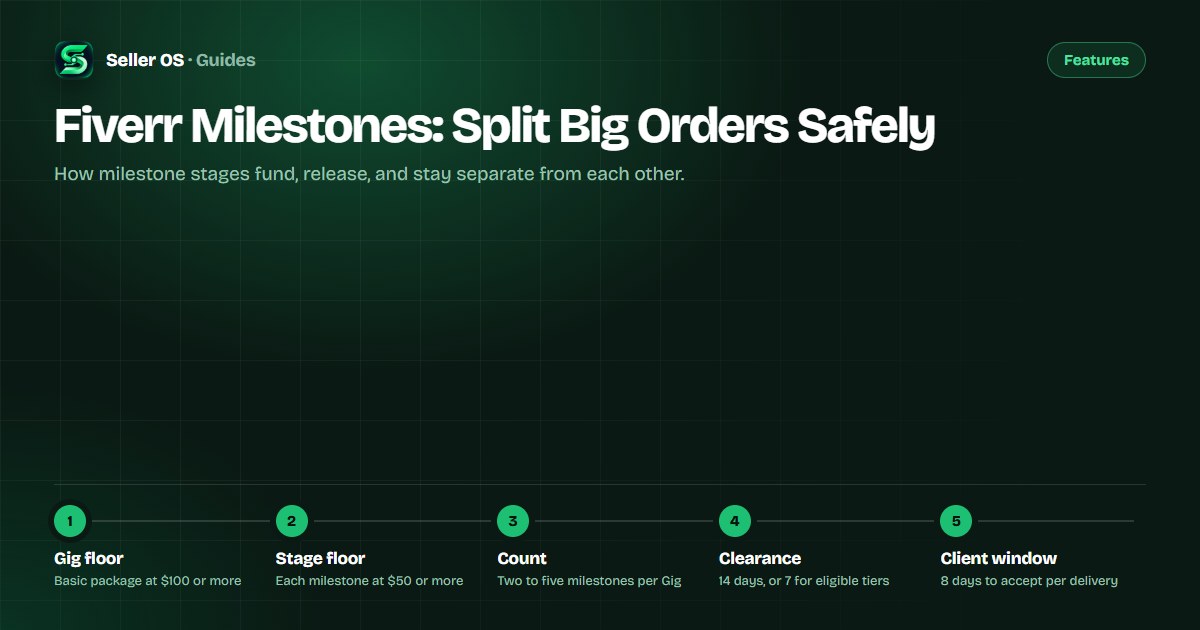
The gate is category and price, not your seller level. To add milestones to a Gig, Fiverr's milestones article requires the basic package to be at least $100, each milestone to be at least $50, and between two and five milestones per Gig; the same article notes custom offers allow up to six. Fiverr does not publish a level requirement for this feature.
Availability is limited to specific subcategories. Fiverr's published list includes Logo Design, Website Design, Video Editing, Voice Over, SEO, Legal, and Business Plans among others, so a seller outside those subcategories will not see the option. Do not assume every category can use milestones; check whether your subcategory appears before promising a staged plan to a client.
- Basic package must be priced at $100 or more.
- Each milestone must be priced at $50 or more.
- Two milestones minimum, five maximum on a Gig.
- Only specific subcategories support the feature.
- No seller level requirement is published for milestones.
How the money and the clocks move
Each stage has its own timeline. The client has 8 days from a delivery to request a revision or accept, then 10 days to pay for the next milestone after accepting; if they do not pay, the order stops. Clearance runs 14 days, or 7 days for Pro, Top Rated, and Seller Plus freelancers. If no one acts after delivery, milestone orders auto-complete after 8 days.
Stopping is a real state, not a pause. A client can stop the order after any accepted milestone, and a stopped order cannot be resumed. Each milestone can also be cancelled individually, and Fiverr's article states that if at least one milestone was completed, the order still counts as completed, so a partially finished project does not vanish from your record.
| Event | Published clock | What happens |
|---|---|---|
| Delivery lands | 8 days to accept | Client accepts or requests a revision |
| Milestone accepted | 10 days to pay | Next stage funds, or the order stops |
| After acceptance | 14 or 7 days clearance | Funds become withdrawable |
| No client action | 8 days | Milestone order auto-completes |
When milestones beat one big order
Stages make sense when the project has natural checkpoints and the price is large enough that a single payment feels risky to both sides. An illustrative example (not platform data): a $900 website project split into three milestones of $300 for structure, $300 for design, and $300 for launch. You are paid after each acceptance, and the client approves direction three times instead of once at the end.
A single order still fits better for fast, contained work: a $150 logo with a two-day turnaround does not need a funding schedule, and adding stages only adds waiting. The test is whether each stage has an output a client can accept or reject on its own. If a stage cannot be judged independently, it is one order pretending to be three.
Keeping the stages from blurring together
The common mistake with milestone orders is writing stages that overlap, then absorbing the confusion as revisions. If milestone two is the design and milestone three is the design plus two extra pages, the client reasonably reads one as covering the other, and the disagreement lands on your metrics. Define each stage by a file or outcome the client can point at, not by a phase name.
Write the boundary into the milestone description: what is included, what is explicitly out, and what triggers a new stage. Extra requests in the middle of a stage belong in a reply on the order, with a custom offer for the addition rather than silent absorption. The scope creep guide covers that conversation, and moving to larger projects covers the pricing side.
Name the output
each milestone ends in a file or a reviewable state
Draw the border
list what is out of scope for that stage
Price the addition
handle new requests as a separate offer
Confirm before starting
get stage acceptance in the order thread
Milestones versus the other contract types
Three alternatives cover nearby situations, and they behave differently. A single custom offer is one payment with one delivery; hourly contracts bill weekly against logged hours for open-ended work; subscriptions recur at intervals for repeat business. Milestones sit in the middle: fixed prices, defined stages, sequential funding.
Pick by how well the work can be described up front. If you can list deliverables and dates, milestones give the client visibility and you staged payments. If hours will wander, hourly fits. If the same small job repeats monthly, a subscription fits. One published constraint helps the decision: milestone and subscription orders cannot be combined and offered simultaneously, so a Gig cannot carry both models at once. Illustrative split (not platform data): a $1,200 edit booked as three $400 stages — rough cut, revision round, final export — gives both sides a checkpoint, while the same project as one $1,200 custom offer pays only at the end and five logged hours would bill whatever the week actually took.
Where Seller OS helps
Seller OS keeps the boundary work honest. Package pricing review checks your stage prices against your profit assumptions, and local client records keep each project's agreed scope where you can see it when a mid-stage request arrives.
It drafts and fills; a person performs every final Send, Save, Continue, or Publish action. It does not create milestone orders for you, release funds, or negotiate stages with your client.
Fiverr Milestones questions
How do Fiverr milestones work?
Milestones split an order into separately delivered, separately charged stages. The client reviews the workflow and pricing before ordering, is charged for the first milestone at order time, and pays for each next milestone after approving the previous one. Each stage has its own delivery window, and your funds clear per completed milestone instead of at the end of the whole project.
Who can offer milestone orders on Fiverr?
Fiverr's milestones article gates the feature by category and price, not seller level: the Gig's basic package must be at least $100, each milestone at least $50, with two to five milestones per Gig, and the option appears only in specific subcategories such as Logo Design, Website Design, Video Editing, and SEO. Check whether your subcategory is on the published list.
When do I get paid for a milestone?
The client is charged for each milestone as the previous one is accepted, and your revenue clears 14 days after completion, or 7 days for Pro, Top Rated, and Seller Plus freelancers. The client has 8 days per delivery to accept or request a revision, then 10 days to fund the next milestone before the order stops.
Can a client cancel a milestone order halfway?
A client can stop the order after any accepted milestone, and a stopped order cannot be resumed. Each milestone can also be cancelled individually. Fiverr's article states that if at least one milestone was completed, the order still counts as completed, so completed stages remain on your record even when later stages do not run.
Split the next big project
Define three stages with a clear output each, price them at $50 or more, and confirm boundaries before starting.