 Seller OS
Fiverr hourly contracts: a freelancer's guide
Fiverr offers hourly work as an optional addition to fixed pricing, aimed at scopes that are unclear or evolving, long-term projects, and estimates over 8 hours. Freelancers eligible from Level One and above can send hourly offers, set a weekly hour limit, and get paid weekly against hours they log on the order page.
This guide covers how a seller receives an hourly contract, how time is logged and billed as Fiverr publishes it, and the record-keeping that prevents disputes. Mechanics come from Fiverr's help center; the fit advice is practical.
Free plan available. Local-first data. Human review on every change.
What an hourly contract is
Fiverr's hourly work article positions hourly work as an optional addition to fixed pricing rather than a replacement for it. It fits three situations it names: scopes that are unclear or evolving, long-term projects, and estimates over 8 hours. Eligible freelancers and agencies work and get paid on an hourly basis, and your hourly rate is optional to display on your profile and in search results with the hourly filter.
The contract has its own terms, separate from a package order. Clients pay for approved weekly reports, the platform holds funds in escrow until approval, and Fiverr publishes a $5 order initiation fee on the client side, tax not included. Fixed-price Gigs keep working alongside hourly offers, so nothing about your existing packages needs to change.
How you receive an hourly contract
Hourly work arrives through custom offers. Fiverr's custom offer documentation lists hourly as an order type alongside single payment, subscriptions, and milestones, and it requires an hourly rate plus a weekly hour limit. A custom hourly offer must carry a minimum time estimate of 8 hours, and you set the weekly limit yourself, though the client can change it after the order starts.
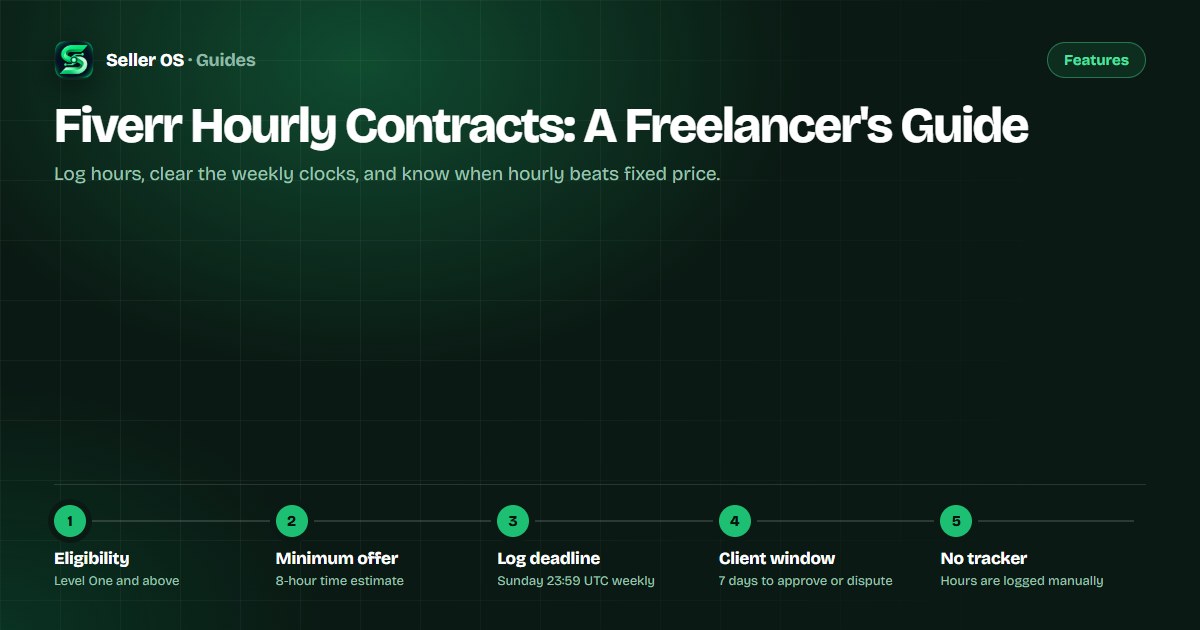
Eligibility starts at Level One, according to Fiverr's article. The offer itself is written like any other custom offer: scope in plain language, rate, weekly limit, and delivery expectations, all sent through the inbox where the client can accept or ask for changes. If you have never sent one, the mechanics in the custom offers guide apply here too.
Confirm your level
hourly eligibility starts at Level One
Set rate and weekly limit
both are required on the offer
Estimate at least 8 hours
the published project minimum
Send through the inbox
client accepts or requests changes
How time is logged and billed
Logging is manual, and Fiverr's article is explicit that there is no built-in time tracker; it describes the current state as a beta version where a built-in tracking system may be available in the future. You log hours on the order page each week with a description of the work, and attaching files or screenshots is recommended practice rather than a platform requirement.
The weekly clock is strict. Hours must be logged by Sunday 23:59 UTC, the client is charged the following Monday, and the client then has seven days, until the next Monday, to approve or dispute. Manual approval is the default and is required for the first weekly report; from the second week the client can enable automatic approval, where reports auto-approve within three days of submission.
- Log on the order page with a description of the work done.
- Deadline each week: Sunday 23:59 UTC.
- Client is charged the following Monday.
- First report requires manual client approval.
- Auto-approval is optional from the second week onward.
Money timing and what happens in a dispute
If a client does nothing, the report auto-approves after seven days and payment follows within another seven days. Funds themselves release within 14 days after approval, or 7 days for Seller Plus subscribers, Top Rated, and Pro freelancers. On the client side, weekly refund requests close after 72 hours, or seven days when manual approval mode is on.
Disputes have the tightest clock in the whole model, and Fiverr's payment protection policy is the article that frames it. If a client disputes a weekly report, you must accept or decline within 48 hours or the report is cancelled automatically. If a client's payment fails, the order is suspended, and Fiverr's article tells you to stop working and contact support after seven days. Ending an order leaves you 24 hours to log any remaining hours.
| Stage | Published timing | Who acts |
|---|---|---|
| Weekly log | By Sunday 23:59 UTC | You log hours |
| Charge | Following Monday | Client is charged |
| Approval | 7 days, then auto-approve | Client approves or disputes |
| Dispute response | 48 hours | You accept or decline |
| Funds release | 14 days, or 7 for eligible tiers | Clearance runs |
When hourly fits better than a package
Hourly earns its place when the work genuinely cannot be priced up front: a retainer where next week's tasks depend on this week's findings, or a migration where the unknowns are the project. It fails when the scope is actually stable, because a client reading an hourly offer for a fixed job will simply compare the ceiling against a package price elsewhere.
An illustrative example (not platform data): a client needs ongoing maintenance, roughly 12 hours a week. A weekly limit of 15 hours at an agreed rate gives them a ceiling and you a predictable week; a flat monthly package would force you to estimate the workload and absorb the overrun. When both numbers are visible, the conversation is about fit rather than guesswork.
Records that prevent the 48-hour dispute
The common mistake with hourly work is logging a week as five lines of vague effort. When a client disputes that report, you have 48 hours to respond, and a description like worked on fixes gives you nothing to argue with. Specific entries, written as you go, are what make a disputed hour defensible.
Build the habit before you need it: log daily rather than Sunday night, describe outcomes rather than activity, attach the artifact that proves it, and keep the agreement in the order thread instead of private messages. The time management guide covers batching the logging itself, and the fees guide covers how weekly charges and commissions land. Illustrative entry (not platform data): Monday, fixed checkout button alignment on mobile, screenshot attached, three hours — a line a client can verify in ten seconds if the 48-hour dispute window ever opens.
Log daily
five short entries beat one long reconstruction
Name outcomes
what changed, not that you worked
Attach proof
screenshots, diffs, or exported files
Keep it on platform
agreements live in the order thread
Where Seller OS helps
Seller OS is built around the same discipline: notes and order context live in local client records, and message drafts for weekly recaps are written for review, so the log you send reads like the work you actually did.
It drafts and fills; a person performs every final Send, Save, Continue, or Publish action. It does not track your time, submit weekly reports, or approve hours on a client's behalf.
Fiverr Hourly Contracts questions
Does Fiverr have hourly contracts?
Yes. Fiverr documents hourly work as an optional addition to fixed pricing for unclear or evolving scopes, long-term projects, and estimates over 8 hours. Freelancers eligible from Level One and above can send custom hourly offers with an hourly rate and a weekly hour limit, and clients can filter search by hourly rate if you choose to display one.
How does Fiverr track hours for hourly orders?
It does not track time for you. Fiverr's article states hours are logged manually on the order page with a description, by Sunday 23:59 UTC each week, and describes the current state as a beta version without a built-in tracking system. Attaching files or screenshots to each entry is recommended practice for keeping logs defensible.
When do I get paid on an hourly order?
The client is charged the following Monday after your weekly log, then has seven days to approve or dispute; if nothing happens, the report auto-approves after seven days and payment follows within another seven days. Funds release 14 days after approval, or 7 days for Seller Plus subscribers, Top Rated, and Pro freelancers.
When should I use hourly instead of a fixed package?
Use hourly when the scope genuinely cannot be priced up front, such as ongoing retainers or projects with unknowns, and when you can state a weekly hour limit a client can budget against. Fixed packages work better for stable, repeatable deliverables where a ceiling is easy to promise. Fiverr positions hourly as an addition to fixed pricing, not a replacement.
Log it while it is fresh
Set your weekly limit, describe hours as you go, and send a report your client can approve without questions.