 Seller OS
Fiverr feedback boosting: rules sellers must know
Fiverr's policy violations page lists feedback boosting as a warning category, stating that authentic unbiased reviews are the backbone of the rating system and that artificially inflating ratings deceives users and damages marketplace credibility. A separate feedback manipulation warning covers attempts to influence reviews.
This guide explains the published policy, the behaviors that count as boosting, and the legitimate alternatives that grow reviews without risking your account. Policy claims are attributed to Fiverr; there are no workarounds here.
Free plan available. Local-first data. Human review on every change.
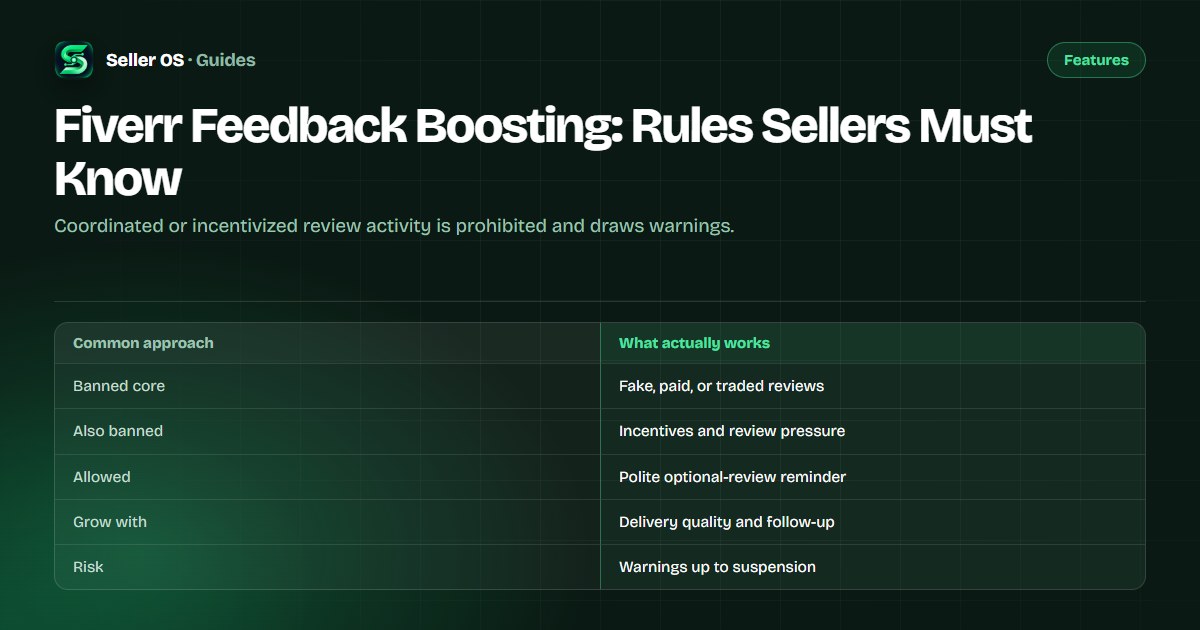
What the feedback boosting policy states
Fiverr's policy violations page states that an account receives a feedback-boosting warning for engaging in the practice, describing purchasing or selling services to inflate ratings or levels as an unfair advantage that deceives users. The reviews policy defines feedback manipulation as any attempt to artificially influence a review, rating, or reputation, including pressure, coercion, incentives, or coordinated activity.
The same policy family covers a distinct feedback manipulation warning for review interference more broadly. Read both as one boundary: the platform protects the review as an independent buyer statement, and any seller action that bends that statement toward a guaranteed outcome sits inside the prohibited zone.
Behaviors that count as boosting
Fiverr's reviews policy names the prohibited set plainly: asking friends, family members, or fake accounts to purchase services to leave positive reviews; incentivizing reviews with discounts, freebies, or refunds; exchanging reviews by buying each other's services; soliciting review changes; conditional deliverables that withhold files, bonuses, or refunds for a review outcome; and emotional manipulation or unprofessional pressure.
A common mistake sellers make is believing that only paid fake reviews count while review-for-discount offers to real buyers are clever marketing. The published policy treats incentives and conditional deliverables as manipulation regardless of whether the underlying order was genuine, so the discount-for-five-stars message is as prohibited as the fake account.
- Fake purchases by friends, family, or alternate accounts.
- Discounts, freebies, or refunds conditioned on positive reviews.
- Review exchanges with other sellers.
- Asking buyers to edit, change, or remove published reviews.
- Withholding delivery or bonuses until a review appears.
Where polite asking crosses the line
Fiverr's reviews policy states that freelancers may politely remind clients that reviewing is optional, without pressure, and may respond publicly to reviews. Asking for a review is therefore not itself prohibited; demanding a positive one, paying for one, or punishing its absence is where the line breaks.
Illustrative scenario: a delivery message that says reviews are optional and feedback helps improve the gig stays inside the boundary. The same message adding a 10 percent refund for five stars, or holding the source files until the review posts, crosses into incentivization and coercion that the policy prohibits, even when the seller frames it as a thank-you gesture.
Legitimate ways to grow review volume
Reviews follow completed value, so the honest engine is delivery quality, clear scope, on-time arrival, and calm revision handling. Time a single polite follow-up to the review window: buyers have 14 days after completion in most categories, or 30 days in Programming and Tech and listed Digital Marketing subcategories, which sets the natural moment for one reminder rather than a sequence of nudges.
Illustrative example: a seller delivering on Monday sends a Thursday note summarizing what was delivered, where the files live, and that a review is optional but appreciated, then never mentions it again. Pair that timing with the follow-up rules and the first reviews guide for the full ethical sequence.
| Instead of this | Do this | Why it is safe |
|---|---|---|
| Paying for five stars | Deliver early with clear files | Value earns reviews |
| Discount for positives | One optional-review reminder | No incentive attached |
| Demanding review edits | Public professional response | Policy allows responses |
| Trading reviews | Resolve issues via Resolution Center | Fixes the real problem |
After a bad review: the compliant path
Fiverr's reviews guidance states that support removes reviews only under the reviews removal policy, and that sellers cannot ask buyers to remove reviews nor remove their own published reviews. Freelancers cannot edit a submitted public review, while buyers can edit theirs only until it goes live, and responses once published cannot be edited or removed.
Your compliant moves are a calm public response while the gig is active, a private lesson-learned note in your own records, and better scoping on the next order. Sellers who consistently apply this loop find that one bad review ages out beneath a run of specific, well-scoped deliveries that earn quiet five-star ratings. The public versus private review guide and the unfair review guide map those rails without promising removals.
Warnings and account consequences
Feedback boosting and manipulation sit inside the enforcement ladder that runs through warnings toward restriction and suspension. Fiverr's enforcement guidance states warnings expire after 90 days but that repeated violations escalate, so a single boosting warning is both a penalty and a preview of what a second one costs.
If policy language ever confuses you, read the warning system guide and the new-seller violations guide before acting. Never try to offset a bad rating with a quick manufactured positive, since that trades a recoverable dip for an account-level risk.
Where Seller OS helps
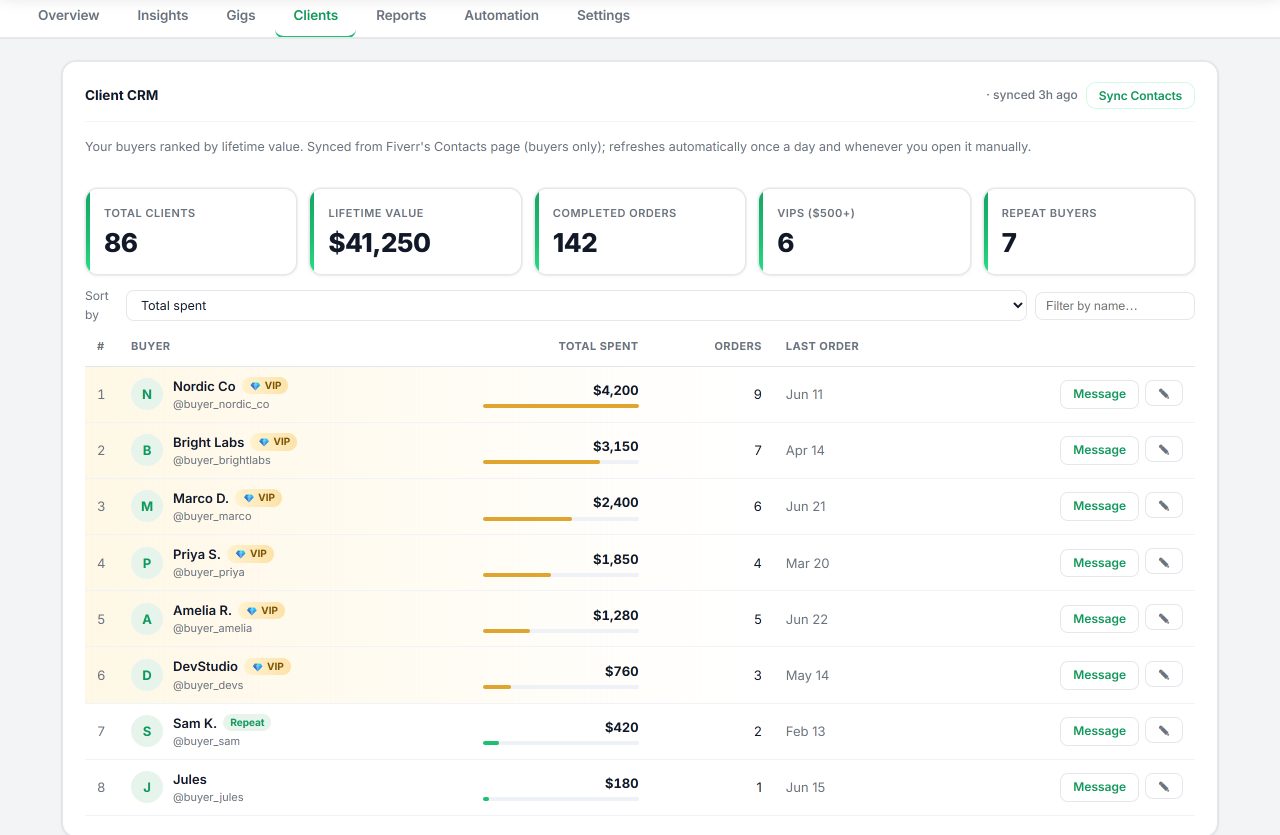
Seller OS supports the legitimate path this policy leaves open: inbox reply drafts and order-message follow-ups you review before sending, local client records that remember who needs one polite reminder, and a short action queue that times that reminder inside the review window. A person performs every final Send.
It does not solicit reviews, incentivize buyers, exchange feedback, or contact buyers outside your visible threads. It drafts and fills; you keep every review-related message inside the polite, optional, pressure-free wording the policy allows.
Fiverr Feedback Boosting questions
What is feedback boosting on Fiverr?
Fiverr's policy violations page describes it as purchasing or selling services to artificially inflate ratings or levels, calling authentic unbiased reviews the backbone of the rating system. The reviews policy adds that any attempt to artificially influence a review, rating, or reputation, including pressure, coercion, incentives, or coordinated activity, counts as manipulation.
Can I offer a discount for a five-star Fiverr review?
No. Fiverr's reviews policy prohibits incentivization, including discounts, freebies, or refunds conditioned on a positive review. It also prohibits conditional deliverables that withhold files or bonuses for a review outcome. You may politely remind buyers that reviewing is optional, without pressure, and respond publicly to reviews that appear.
Can I ask friends to buy my gig and leave reviews?
No. Fiverr's reviews policy states sellers must not ask friends, family members, or fake accounts to purchase services for the purpose of leaving positive reviews. That is listed as feedback boosting even when real money changes hands. Grow reviews through delivery quality, clear scope, and one polite optional reminder instead.
How do I get more Fiverr reviews without breaking rules?
Deliver well, close the loop with a summary message, and send one polite reminder that reviewing is optional while the 14-day or 30-day window is open. Fix problems through the Resolution Center before they become bad reviews, and answer published reviews professionally. Volume follows repeatable quality, not incentives or exchanges.
Earn the review, never buy it
Deliver cleanly, remind once politely, and respond professionally.