 Seller OS
The Fiverr warning system: levels and windows
Fiverr tells you when something you did breaks a rule, and it keeps a record of those notices. The warning system is how the platform logs them, weighs them together, and decides what happens if the behavior continues. Reading that record correctly matters, because the notice you receive is not the same thing as the outcome you face.
This guide covers the warning ladder as Fiverr publishes it, the standing window that keeps older notices in view, what each stage means for your account, and the response that fits each stage. It stays on the warning system itself; the underlying rules new sellers break have their own page.
Free plan available. Local-first data. Human review on every change.
What a warning actually records
Fiverr describes how it enforces policy in a published article, and that page is the reference for everything below. A warning is a recorded notice tied to a specific rule: it names the policy, the content or action that broke it, and the correction expected. It is not a general caution. Treat the citation as the part that matters, because the fix follows from which rule was named and where else that rule is in play.
Warnings are account history, not gig noise. Editing the one gig that was flagged does not clear the record; the notice stays attached to your account while the standing window runs. That is why the same slip repeated across different gigs reads as a pattern instead of an accident, and why the first response should be an audit rather than a quick edit.
Fiverr also states that a seller can appeal a decision, as a complaint with Customer Support, and its enforcement page defines that process and its timing. Read it before you respond, so your first message matches the process instead of working against it. The rule text lives in Fiverr's enforcement article.
The warning ladder and what each level means
Fiverr does not publish a simple count of warnings before an action, so any guide that promises one is guessing. What the enforcement page describes is a progression in which a notice can be followed by further steps if the behavior continues, with severity and repetition both feeding the decision. Some categories carry immediate consequences regardless of history.
Read each stage as a question the platform is asking. A first notice asks whether you will correct the named problem. A repeat asks whether the correction held. A severe first offense skips ahead entirely. Your job stays constant across all three: remove the cause and let corrected behavior, over real orders, show that the rule is now satisfied.
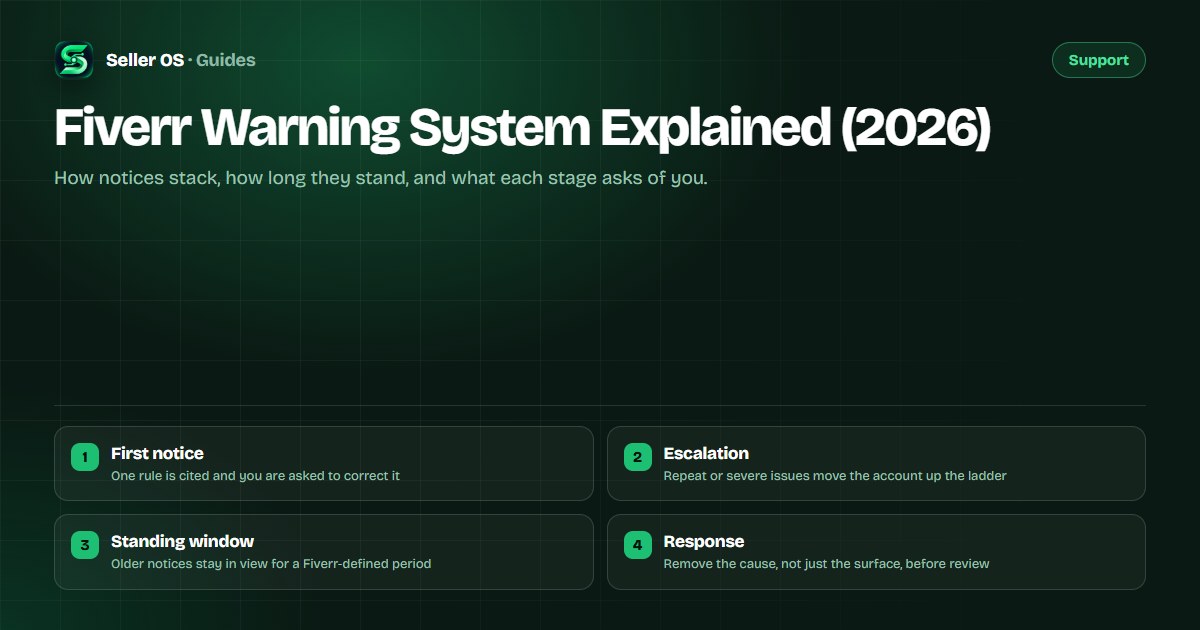
- First notice: one policy named, correction requested.
- Repeat notice: the same or a related issue returns inside the standing window.
- Severe case: a category of behavior that carries immediate account action.
- Account action: selling limits, ineligibility, or suspension.
The standing window and why old notices matter
Fiverr attaches a period to how long a notice stands in your account, and behavior inside that period is read together. This is the detail sellers miss when they treat every warning as a clean slate. Two notices years apart may not be linked; two inside the same window read as a pattern. Because the length is set by Fiverr, confirm it on the current enforcement page rather than an older description.
The practical consequence is restraint. The worst response to a notice is to keep operating unchanged and hope the window closes unnoticed. The second worst is to repeat the same edge-case behavior in other gigs or saved replies. Both turn a single manageable notice into evidence of a pattern, which is exactly how an account begins to climb.
The right response at each stage
At a first notice, correct the cited issue completely. If the notice names contact details in a description, remove them everywhere they appear, not only on the flagged gig. If it names a review request, stop that wording in every saved reply and template. Partial fixes leave the cause alive.
If the issue is genuinely unclear, use the single appeal route the enforcement page describes instead of filing message after message. One factual appeal is part of the process; a stream of tickets is not. Keep it short: what happened, what you changed, and what you are asking Fiverr to review.
Then slow down and sweep the account. Live gig descriptions, package text, saved replies, and profile fields all get reviewed together. The violations checklist lists the common causes, and the appeal guide covers the formal process once an account has moved past a warning.
What recovery looks like, honestly
Clearing a warning is not a button. The record ages out of the standing window on Fiverr's schedule, and the strongest signal you can send meanwhile is steady, corrected behavior across real orders. There is no published shortcut, and any service offering to wipe account history is selling something it cannot produce.
If an account action lands before you correct course, the appeal is a complaint made through Customer Support inside the window Fiverr publishes. The outcome is Fiverr's decision; no guide should promise reinstatement. What stays in your control is a clear record, attached evidence, and one well-written request.
| Stage | What changes | Your move |
|---|---|---|
| First notice | A rule is cited; selling continues | Correct the cause everywhere, not once |
| Repeat notice | History reads as a pattern | Audit the whole account and templates |
| Restricted selling | No new orders can be received | Finish active orders, file one appeal |
| Suspension | Selling ends under Fiverr's terms | Use the published complaint path once |
Where Seller OS helps
Seller OS reads the account and gig surfaces for the same patterns Fiverr flags, so a notice does not arrive before you have had a chance to correct the cause. Its monitors watch gig fields and saved replies for contact details, mismatched claims, and the edge-case wording that trips policy review.
It does not touch enforcement and never claims to. There is no appeal automation, no account-history editing, and no messaging on your behalf. The tools run locally in Chrome, surface what they find for a person to review, and leave every fix and every submission to you.
Fiverr Warning System Explained questions
How many warnings before Fiverr bans an account?
Fiverr does not publish a fixed number, and any figure you see quoted is a guess. Its enforcement article describes a progression that depends on severity and repetition, not a simple countdown. A single severe violation can carry immediate action, while a minor one may resolve with a correction inside the standing window.
Do Fiverr warnings expire?
A warning stands in your account history for the period Fiverr defines, and behavior inside that window is read together. After the window passes, older notices carry less weight, though Fiverr does not promise they vanish. Check the current enforcement article for the window rather than trusting an older summary.
What should I do straight after a Fiverr warning?
Read the cited rule, then fix the underlying cause across the whole account rather than only the flagged page. Audit live gigs, saved replies, and profile fields for the same pattern, because Fiverr reviews the account, not one listing. If the notice is unclear, use the single appeal route the enforcement page describes.
Can a Fiverr warning be removed from my account?
There is no published self-service way to erase a warning, and no legitimate service can wipe account history for you. The record follows the window Fiverr sets. What you control is corrected behavior over real orders, which is the signal that matters when the account is next reviewed. Treat any promise of removal as a red flag.
Read the notice, then fix the cause
Correct the cited rule everywhere it appears, keep the appeal to one factual request, and let steady orders carry the rest.