 Seller OS
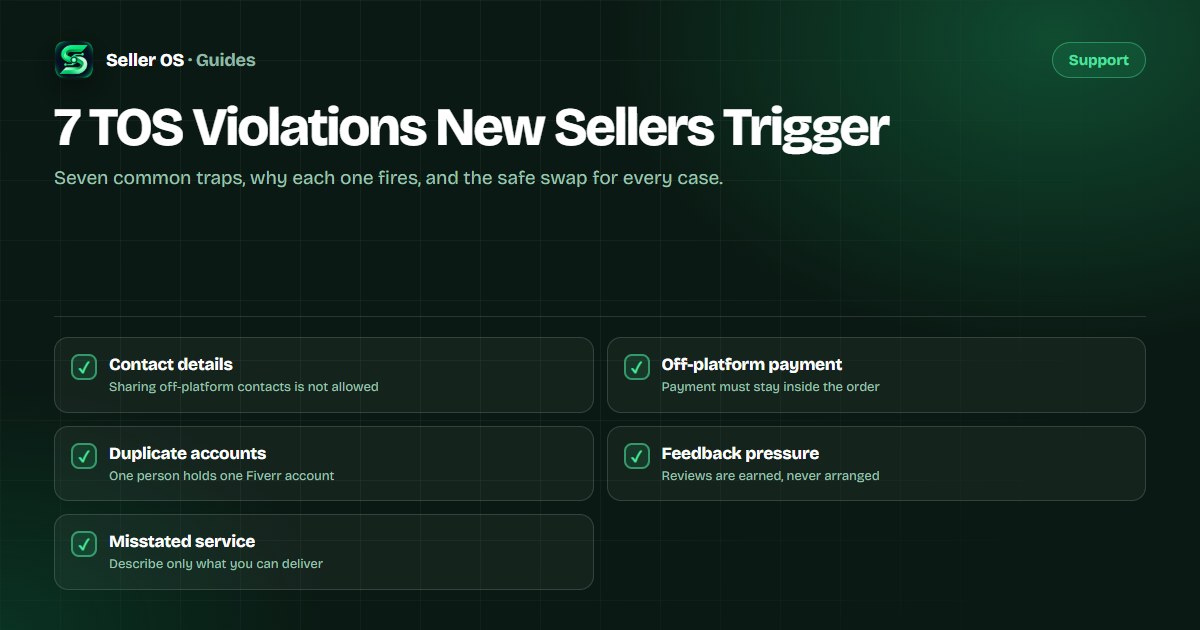
7 TOS violations new Fiverr sellers trigger
Most new-seller account trouble does not come from bad intent. It comes from habits that feel normal and rules that were never read. Fiverr's Terms of Service and its Help Center name what is allowed, and the gap between those rules and ordinary marketplace behavior is where the notices come from.
This guide lists seven violations new sellers trigger most often, each with the behavior that causes it and the safe alternative that keeps the same result. Every rule here traces to Fiverr's terms or Help Center, and where a number is not published, the guide describes the mechanism instead of inventing a threshold.
Free plan available. Local-first data. Human review on every change.
Why new sellers trip these rules first
New sellers get flagged less often for intent than for habit. The habits came from other marketplaces, social media, or a friend's advice, and they collide with Fiverr's rules. Fiverr's Terms of Service and Help Center name what is allowed; the space between those rules and everyday marketplace behavior is where the notices come from.
The seven below are the ones that fire most. Each entry names the behavior, why it trips the rule, and the safe alternative that keeps the same outcome. Where Fiverr does not publish a number, this guide describes the mechanism and stops there.
Off-platform contact and payment
Taking the conversation off-platform is the most common first violation. Sharing an email, phone number, social handle, or payment link so a buyer can reach you elsewhere breaks the rule that keeps orders and messages inside Fiverr. It also removes the buyer protections that make the platform worth using.
The safe alternative is to keep every conversation in the inbox and make the offer clear enough that no one needs to leave. If a buyer asks to move, reply politely that all work and payment stay on Fiverr. The contact sharing guide shows the wording.
Off-platform payment is the same rule with a sharper edge. Asking for or accepting payment outside the order removes you from the system that handles disputes, refunds, and chargebacks. Fiverr's terms, published at the Terms of Service, make the on-platform requirement explicit.
Duplicate accounts and borrowed identity
Fiverr allows one account per person. A second account created to test a new niche, dodge a limit, or restart a reputation breaks that rule, and the signals that link accounts are the ones you cannot easily hide: shared identity details, one payout method, one device, or one connection.
Account sharing trips the same rule from another direction. Letting someone else log in and sell from your account, or selling access to it, hands your reputation to another person and violates the terms. The multiple accounts guide covers the location dimension and what households should do.
Reviews must be earned, not arranged
Feedback manipulation includes buying reviews, swapping them with another seller, offering a discount for a positive rating, or asking a buyer to change a review. Each version distorts the signal buyers rely on, and each is a terms violation regardless of how common the practice looks.
The safe path is slower and simpler: deliver work worth reviewing and ask once, neutrally, for honest feedback. Reviewing the order experience is fine; attaching a request to a specific star rating is not. When a review seems unfair, the correct response is a factual reply and the dispute tools, not a manipulation.
Describe only what you deliver
Misrepresentation covers claiming skills you cannot perform, promising results you cannot support, or describing a deliverable that does not match what ships. A gig that overstates scope wins the click and then loses the order to a cancellation, a bad review, or a policy notice.
A close cousin is unlicensed or copied work. Delivering assets you do not have the rights to use, or presenting others' work as your own in a portfolio, is a terms and copyright problem. Use work you created or work you are licensed to show, and match every claim to something you can deliver.
The habits that keep you clear
The seven rules collapse into a short set of habits. Keep communication and payment on the platform, hold one account per person, earn reviews instead of arranging them, and describe only the work you can deliver. Read the terms once rather than absorbing them second-hand.
Run the checklist below against a live account. Each row names the trap, why it fires, and the safe swap.
| Violation | Why it fires | Safe alternative |
|---|---|---|
| Off-platform contact | Contact details in messages or gig text | Keep all talk in the inbox |
| Off-platform payment | Moving payment outside the order | Keep payment on Fiverr |
| Duplicate account | A second account for you or your business | Sell from your one account |
| Account sharing | Someone else logs in to sell as you | Only you use your login |
| Feedback manipulation | Buying, swapping, or pressing for reviews | Ask once for honest feedback |
| Misrepresented services | Claims you cannot actually deliver | Describe what really ships |
| Copied or unlicensed work | Rights you do not hold | Use original or licensed assets |
Where Seller OS helps
Seller OS checks the surfaces where these seven rules usually surface: gig descriptions, package text, and saved replies. It scans for contact details, payment wording, and review requests that lean too hard, then reports them for a person to decide on.
It is a local reading aid, not a compliance guarantee. The extension does not file anything with Fiverr, edit your account, or promise that a cleaned field is policy-safe. A person reviews each finding and makes the change.
7 TOS Violations New Sellers Trigger questions
What is the most common Fiverr violation for new sellers?
Taking contact or payment off-platform is the most common. Sharing an email, phone number, or payment link so a buyer can reach you elsewhere breaks the rule that keeps orders and messages on Fiverr, and it strips away the buyer protections the platform provides. Keep every conversation in the inbox.
Can I have a second Fiverr account for a different business?
No. Fiverr permits one account per person, and a second account for another business is still a second account for you. A single account can run multiple gigs, so expand through new services on the same login rather than a fresh one. Duplicate accounts are a terms violation.
Is it a violation to ask a buyer for a five-star review?
Asking for honest feedback is fine; attaching a request to a specific rating is not. Buying, swapping, or pressuring reviews counts as feedback manipulation and breaks the terms. Deliver work worth reviewing, ask once in neutral wording, and let the buyer decide the rating on their own.
Do these rules apply to brand-new sellers with no reviews?
Yes. The terms apply from the first day, not once an account grows. New sellers are in fact more likely to trip the habits above because the rules were never read. Treat the checklist as a pre-launch step, and read Fiverr's Terms of Service and Help Center once before publishing.
Keep the money and the talk on Fiverr
Run the seven-point checklist against your account, fix any habit that moves contact, payment, or reviews off the rules.