 Seller OS
Fiverr support ticket spam: why it hurts appeals
Support queues reward a clean thread, not a loud one. Every extra ticket you open starts a separate record, and a reviewer who finds five copies of the same complaint has more to reconcile, not more reason to hurry.
This guide explains why ticket discipline matters for support and appeals, how to consolidate evidence into one thread, and when one polite follow-up is appropriate. It connects to the appeal paths, so you send one strong case instead of many weak ones.
Free plan available. Local-first data. Human review on every change.
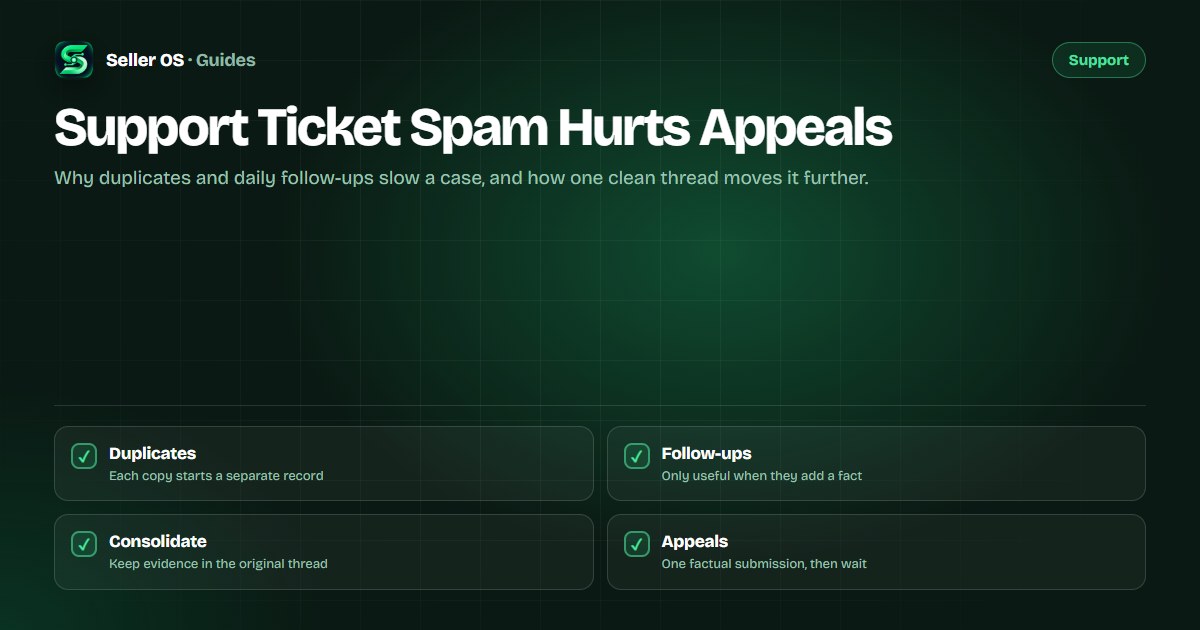
What counts as ticket spam
Ticket spam is not only abuse; it is also volume. Opening a new ticket for each thought, re-sending the same complaint daily, or filing the same issue through several channels all produce the same result: one issue spread across many records.
The intent does not change how it reads in a queue. A reviewer sees repeated submissions about one account or order and has to decide which thread is the current one. The what to include guide covers writing the single good ticket; this page is about not multiplying it.
- A new ticket for each new message in the same issue.
- Daily or hourly follow-ups that carry no new information.
- The same complaint filed by email and through the help center.
- Separate tickets for each point instead of one clear case.
Why duplicates slow your case
Fiverr's Help Center describes support as a queue you reach through published contact routes, and Fiverr publishes no promise that extra tickets move you forward. Each duplicate adds a copy to reconcile, and none of them carries the context the first one had.
There is a second cost. Repeated unsolicited submissions can read as pressure, which is the opposite of what an appeal needs. The ban appeal guide builds the case on facts and one submission for exactly this reason.
Consolidate everything into one thread
Pick the original ticket and make it the home for the whole issue. Add new information there rather than starting over, and keep attachments in the same place so the reviewer never has to search across threads for the record.
If you already opened copies, stop adding to them. Consolidation means choosing one thread going forward, not deleting history. Send any genuinely new fact from the original, and let the extra ones rest.
Keep the first ticket
find the original and stay in it.
Add facts, not restatements
only new information belongs in a reply.
Attach once
put the evidence in the thread it belongs to.
Label the ask
one line stating what you need, unchanged from the first message.
Stop opening copies
do not file the same case by email as well.
When a single follow-up is appropriate
A follow-up is reasonable when something real changed: the issue got worse, a deadline passed without a response, or you have new evidence. It is not reasonable as a daily ping. One polite note, in the same thread, with the new fact in the first sentence, is the version that helps.
The support unavailable guide covers what to do when there is simply no reply yet. The short version: confirm the thread exists, add anything genuinely new, and wait. Fiverr publishes no response time, so there is no official moment at which a ticket is late.
Ticket discipline for appeals
Appeals live and die on the record. An appeal is a complaint with Customer Support, and the strongest version states the decision, the facts, what you did since, and one clear request. Sending it once, from the registered email address, keeps that record clean.
If you are also waiting on an unrelated support question, keep the two threads separate. Mixing an appeal into an order enquiry buries both. The support contact guide maps which issue belongs in which route.
A ticket discipline checklist
Before you send anything, run the list. The test for every message is whether it adds a fact the previous one did not. If it only repeats, it is a follow-up at best and noise at worst, and waiting is the better move.
None of this guarantees a faster answer, because Fiverr does not publish processing times. What it does is keep your case readable and your record intact, which matters most if the issue later becomes an appeal.
- One issue, one thread, from start to finish.
- A new reply only when it carries new information.
- No parallel case filed through a second channel.
- One follow-up after a real change or a long quiet spell.
- Registered email, one clear ask, evidence attached inside the thread.
Where Seller OS helps
Seller OS does not contact Fiverr and cannot send a ticket for you, so ticket discipline stays in your hands. What it does is make the record easier to assemble: local order and client notes keep the dates, order numbers, and messages a support thread needs in one place, so you are not reconstructing the story from memory.
The inbox assistant drafts replies for your review, including a single consolidated follow-up you can edit before sending. Nothing sends or saves on its own; a person performs every final action, and everything stays in Chrome local storage.
Support Ticket Spam Hurts Appeals questions
Does sending more support tickets get faster answers?
Fiverr does not publish a promise that more tickets speed resolution. Each duplicate starts a separate record, so the reviewer has to reconcile copies instead of reading one thread. The practical approach is one issue in one thread, with a new reply only when it carries a fact that was not there before.
How many times should I follow up with Fiverr support?
Follow up when something real changes: a new document, a worsening issue, or a long quiet spell. One polite note, in the same thread, with the new fact first, is the useful version. Repeated daily pings do not add information and can read as pressure rather than a request for help.
Can ticket spam hurt an appeal?
It can. An appeal is judged on the record, and the strongest version is one clear, factual submission from your registered email. Many copies of the same complaint split that record and can look like abuse. A single well-structured case is easier to review than a stack of near-identical messages.
Should I open a new ticket or reply to the old one?
Reply to the original when the issue is the same. Keeping one thread preserves the context a reviewer already gathered and keeps your evidence together. Open a new ticket only for a genuinely separate issue, and do not file the same case by email as well.
One issue, one clean thread
Consolidate the evidence, follow up once when something real changes, and keep the appeal record intact.