 Seller OS
Fiverr private vs public reviews: what buyers see
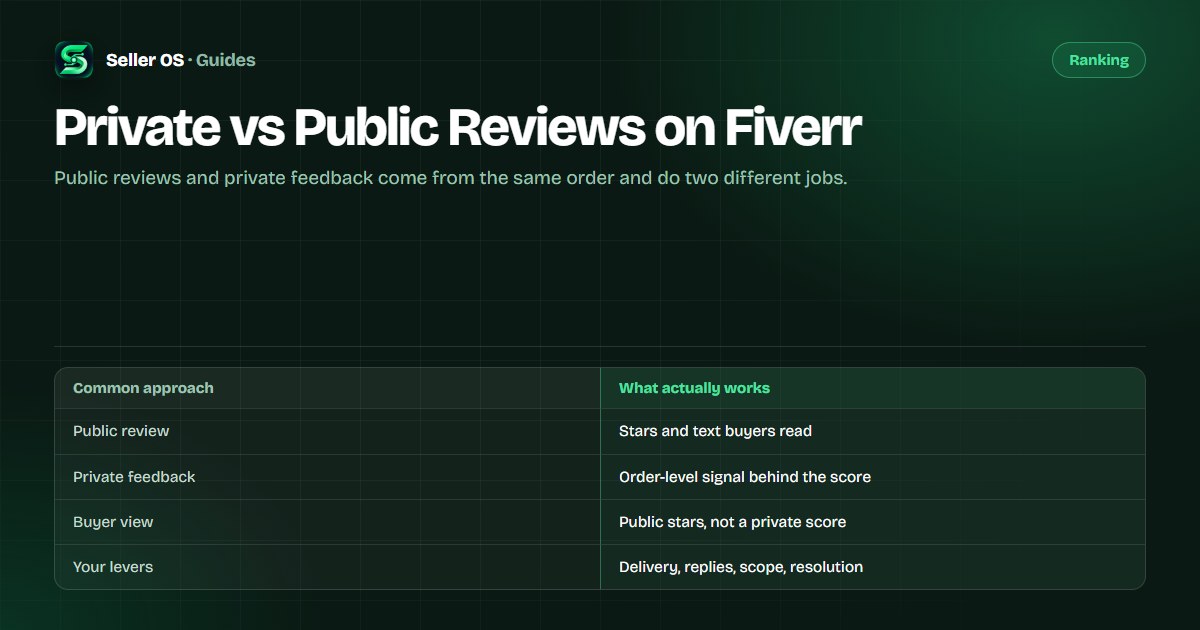
Fiverr collects feedback in more than one stream. Public reviews are the stars and text a buyer reads on your gig and profile. Private feedback is the less visible signal that feeds the Success Score. They come from the same completed order but they do different jobs.
This guide separates the two, explains who sees each one, shows how private feedback flows into the score, and marks the line between what you control and what you do not. It does not repeat the score-movement playbook; it explains the inputs that playbook works on.
Free plan available. Local-first data. Human review on every change.
The two review streams
The public stream is optional feedback left after an order, published after both parties submit or the review window closes. It shows as a star rating plus written text, and it is what future buyers scan on your gig page. The orders without reviews page covers the case where a buyer never leaves any.
The private stream is feedback that shapes the platform's view of the order. Fiverr's Success score page describes the score as evaluating each gig on areas tied to the order process and the client relationship, and that signal draws on the experience behind the order, not only the visible star.
| Public review | Private feedback | |
|---|---|---|
| Who sees it | Any buyer on your gig | Not shown as a public rating |
| What it shapes | Visible reputation | The score's client-facing areas |
| Where it shows | Stars and written text | Fiverr's area breakdown |
| Your control | How you deliver and respond | How you deliver and respond |
What the buyer actually sees
A buyer sees your public stars and the written feedback on the gig page, and your overall rating on the profile. They do not see a separate private score, and they do not read private input the way they read a public reply. The public stream is the one that sells.
That is why a single public review can still matter after a private signal has already landed. The public text is the part other buyers weigh, which means your public reply, and the work behind it, are the levers you can still pull.
How private feedback reaches the Success Score
Fiverr's score page lists the areas it evaluates per gig, including client satisfaction, effective communication, conflict-free orders, order cancellations, delivery time, and Value for Money. Private, order-level signals are part of how those areas are judged, which is why a score can move without a visible review changing.
The score is also relative. Fiverr states it is based on your performance relative to other freelancers in your price range, and that a score of 10 is not required for success. A private signal does not translate into a number the buyer sees; it feeds the areas, and the areas feed the score.
What is within your influence
You cannot see private feedback, so you cannot argue with it. What you can do is shape the inputs it draws on: deliver on time, answer inside the response window, set scope that matches the price, and resolve friction inside the order instead of letting it reach the Resolution Center. Those habits move the client-facing areas.
A hypothetical example: two sellers finish the same project. One ships a day early and answers the scope question before it becomes a dispute; the other ships on time but goes quiet for a day mid-project and settles a refund. Same deliverable, different experience, and the second seller's score areas absorb the difference.
Two things this does not mean
It does not mean public reviews are irrelevant. They remain the visible proof buyers use, and a public rating still shapes clicks and orders. The bad review guide is the right page when a public review lands and you have to respond well.
It also does not mean you can game the private stream. Chasing a perfect score by editing the listing or pressuring buyers is the opposite of the intent, and Fiverr's score is explicitly not a ten-or-fail target. The honest read is simpler: treat every order as the input to both streams.
Reading both streams together
Public and private feedback describe the same order from different angles. When they disagree, the disagreement is information. A glowing public review with a lagging satisfaction area suggests the buyer wanted to be kind in text while the experience still left a gap, often in speed or expectations.
Read them as a pair rather than ranking one above the other. Start with the public view for what buyers see, then open the score areas to see which underlying signal is strongest. The stuck score guide is where that reading turns into experiments.
Where Seller OS helps
Seller OS cannot see private feedback either, and it does not pretend to. What it does is keep both streams in view on your side: it records public review history and your tracked score areas locally, so a change in one can be compared against the other without relying on memory.
It also drafts the work that shapes both signals, from buyer replies to re-engagement messages, as reviewable drafts. Reports summarize the record for you. Nothing is sent, saved, or changed without your click, and everything stays in Chrome local storage.
Private vs Public Reviews on Fiverr questions
What is the difference between private and public Fiverr reviews?
A public review is the star rating and written feedback buyers see on your gig and profile, published after both parties submit or the review window closes. Private feedback is order-level input that is not shown as a public rating and feeds the Success Score's client-facing areas. The same order can produce both.
Does private feedback affect my Fiverr Success Score?
Fiverr describes the Success Score as evaluating each gig on areas tied to the order process and the client relationship, and private order-level signals are part of how those areas are judged. That is why a score can move even when no new public review appears. The score is also relative to other sellers in your price range.
Can I see my private Fiverr reviews?
Private feedback is not shown to you as a public rating, so you cannot read or contest it directly. What you can see is the result: the area breakdown Fiverr shows per gig under Scores by Gig. Read those areas to infer which experience a buyer may have left, rather than looking for a hidden review.
How do I protect my Success Score from bad private feedback?
You cannot control the feedback, only the experience behind it. Deliver on time, reply inside the response window, set scope that matches the price, and resolve friction inside the order instead of letting it reach the Resolution Center. Those habits move the client-facing areas that private signals feed.
Treat every order as two signals
Public stars sell; private feedback feeds the score. Improve the experience behind both, one component at a time.