 Seller OS
Fiverr withdrawal India: payouts, fees, and tax
India is one of Fiverr's largest seller markets, so the details of getting paid matter. Fiverr's help center publishes a single global set of payout methods rather than a country table, and each method carries its own provider coverage rules for Indian accounts.
This guide covers the routes Fiverr publishes for India, the conversion mechanics behind a rupee payout, and the paperwork questions sellers meet. The tax sections are informational, name the authority, and are never advice about your own return.
Free plan available. Local-first data. Human review on every change.
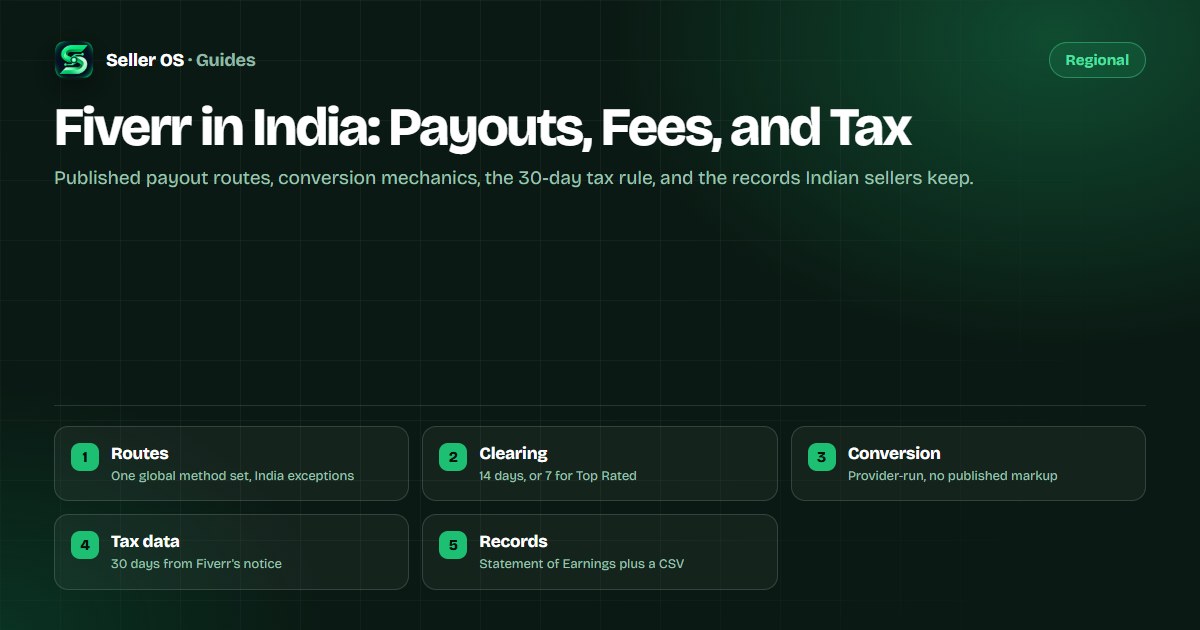
The payout routes Fiverr publishes for India
Fiverr's help center lists one payout set for every country: PayPal, bank transfer through Payoneer, a Payoneer account, and the Fiverr Revenue Card. The Revenue Card is for existing cardholders only, closed to new users in December 2022, and Fiverr's Payment Terms state it is available worldwide except for India and Russia.
That leaves the Payoneer-based routes as the published options for Indian accounts with no stated exception, plus PayPal only where PayPal itself supports receiving payments. Fiverr states that Payoneer availability depends on your country and tells you to confirm coverage with Payoneer, so treat every route as provisional until your Earnings page accepts it. The withdrawal article carries the live list.
- Add methods from Earnings and Manage payout methods, never from Billing and Payments.
- Fiverr states a method added under Billing and Payments cannot withdraw your earnings.
- Only one Payoneer-based method can be active at a time.
- One withdrawal method can be linked to only one Fiverr account.
- Fiverr states withdrawals are final and cannot be reversed.
Clearing, waiting periods, and transfer windows
Nothing moves on delivery day. Fiverr's Payment Terms state that earnings clear 14 days after an order is marked complete, and 7 days for Top Rated sellers, so your available balance lags every delivery by design. Plan spending against cleared funds, not against the calendar date you hit Deliver.
Three published waits sit on top of clearance. Fiverr states you wait 24 hours after your first withdrawal, 24 hours after adding or changing a withdrawal method, and 48 hours after updating a verified phone number. None of those are country rules; they apply to every account.
Scenario: your order completes on a Tuesday, the funds clear two weeks later, and you add a new bank route that same morning. The earliest that route can pay out is the next day, because the 24-hour hold starts when the method is added, not when you opened the account.
Clear first
14 days after completion, 7 days for Top Rated sellers.
Register on Earnings
the method must live under Manage payout methods.
Respect the hold
a fresh method starts a fresh 24-hour wait.
Stay under the cap
Fiverr publishes a $5,000 USD maximum per transaction.
How conversion touches a rupee payout
Your balance is valued in US dollars, and Fiverr's Payment Terms state that currency exchange for withdrawals is performed by its payment service providers, not by Fiverr. Non-dollar figures on screen can change daily with exchange rates and may also include conversion fees.
Two published details matter here. For a bank transfer in local currency, Fiverr notes that a currency conversion rate applies, and it states that the amount you receive may be less than the amount you withdrew because of your provider's rates or fees. Fiverr also says it sends the full amount you requested.
Worked example, invented for shape only: $300 clears and you ask for a local-currency bank transfer. Fiverr states the full $300 leaves the platform; suppose your provider's combined rate and fees take 4%, a figure no Fiverr page publishes, and about $288 worth arrives. The lesson is the gap, not the percentage.
The withdrawal comparison breaks the routes apart, and the currency conversion guide goes deeper on who quotes the rate. Fiverr publishes no markup percentage and no supported withdrawal currency list, so read those numbers off your provider rather than off a summary.
- Request US dollars when you want a predictable baseline.
- Read the provider's rate and fees separately from the fixed method fee.
- Check Fiverr's help article and the linked provider page for the current fee.
Tax and paperwork questions you will meet
Fiverr's India Sellers Tax page states that sellers must submit tax data, covering GST/TCS under GST and Section 194-O, within 30 days of the first notification, and that Gigs may be frozen or unpublished when the data is missing. That is a platform rule with a platform deadline; the tax positions behind it are not Fiverr's to decide.
On documents, Fiverr states that a TDS certificate in Form 16A is emailed quarterly when tax was deducted, and that TDS is calculated on 100 percent of the gig amount while your Statement of Earnings shows the 80 percent you received. Indian sellers also provide PAN and GSTIN details for billing.
Two questions Fiverr's pages do not answer are FIRC and purpose-code handling on inward remittances, and whether GST registration applies to your situation. The first sits with your bank and the Reserve Bank of India's published foreign exchange framework; the second sits with the Indian tax authorities.
Watch for Fiverr's notice
the 30-day clock starts at the first notification.
Submit what the account asks for
the live requirement shows on your own dashboard.
Direct remittance questions to your bank
banks handle FIRC and purpose codes.
Keep every Form 16A
Fiverr emails it quarterly when tax was deducted.
Mistakes that stall an Indian seller's payout
The most common mistake is adding the payout method in the wrong place. Fiverr states that a payment method added on Billing and Payments cannot be used to withdraw your earnings, so sellers who set one up there and then wait at the Earnings page conclude, wrongly, that payouts are broken for India.
Two more are quieter. Sharing one withdrawal method across two Fiverr accounts can, in Fiverr's words, result in both accounts being permanently disabled. And a Payoneer currency choice is permanent once saved, so a currency picked for one transfer sticks until you remove and re-add the method.
- Method added under Billing and Payments — it cannot withdraw earnings.
- One method shared across two accounts — Fiverr may disable both.
- A Payoneer currency edited after saving — removal and re-add is the only path.
- An instant-payout expectation — clearance and holds both come first.
Records that make filing season calmer
Fiverr does not issue invoices for completed orders or for the commission it withholds. What you get instead is a Statement of Earnings, a twelve-month PDF you download from the Financial Documents tab on your Earnings page, plus a CSV activity report you trigger from the Activity table and receive at your registered email.
A practical habit: pull the CSV after every quarter and keep it beside the Form 16A emails. Fiverr notes that the Activity table shows dates in your local timezone while filters and reports use UTC, so line the two up before you reconcile anything.
The invoices guide covers what Fiverr does and does not invoice, and the US 1099 guide shows the equivalent document set for American sellers. Keep your own ledger; the platform hands you records, not a filing.
| Record | Format | Where it comes from |
|---|---|---|
| Statement of Earnings | 12-month PDF | Earnings, Financial Documents tab |
| Activity report | CSV by date range | Activity table, emailed to you |
| TDS Form 16A | Quarterly certificate | Emailed when tax was deducted |
| Service invoices | PDF per receipt | Billing and Payments, your purchases |
Where Seller OS helps
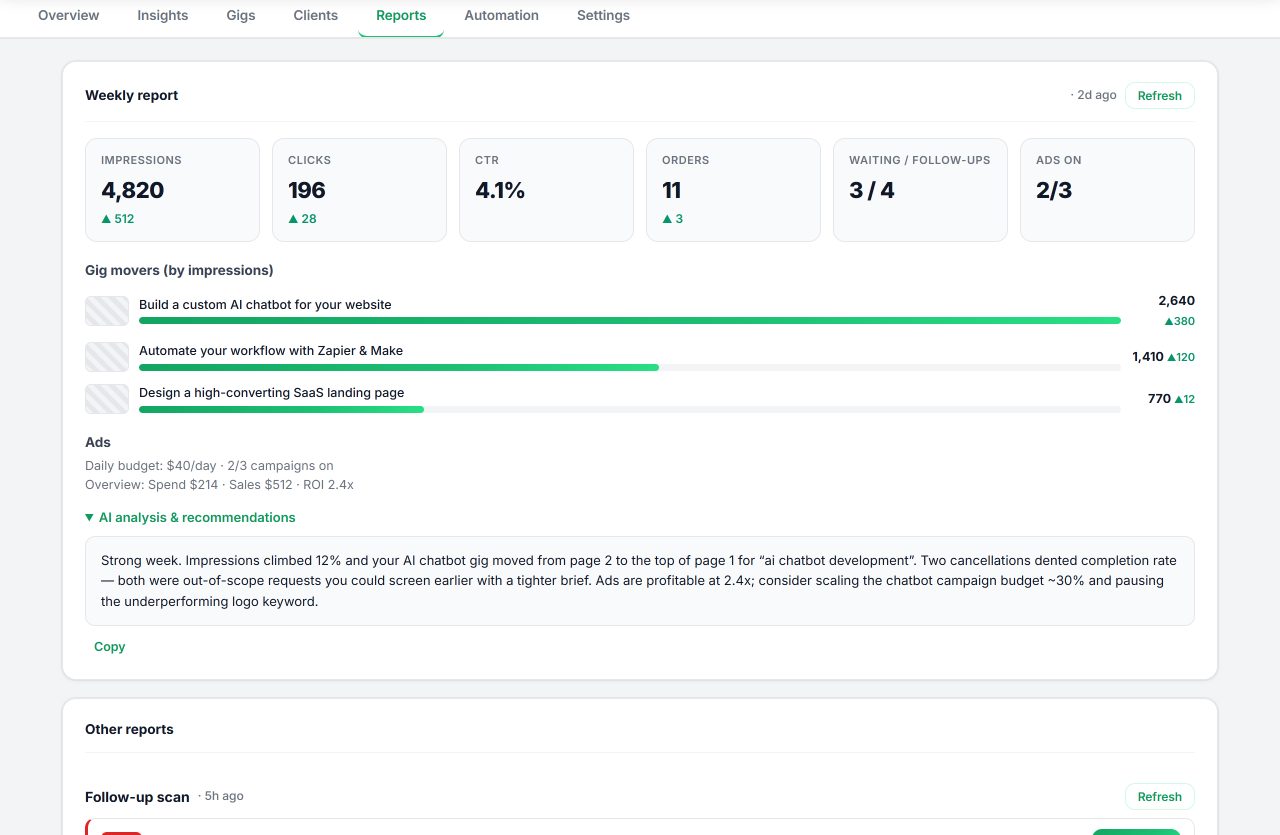
Seller OS keeps the order-side facts local: client records with dates and notes, a reports view over recent orders, and a short action queue. When a quarter closes, the order history you already have sits in Chrome local storage, ready next to the CSV you download.
It does not move money or do tax work. No payout requests, no exchange rates, no calculations for any authority, and every withdrawal stays a manual step you perform in your own Fiverr account.
Fiverr in India questions
How do I withdraw Fiverr earnings in India?
Set the method up under Earnings and Manage payout methods, because a method added under Billing and Payments cannot withdraw your funds. Fiverr's published set is global: PayPal, bank transfer through Payoneer, a Payoneer account, and the Revenue Card for existing cardholders, which Fiverr's Payment Terms exclude from India.
Does Fiverr pay directly into Indian bank accounts?
Fiverr publishes bank transfer through Payoneer inside one global method set rather than a per-country table, and it states that each method may carry location restrictions. Confirm coverage with the provider and watch what your Earnings page accepts before you rely on a route for regular income.
How long does a Fiverr withdrawal take to reach India?
Start with clearance: 14 days after completion, or 7 days for Top Rated sellers. Then add the published holds, 24 hours after a first withdrawal or a changed method, and the transfer window your route publishes. Fiverr does not publish an India-specific delivery time beyond those steps.
Do I need GST registration to sell on Fiverr in India?
Fiverr's India Sellers Tax page requires tax data covering GST/TCS under GST and Section 194-O within 30 days of the first notification, or your Gigs may be frozen. Whether registration itself applies to you is a question for the Indian tax authorities and your own adviser; Fiverr publishes no thresholds.
Set the route once, keep the records
Add your method from Earnings, confirm provider coverage with them, and pull the Statement of Earnings each year.