 Seller OS
Fiverr algorithm explained: how gigs rank in 2026
Fiverr does not publish a ranking formula, and anyone who quotes one as fact is guessing. What the platform does publish is a short list of signals — relevance, performance, quality — plus definitions for the steps between a buyer's search and your order queue.
This guide maps each stage from query to click to order, names the lever you control at that stage, and separates Fiverr statements from recycled blog claims. Tactics live in the linked guides.
Free plan available. Local-first data. Human review on every change.
What Fiverr publishes about ranking
The Fiverr search and recommendation article is the closest thing to an official description of how results are assembled. It states that Pro status can influence search ranking, that promoted listings carry an ad badge in search results, and that hiding an ad does not affect your organic rating. Beyond that, ranking explanations are inference.
The most useful published line sits in the Advanced Analytics article: the algorithm prioritizes title text first, then the positive keywords field, then the description. Read that as an order of importance among fields, not a weight table. It tells you where a phrase matters most without telling you how much it matters.
Fiverr also gives its own patience instruction: give any new or updated keywords at least 30 days before reviewing their impact. Treat that as an observation window for a phrase change, not a promise about results.
- Relevance — how well your fields match the query
- Performance — what happens after buyers reach your gig
- Quality — how orders and client relationships finish
- Placement — category, subcategory, and gig status
- Paid placement — Fiverr Ads, marked with an ad badge
What Fiverr does not publish
There is no public formula. The Success Score article names six key areas — client satisfaction, effective communication, conflict-free orders, order cancellations, delivery time, and value for money — and says your score is relative to other freelancers in your price range. It publishes no weights and no mapping to the 1 to 10 scale.
Three claims circulate in blogs and fail a sourcing check against Fiverr's own pages. First, that levels require a fixed count of active days: the published criteria table lists no such requirement. Second, that Level 2 unlocks twenty gigs: the help center lists ten. Third, that accounts are scored at a set hour each day: Fiverr says only that you move up automatically within 24 hours and that levels may change at any time.
Statistics are just as private. Fiverr publishes no refresh cadence for gig statistics, so a delay between your edit and your dashboard is not evidence of a penalty. Writing unknown beats inventing a rule that then governs every decision you make.
| Claim you will read | What Fiverr publishes | Verdict |
|---|---|---|
| Levels need 60, 120, or 180 active days | Criteria list six metrics and no day count | Unsupported |
| Level 2 unlocks twenty gigs | The help center lists ten active gigs for Level 2 | Incorrect |
| A known Success Score formula exists | Six areas named, no calculation published | Unsupported |
| Rankings reset on a fixed schedule | No cadence appears on any current page | Unknown |
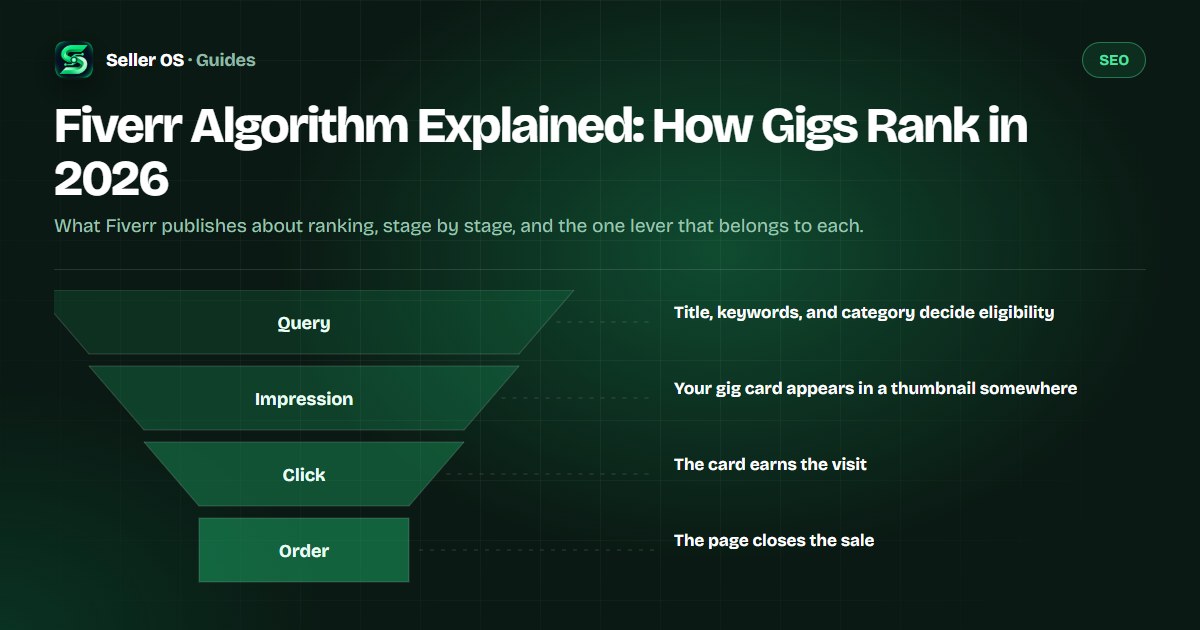
Stage one: from query to impression
Search begins with matching. Your title, five positive keyword phrases, five tags, description, and category decide whether your gig is even a candidate for the search. Fiverr's stated priority puts the title first, so the words a buyer types should appear in your title in the buyer's wording, not yours.
Category is the lever sellers discover too late. Fiverr says the category cannot be changed after the gig is published, so a gig filed under the wrong subcategory competes in a queue it never chose. Placement is decided before the copy is written.
Category
pick the subcategory a buyer would browse, before writing anything
Title
the primary phrase in buyer wording, front-loaded after the I will prefix
Positive keywords
up to five words or short phrases that describe the service
Tags
five slots, each a distinct phrase rather than a repeat of the title
Description
the supporting mention, written in sentences a person would say
Stage two: from impression to click
Fiverr defines impressions as the number of times your gig appeared in Fiverr thumbnails, including the homepage, category pages, search results, and profile pages. Clicks are the visits that followed. Appearances, then visits — that is the whole stage.
Because impressions count appearances rather than people, a rising impression count with a flat click count is a card problem rather than a ranking problem. The buyer saw the listing and declined it. The lever here is the thumbnail, the first words of the title, and the price and level badges visible on the card.
Illustrative reading: a gig shows 1,200 impressions and 36 clicks in a 30-day window, or 3 clicks for every 100 appearances. Compare that to your own earlier window and to no one else. Fiverr publishes no benchmark, and standard accounts do not see a click-through rate at all; that metric appears only in Seller Plus tabs.
Stage three: from click to order
The gig page closes the sale: description, packages, gallery, FAQ, reviews, and the response time buyers can see. Fiverr states that response time is visible to clients while response rate stays private to you, and that a buyer's profile view includes location, languages, response times, bio, skills, and certifications. Every one of those is a lever you control.
Conversion is measured, but not uniformly. On the per-gig dashboard Fiverr calculates conversion rate as total orders divided by total impressions for that gig. The Seller Plus tabs define conversion off orders after clicks instead. Attribute the number to the screen you are reading before you compare anything, because the two definitions produce different figures from the same week.
Order outcomes loop back into standing. The Success Score page lists negative reviews, late deliveries, cancellations, poor communication, conflicts, and decreased client satisfaction as causes of a dropping score, and Fiverr states that a critically low score affects your visibility.
Signals that act outside the query
Some inputs are not about the words on your gig. Levels run on six metrics — Success Score, rating, response rate, orders, unique clients, and earnings — and your level badge appears on gig cards, gig pages, and your profile. Fiverr's Choice is awarded for outstanding quality and client satisfaction, though no criteria for keeping it are published.
Availability and gig status act the same way. When you set yourself unavailable, gigs are temporarily removed from search and return when you become available again. Significant edits to title, category, or pricing may trigger a review during which the gig may not be visible. Both behaviors are published, and both explain sudden impression drops that have nothing to do with your copy.
Myth-driven mistakes that cost weeks
The common mistake is optimizing for a formula that does not exist. Sellers rewrite five fields in one evening, watch the dashboard for three days, and revert everything when nothing moves. Fiverr's own guidance asks for at least 30 days on keyword edits, and a batch of simultaneous changes makes the result unreadable anyway.
The second mistake is keyword stuffing, which spends the characters a buyer needs and adds nothing measurable. Fiverr's priority order already favors the title and keyword fields, so repeating a phrase in every paragraph competes with your own title.
The third mistake is waiting for a fixed timeline. Fiverr publishes none, which is why the ranking timeline guide works in ranges and signals instead of dates. Change one thing, date it, and read your own prior window.
Where Seller OS helps
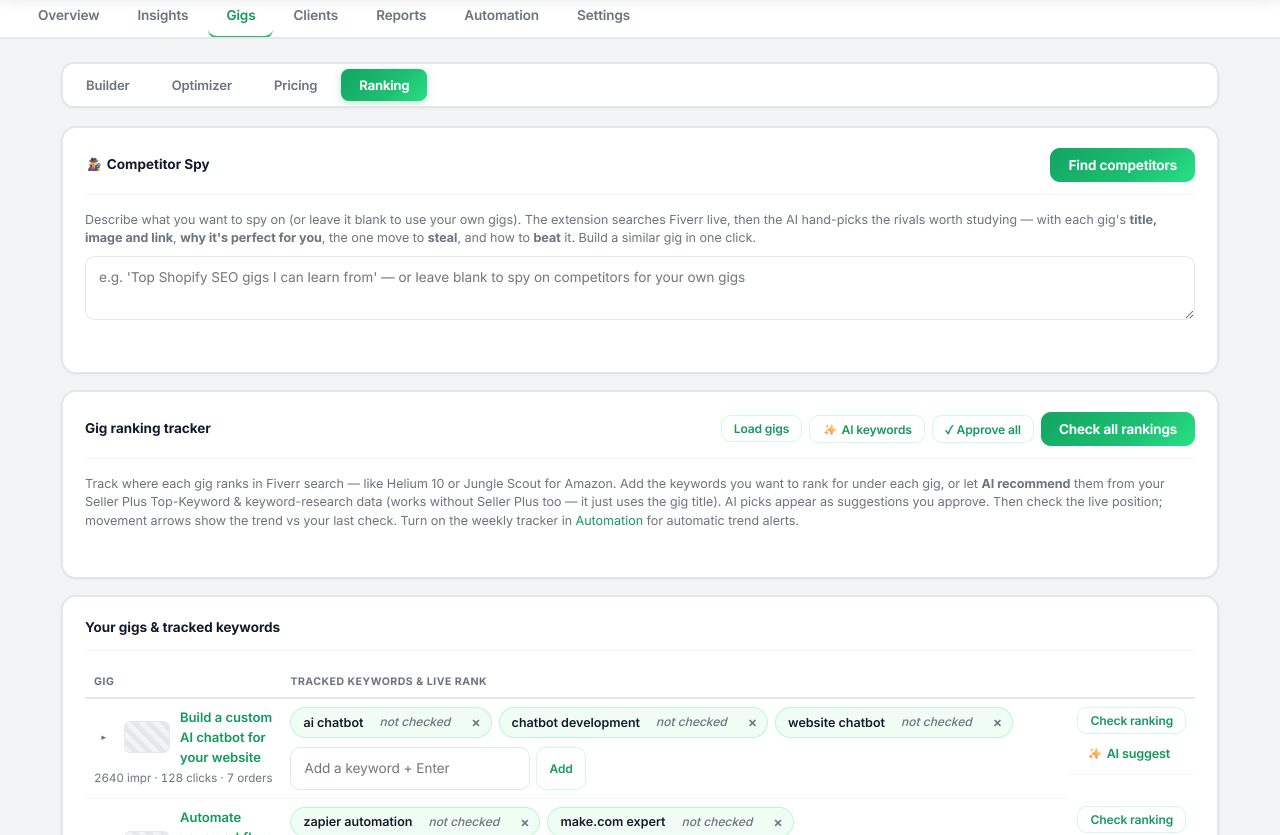
Seller OS handles the observation half of this model. The rank tracker keeps tracked keywords with local position history, movement, and competitor positions, so an edit made on a dated afternoon reads against a dated baseline. The Gig Performance Optimizer reviews a live gig copy and gallery against that gig's own performance data.
It does not know Fiverr's weights, cannot predict a ranking, and never claims one. Drafts and proposals are written for you to review; a person performs every final Save, Continue, or Publish action, and nothing is published or sent automatically.
Fiverr Algorithm Explained questions
How does the Fiverr algorithm work in 2026?
Fiverr publishes a priority order rather than a mechanism: title text first, then the positive keywords field, then the description, alongside performance and quality signals from completed orders. No formula, weights, or refresh schedule is published anywhere, so any specific calculation you read is third-party guesswork.
What are the main ranking factors on Fiverr?
Group them as relevance, performance, and quality. Relevance comes from your category, title, keyword field, tags, and description. Performance covers what buyers do after seeing the gig — clicks, orders, and conversion. Quality covers how orders finish: delivery time, cancellations, communication, and client satisfaction that feed your Success Score.
Does changing my gig title reset my ranking?
Fiverr publishes that significant edits such as title, category, or pricing may trigger a review, during which the gig may not be visible. It does not publish a reset mechanic. Change one field at a time, note the date, and give keyword edits the 30-day window Fiverr recommends.
How long does a ranking change take to show?
Fiverr publishes no timeline for ranking or for statistics refresh. Its one concrete instruction is to wait at least 30 days before judging new or updated keywords. Compare your own windows before and after a dated change, and treat daily movement as noise.
Work the stage you are actually stuck on
Check your gig status, then fix one field, date it, and read the window before changing anything else.