 Seller OS
Fiverr keywords with high search volume: how to find them
Fiverr does not show sellers search volume outside Seller Plus, so high-volume keywords have to be judged from signals you can see: autocomplete order, how deep and busy a category runs, and how quickly the top gigs collect reviews. Those signals are directional. They show where demand concentrates, not how many searches happened.
This guide covers the signals worth reading, the competition that arrives with them, and how to use a popular phrase without rebuilding a working gig around it. It also covers what to do when a term is clearly too broad for your listing right now.
Free plan available. Local-first data. Human review on every change.
You cannot see Fiverr's search volume
Fiverr does not publish keyword search volume to sellers outside its Seller Plus program. The Keyword Research tab inside Seller Plus shows a Search Volume column alongside Overall Rank, Average Order Price, Conversion Rate, and Competition, and Fiverr documents that tab as limited to Standard and Premium members and web-only.
That means the volume numbers in third-party tools are estimates built from those vendors' own methods, not exports from Fiverr. Estimation is not useless, but it should not decide your title. Use observable demand signals instead, and treat any figure you cannot trace back to Fiverr as a hint rather than a measurement.
Demand signals you can actually observe
Autocomplete is the most direct free signal. Fiverr suggests phrases as you type, and the order and variety of those suggestions reflect what buyers search. Fiverr's own community guidance suggests using those suggestions when you research, and studying the keywords successful sellers use in your subcategory.
Result pages add two more signals. Category and subcategory depth shows how much supply already serves the term, and review counts on the top gigs suggest how much order flow the phrase carries. A phrase with many reviews accumulating on the top gigs has demand; it also has rivals who already rank there, which is the trade you are evaluating.
- Autocomplete position: earlier suggestions tend to be more common buyer phrasings.
- Suggestion variety: many variants suggest an active and specific buyer base.
- Result depth: a page full of relevant gigs means established supply.
- Review velocity: recent, frequent reviews on top gigs point to ongoing orders.
Reading autocomplete like a demand map
Type a head term and write down what appears, in order. Then type it with a qualifier: a platform, an industry, a format, a buyer stage. The variants Fiverr offers are buyer phrasings you can test, and the point where suggestions stop is usually where demand thins out and competition stops paying attention.
Repeat the exercise across two or three sessions before you trust a pattern. Suggestions can vary with location and season, so a phrase that shows up once is a lead; a phrase that keeps showing up is a signal worth acting on.
Type the head term
record the first five suggestions in the order shown.
Add a platform
for example, shopify or wordpress, and note the new variants.
Add a buyer stage
for example, for startup or for small business.
Try a format or size word
for example, 60 second, one page, monthly.
Cross-check against your inbox
if a suggestion never appears in real buyer messages, weigh it lower.
The trade-off behind every popular keyword
High demand and high competition arrive together, because a phrase worth searching is a phrase worth selling against. The top of a popular term is usually held by gigs with long histories, strong review counts, and sometimes badges or Pro status, which Fiverr states can influence search ranking.
This does not make popular phrases off-limits; it makes them a placement decision. A popular phrase is a reasonable title choice if your gig genuinely is the obvious match and you can afford to wait. It is a poor first move for a new listing with no order history, which will usually get more from a specific phrase it can win this month.
Worked example: three levels of demand
An illustrative read for a video editing service shows how demand and difficulty scale together. The labels describe appearances on a public result page, not measured search data, and your own pages will differ by session and location.
| Phrase | Demand signal | Competition signal | Fit for a new gig |
|---|---|---|---|
| video editing | Suggests immediately, many variants | Deep result set, strong top gigs | Poor first bet |
| youtube video editing | Strong suggestion, active variants | Competitive but relevant | Reasonable target |
| youtube video editing for gaming channel | Appears after qualifiers | Thin result set, mixed quality | Best first target |
| edit my vlog footage | Buyer-phrased suggestion | Few exact matches | Test in a tag or FAQ |
How to use a high-volume phrase wisely
If the popular phrase describes exactly what you sell, it belongs somewhere in the gig. The question is where, and how much of a working gig you rebuild for it. A measured approach starts in the supporting fields and escalates only when the data agrees with the move.
The title is the expensive slot. Fiverr's matching reads it before any other field, and it is likely carrying whatever visibility the gig has today. Treat a title rewrite as the last step of a proven experiment, not the first step of a hunch.
Start with the positive keywords field
test the popular phrase without touching the title.
Leave the title phrase alone while it is performing
changing it resets your strongest signal.
Wait at least 30 days
that is the window Fiverr names before judging a keyword change.
Watch impressions first, then clicks
visibility usually moves before orders on a small gig.
Promote the phrase to the title only when the data supports the move.
Mistakes with high-volume keywords
Chasing the biggest phrase in your field is the standard mistake, because it trades a winnable position for an unwinnable one. The second is trusting a volume estimate as if it were measured data. The third is rewriting the whole gig around one popular term and losing the specific buyer language that was already working.
A fourth mistake is guessing what buyers type. High volume is not one phrase; it is a family of phrasings. Reading autocomplete, inbox threads, and the wording of reviews keeps you close to the actual language instead of the language you would personally use.
Where Seller OS helps
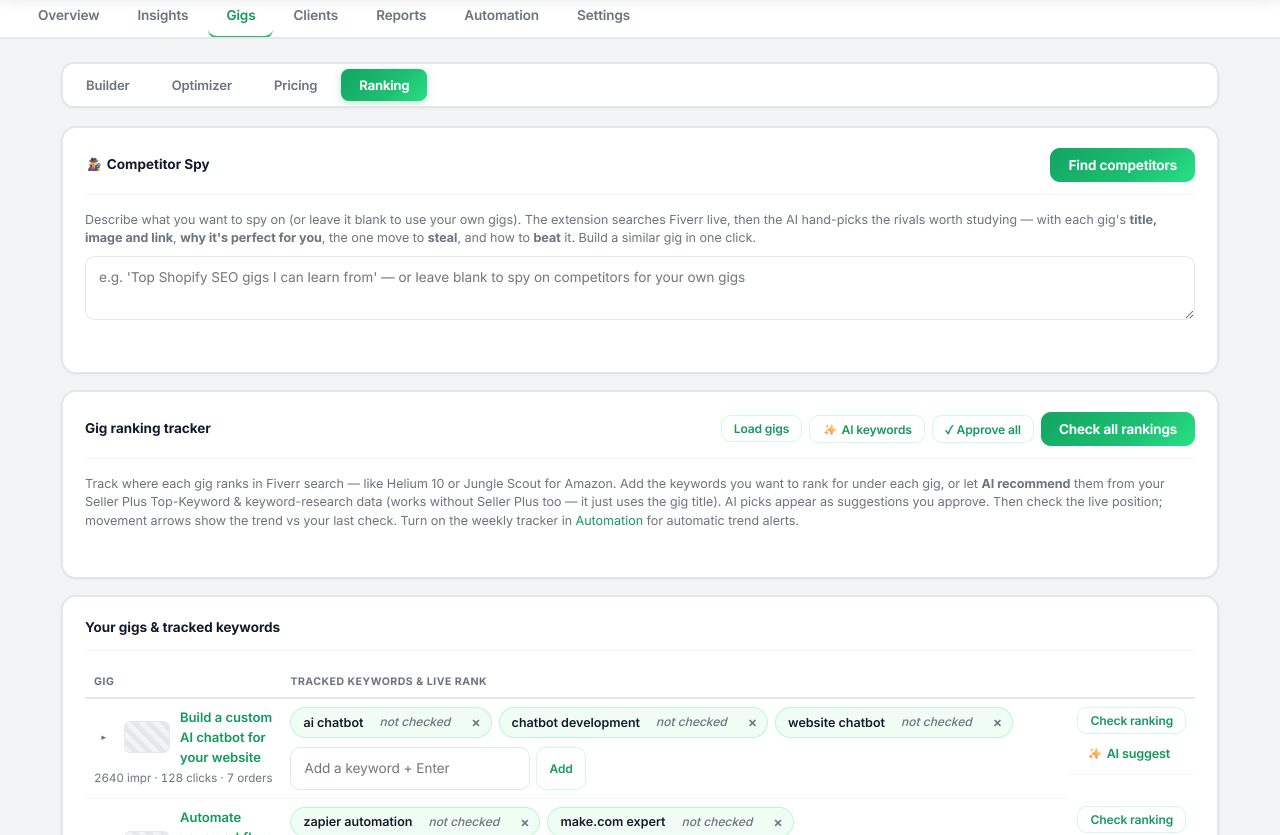
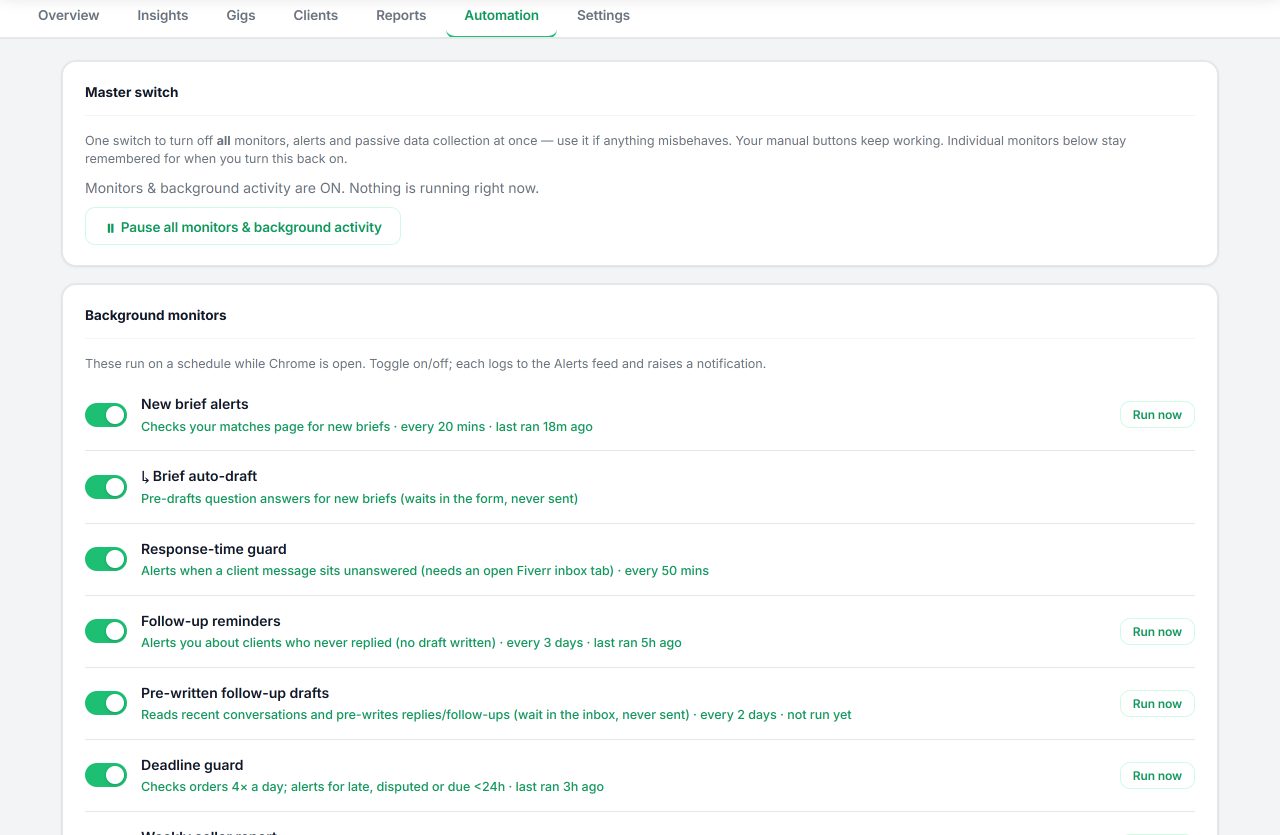
Seller OS helps you watch demand and competition together: tracked keywords collect local position history, and Pro monitors refresh positions while Chrome is open and flag notable moves, so a phrase you adopted is followed over weeks instead of judged on one search.
Keyword help also suggests terms that fit your fields when you build or optimize a gig. It samples and suggests; it never edits, sends, or publishes anything on its own.
Fiverr Keywords With High Search Volume questions
How do I find high-search-volume keywords on Fiverr?
Without Seller Plus, read observable signals: the order and variety of autocomplete suggestions, how deep and active the category results look, and how quickly the top gigs collect reviews. Those signals show where demand concentrates. Seller Plus members can add Fiverr's own Search Volume column from the Keyword Research tab.
Does Fiverr show keyword search volume?
Only inside Seller Plus. Fiverr's Keyword Research tab displays Search Volume along with Overall Rank, Average Order Price, Conversion Rate, and Competition, and Fiverr documents the tab as web-only and limited to Standard and Premium members. Outside that program, no official volume data is published, so third-party numbers are estimates.
Are high-volume keywords always the best choice?
No. High volume usually comes with high competition, and the top results for popular terms are often held by gigs with long histories and strong review counts. A specific phrase you can actually win can outperform a broad term you never reach. Use popular phrases where they fit your service, but do not build a new gig around one.
Should I put a popular keyword in my gig title?
Only after testing it in a weaker slot first. Title text is read first in Fiverr's stated priority order, so it is your most valuable field and the riskiest to change. Test the phrase in a positive keyword slot, wait at least 30 days, and check impressions and clicks before promoting it.
Aim at demand you can actually reach.
Install Seller OS, read the signals behind popular phrases, and prove one keyword per 30-day window.