 Seller OS
Fiverr gig packages that sell upgrades
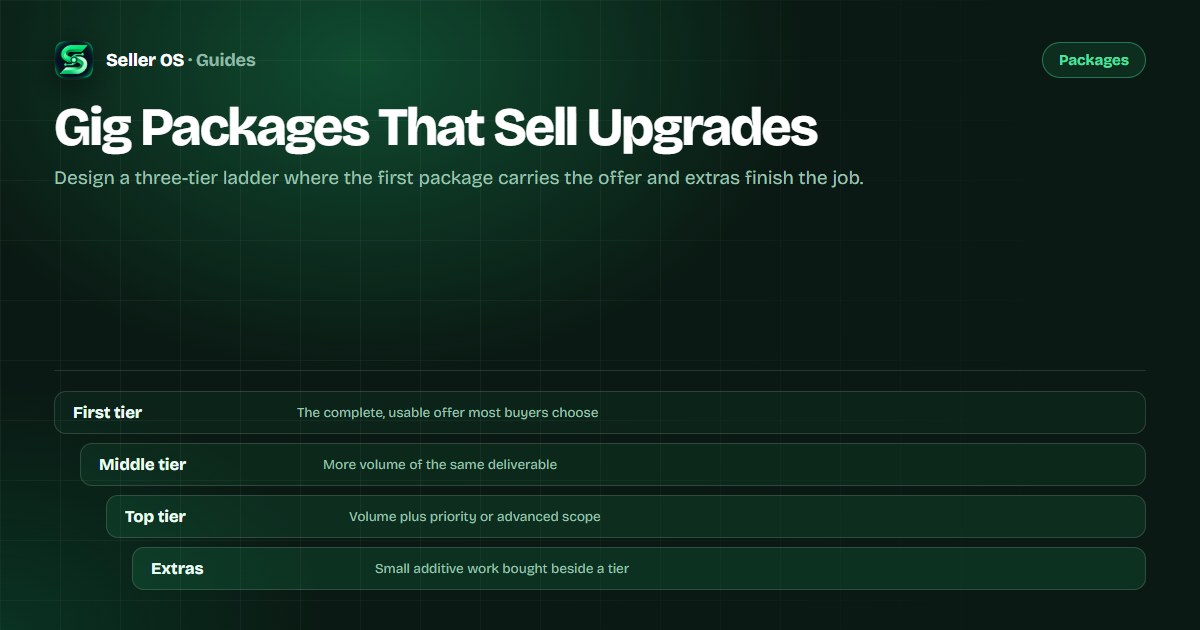
Three tiers are not three prices on the same work. They are a scope ladder: each step adds a defined amount of output, and the buyer climbs only as far as their project needs. When the first tier is load-bearing, most buyers start there and a predictable share choose to upgrade.
This guide designs that ladder. It covers what each tier should contain, how extras differ from tiers, one worked example, and the sizing errors that turn an upgrade into a refund. It is a design guide for the offer itself, not a pricing formula.
Free plan available. Local-first data. Human review on every change.
Why a scope ladder beats three random prices
Fiverr gigs let you publish packages at different prices, and the Help Center explains that buyers pick a package and can add extras at checkout (see How Fiverr works for clients). The mistake is treating those slots as three arbitrary prices on one fixed deliverable. A buyer cannot tell what changed between them, so the middle price looks like the same work for more money.
A scope ladder fixes that by making each tier a different amount of the same core output. The base tier is the smallest complete unit of work someone can actually use. The middle tier is more of that unit. The top tier is more volume plus a defined extra, such as priority or an advanced format. Every step is describable in one line.
Ladders also make your extras meaningful. An extra should be something a buyer adds beside a tier, like a faster clock or a commercial license. If an extra duplicates a whole tier, it is really a tier, and it belongs in the column above.
- Each tier changes quantity or scope, not just the number at the end.
- Each tier can be described in a single sentence.
- The first tier is the smallest complete deliverable.
- Extras add a small piece beside a tier, never replace one.
Make the first tier carry the offer
The base package does most of the selling, because it is the price buyers compare across search results. If it is deliberately crippled so that nothing is usable without an upgrade, buyers notice and the review reflects the frustration. A load-bearing first tier is a real deliverable a stranger could put to work the same day.
Volume is what most buyers upgrade for, so let the base be complete but small. One concept, one revision round, a standard file format. Then the middle tier doubles the usable quantity, and the top tier adds volume plus a service the buyer values, such as a faster turnaround or an editable source file.
The base price should cover your time on the smallest realistic order. If it cannot, the tier is undersized and every base order runs at a loss until the buyer upgrades, which is not a plan.
One worked ladder, start to finish
Here is a hypothetical ladder for a logo gig. It is an illustration of the shape, not a template to copy, and your own numbers depend on your market and costs.
Notice how the middle tier is the same work with more range, and the top tier is range plus a genuinely different service. That structure gives a buyer an obvious reason to climb and an obvious reason to stop at their own budget.
| Tier | What the buyer gets | Extras that pair |
|---|---|---|
| Starter | 1 concept, 2 revisions, PNG and JPG | Extra concept; faster delivery |
| Standard | 3 concepts, 4 revisions, all file formats | Source file; faster delivery |
| Premium | 5 concepts, editing session, source file | 24-hour first draft; social kit |
Extras buyers actually add
Useful extras share one trait: they are small, additive, and easy to picture. Buyers add them when the price is low relative to the tier and the value is immediate. Speed, source files, extra revision rounds, commercial usage, and additional concepts all qualify because each one removes a specific worry.
Price an extra so that it never undercuts the tier above it. If the base tier plus two extras costs more than the middle tier but delivers less, you have built a confusing menu. Keep the tier the cheaper path to more core output, and let extras cover needs the tiers do not.
Resist the urge to list many extras. A long menu slows the decision. Three to four well-chosen extras that pair with every tier are easier to buy than a wall of small options.
Sizing mistakes that cost you the order
The most common error is a base tier so thin it reads as bait. The second is a top tier that bundles unrelated work, so buyers who want one part cannot buy it without paying for the rest. Both push buyers back to the search results.
Another quiet error is pricing the middle tier too close to the base. If the gap is small, the middle tier looks like the sensible default and the base looks pointless, which is fine only if you want everyone on the middle. Make the jump between tiers reflect the real jump in work.
- Base tier too small to be useful on its own.
- Top tier mixing unrelated services into one price.
- Extras priced close enough to duplicate a tier.
- Middle tier priced too near the base to signal a real step.
Where Seller OS helps
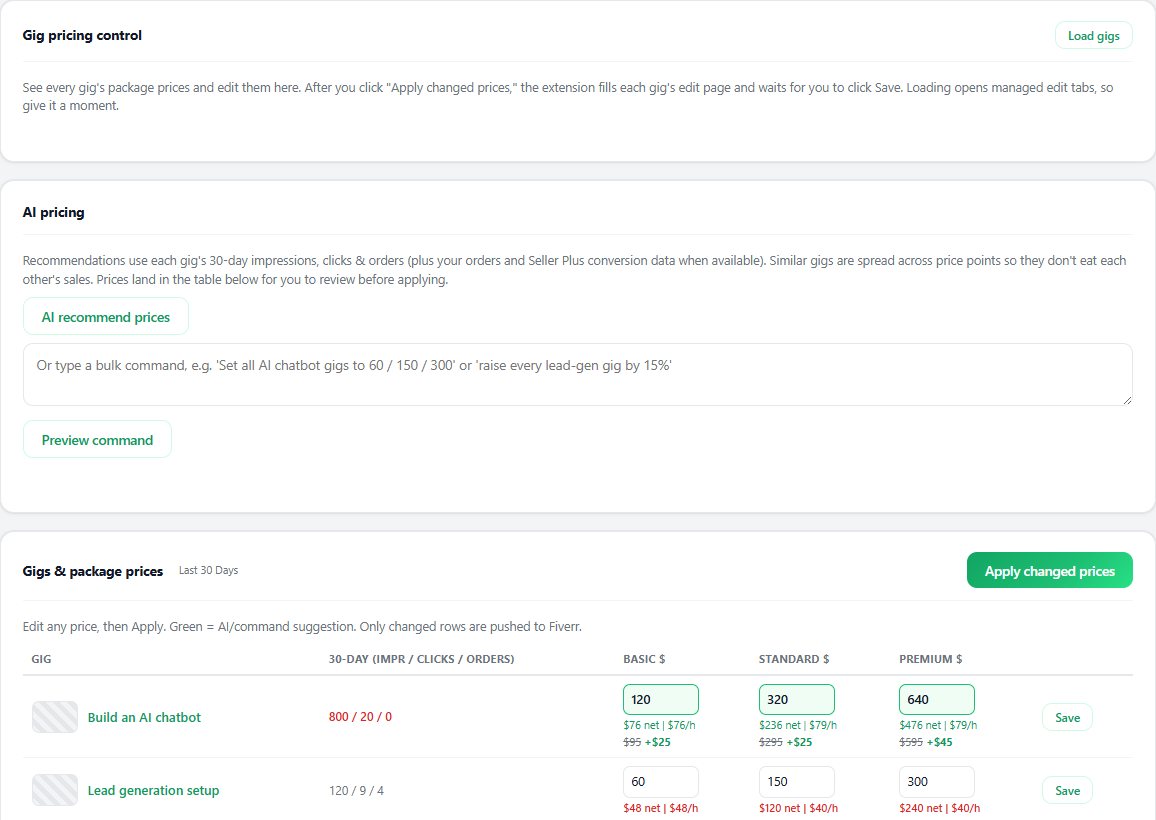
Seller OS works on the offer side of a gig, where the extension can help without pretending to be Fiverr. The gig builder turns a description of your service into a structured draft with named tiers and extras, and the pricing view keeps your package prices and fee math in one place so you can see what a ladder actually pays.
Nothing here publishes on its own. You review the draft, adjust the numbers, and complete every Save or Publish action yourself. Drafts, prices, and notes stay in Chrome local storage on your machine.
Gig Packages That Sell Upgrades questions
What should go in the first Fiverr package?
The base package should be the smallest complete deliverable a buyer can use without buying anything else: one usable unit of the work, a defined number of revisions, and a standard file format. It carries most of the comparison shopping, so it has to stand on its own rather than tease an upgrade.
How many packages should a Fiverr gig have?
Three tiers is the common pattern because it gives a low entry, a sensible middle, and a premium option, but the number matters less than the structure. What matters is that each tier changes the quantity or scope in one clear sentence and the first tier is complete on its own.
Are Fiverr extras the same as a higher package?
No. A package changes the core deliverable, while an extra adds a small piece beside it, such as faster delivery, a source file, or an extra concept. If an extra delivers the same thing as the next tier, it is really a tier and belongs in the column above.
How do I price a Fiverr package ladder?
Start from your time on the smallest realistic order and make sure the base price covers it. Then set each higher tier from the extra work it includes, not from a flat markup. Keep the gap between tiers proportional to the jump in work so the middle tier reads as a real step.
Build a ladder buyers can climb.
Draft named tiers and extras, check the fee math, and review every price before you publish.