 Seller OS
A Fiverr custom offer pricing script that holds
A custom offer price is easy to state and hard to hold. The number is not the hard part; the discipline around it is. Sellers who quote from scope and explain the inclusions rarely get haggled, because the buyer can see what the money buys.
This guide is about the pricing script that surrounds an offer: how to anchor to scope, list what is included, present tiers, and hold the number under pushback. The field mechanics belong to the custom offers guide, and message wording belongs to the offer copy guide.
Free plan available. Local-first data. Human review on every change.
Price from scope, never before it
The most expensive mistake in custom offers is quoting before the deliverable is defined. A number sent before the scope invites arguments later, because the offer fields turn that number into a commitment with a delivery date and a revision count attached.
Define first, then price the definition. A countable deliverable, its format, and its boundary, meaning what the price does not cover, give the number something to rest on. When a buyer asks how much before describing the work, answer with a range tied to the variables that move it, then ask the two questions that firm it up.
- Deliverable: what arrives, in what format, at what length.
- Boundary: the two or three things the price excludes.
- Variables: the quantities that change the number.
- Assumptions: what you need before the clock starts.
The four-move pricing script
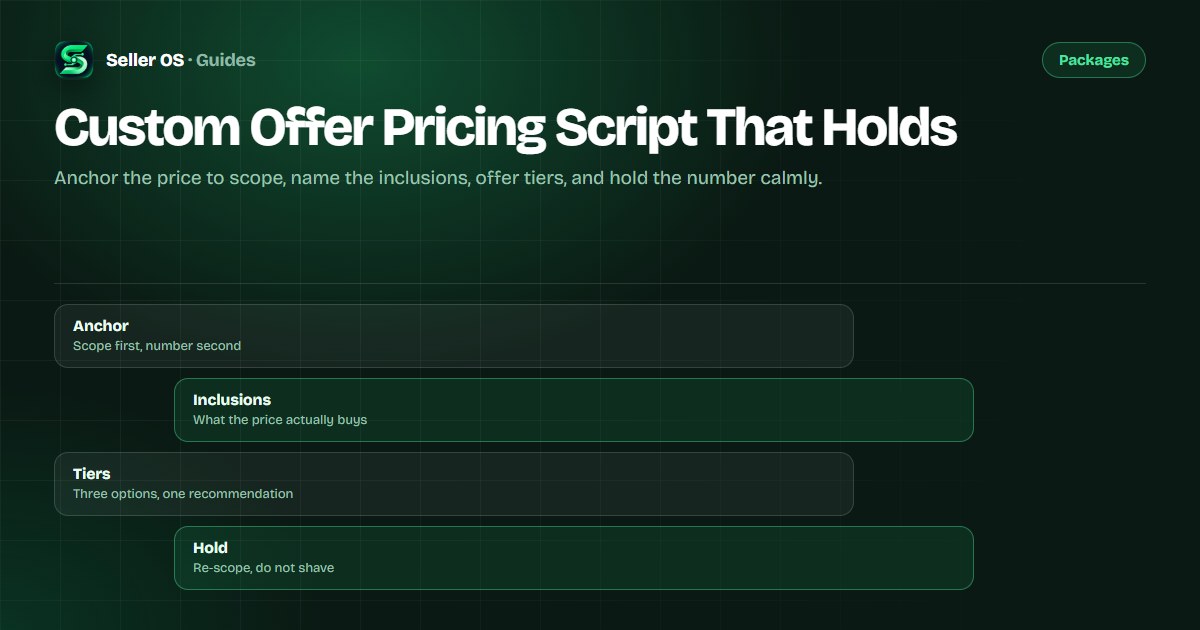
The script has four moves, in order: anchor to scope, list the inclusions, present the options, and close on one decision. Each move answers a question the buyer is already asking, which is why it reads as service rather than sales.
Keep it short enough to scan on a phone, because the fields already carry the numbers and the message only has to make them make sense.
Anchor
restate the deliverable and its boundary in one countable sentence.
Include
list what the price buys, in short bullets.
Options
present two or three tiers with one recommendation.
Close
state the price once and name the next step.
Presenting tiers that keep the anchor high
Three options beat one number because they turn a yes-or-no into a choice. You can build tiers with the offer's own fields: Fiverr supports milestone offers with up to five steps, so a single offer can hold a small, medium, and large path without splitting the conversation.
Order the tiers so the middle is the one you want chosen, and name what each step adds rather than calling it more. A larger scope, a faster lane, or an extra format are real deltas; better quality is not, and buyers read it as a hollow upsell.
If the request genuinely needs two different things, send two offers or restructure into milestones rather than promising a hybrid the fields cannot express. Milestone and subscription order types cannot be combined in one offer.
| Tier | Adds | Role |
|---|---|---|
| Small | The core deliverable only | A complete, usable floor |
| Medium | Extra scope plus one revision round | The one most buyers should take |
| Large | All extras plus a faster lane | A real project, priced honestly |
Holding the number when a buyer pushes back
Pushback is not rejection; it is a request for a reason. The worst response is an instant discount, because it tells the buyer the first number was not real. The better response keeps the number and moves the scope, which is a different conversation from shaving the same work.
Two sentences carry most pushback. The first restates the inclusion that costs the most. The second offers a smaller version at a lower number with its own boundary. That way the buyer gets a real choice instead of a concession, and your anchor stays intact.
Worked example, hypothetical: a buyer says the $600 quote is high. The reply: the number covers three full drafts, two revision rounds, and the extra research for your category, which is where most of the time goes. If the budget is tighter, I can do one draft and one revision round for $320, and we can expand later if it works.
The rare times a discount is right
There are a few honest reasons to lower a price: a larger volume that genuinely lowers your cost per unit, a repeat buyer whose second project is easier than the first, or a strategic first order in a category you want to grow. Each one has a stated reason, and every discount should attach to something the buyer gives back, such as volume, a longer timeline, or a simpler scope.
A discount with no reason teaches a buyer to expect the next one. If you cut the price of the same scope once, the second project is negotiated from the lower line, and the work has to carry the same cost. When the budget is the real blocker, change the scope and re-price the smaller version; the price objection guide covers that conversation in depth.
A full pricing script, start to finish
The project, hypothetical: a buyer messages a video editor asking for a 90-second product video and three social clips, with a launch in three weeks and no stated budget. The scope is real but open, so the script defines it before pricing it.
The offer: I will deliver a 90-second product video plus three vertical clips with captions. The video includes the edit, licensed music, and sound cleanup; the clips are cut from the same footage with text overlays. That includes two revision rounds on the main video and one on the clips, and I need your raw footage and brand files by Thursday, which puts the first cut on the 12th, a week inside your launch. The price is $650. If you want to start smaller, the video alone with one revision round is $420, and we can add the clips later.
Why it holds: the scope is countable, the inclusions are named, the boundary is implied by the smaller option, and the price appears once with a reason behind it. A buyer can choose a tier or accept the full one, and neither choice requires you to defend a number you invented on the spot.
Where Seller OS helps
Holding a price is easier when the number is grounded in your own history. Seller OS keeps profit assumptions and the prices you recently applied in view, so a new offer starts from what the work actually earns rather than from a guess, and a test does not silently overwrite itself.
It drafts the surrounding message from local client records and the conversation, then stops at review. A person sets the final number and presses Send, and the extension never sends or negotiates on its own.
Custom Offer Pricing Script That Holds questions
How do I price a Fiverr custom offer?
Scope the deliverable, its format, and its boundary first, then attach the number to those variables. Name what the price includes, and set a delivery date from real capacity rather than optimism. Fiverr's offer fields run from $5 to $20,000 with delivery from 1 to 90 days, so the range is wide enough to price the work honestly.
What if the buyer says my Fiverr offer is too expensive?
Do not discount the same scope. Restate the inclusion that costs the most, then offer a smaller version at a lower number with its own boundary. That gives the buyer a genuine choice and keeps your anchor honest. A quick discount instead teaches the buyer that your first number was not real.
Should I offer tiers inside one Fiverr custom offer?
Often, yes. Fiverr supports milestone offers with up to five steps, so one offer can hold a small, medium, and large path. Order them so your recommended middle option is the obvious fit, and name what each step adds rather than calling it more of the same.
When should I discount a Fiverr custom offer?
Only with a stated reason: more volume that lowers your unit cost, a repeat buyer's easier second project, or a strategic first order in a new category. Attach every discount to something the buyer gives back, such as volume or a simpler scope, and never cut the price of the identical scope twice.
Price the scope, then hold the line.
Anchor to what the work is, name the inclusions, offer tiers, and re-scope instead of shaving the number.