 Seller OS
Fiverr SEO for interior designers
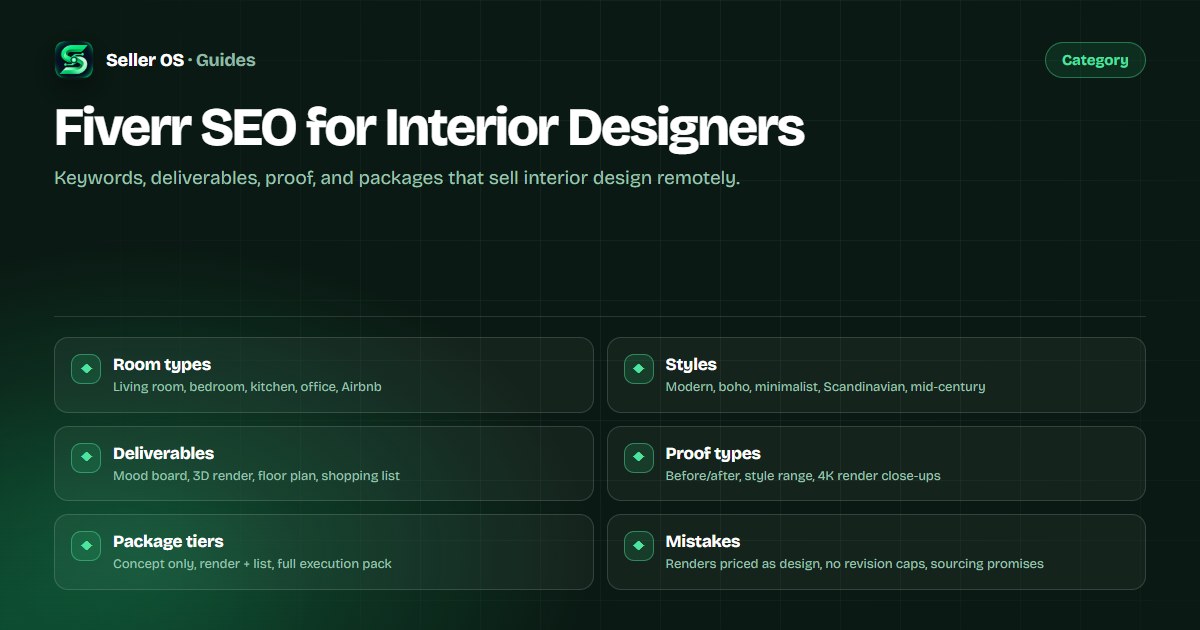
Interior design on Fiverr is a visual category where buyers search by room type, style, and deliverable — mood board, 3D render, floor plan, shopping list. Your gig title, tags, and gallery need to speak that language so the right clients find you.
This guide covers the keywords buyers actually type, the deliverable bundles that sell without site visits, portfolio conventions that prove range, package structures that protect revision boundaries, and the common mistakes that make gigs invisible or unprofitable.
Free plan available. Local-first data. Human review on every change.
How buyers search for interior design
Buyers rarely search "interior designer." They search by problem: "living room design," "bedroom makeover," "kitchen layout," "Airbnb interior." Style terms matter: "modern interior design," "boho bedroom," "Scandinavian living room." Deliverable terms close the deal: "mood board," "3D render," "floor plan," "shopping list with links."
Your title and tags should combine room, style, and deliverable. A title like "I will design your living room with 3D renders and shopping list" captures all three. Tags such as "living room design," "3D rendering," "mood board," "shopping list," "interior design" cover the main search dimensions.
| Search dimension | Example phrases (validate locally) | Where to place |
|---|---|---|
| Room + style | modern living room design, boho bedroom decor | Title, tags, description |
| Deliverable | 3D render, mood board, floor plan, shopping list | Title, tags, FAQ |
| Platform/tool | SketchUp, 2020 Design, AutoCAD, Blender | Description, requirements |
| Project scope | full home design, single room, renovation plan | Packages, description |
| Client type | Airbnb host, homeowner, real estate agent | Description, FAQ |
Deliverables buyers expect without site visits
Remote interior design sells concept packages, not construction supervision. The standard deliverable set buyers look for: a concept board (mood board) showing style direction, a 2D floor plan with furniture layout, 3D renders (usually 4–6 views), and a clickable shopping list with product links and prices. Some sellers add a design rationale document explaining choices.
Price the concept separately from the render. A mood board and floor plan take less time than photorealistic 4K renders. Offering "concept only" as Basic, "concept + 3 renders" as Standard, and "concept + 6 renders + shopping list + revisions" as Premium lets buyers self-select by budget and need.
- Mood board: style palette, textures, furniture silhouettes, lighting direction
- 2D floor plan: scaled layout with furniture placement, traffic flow, dimensions
- 3D renders: 4–6 camera angles, 4K resolution, day/night lighting options
- Shopping list: product names, retailer links, prices, budget summary
- Design rationale (optional): 1-page PDF explaining key decisions
Portfolio proof conventions for interior design
Buyers evaluate range, not just one pretty render. Show 3–5 projects covering different room types and styles: a modern living room, a boho bedroom, a functional home office, an Airbnb turnover. For each project, include the mood board, floor plan, and final renders side by side so buyers see the process.
Before/after comparisons work powerfully when you have them — a blank room photo next to your rendered result. If you lack client photos, create spec projects for your portfolio. Fiverr's portfolio allows up to 20 projects with 5 files each; use the 1280×769 recommended size and keep text under 10 words per image per Fiverr's gallery guidelines.
Pin your two strongest, most different style projects first
Add 3–4 more projects showing room-type variety
Include mood board → floor plan → render sequence for each
Tag projects with room type and style for filtering
Enable Live Portfolio so completed orders auto-populate
Package tiers that protect your time
Three packages work best when each tier adds a clear, bounded deliverable. Basic: mood board + 2D floor plan (1 revision). Standard: Basic + 3 renders + shopping list (2 revisions). Premium: Standard + 6 renders + 4K + source files + 3 revisions + 1 video walkthrough. This structure prevents scope creep because every added deliverable is explicit.
Set revision boundaries in the package description, not just the revision count. Write "2 rounds of revisions on layout and style; render changes after approval count as new renders." This stops the endless tweak cycle. Use extras for fast delivery and additional revisions, not for core deliverables.
| Tier | Deliverables | Revisions | Illustrative price range |
|---|---|---|---|
| Basic | Mood board, 2D floor plan | 1 | $50–120 |
| Standard | Basic + 3 renders, shopping list | 2 | $150–300 |
| Premium | Standard + 6 renders 4K, source files, video walkthrough | 3 | $350–700 |
Mistakes that cost visibility and profit
The most common mistake is pricing renders as if they were design. A 4K render takes hours; a mood board takes one. If Basic includes renders, you lose money on every small order. Keep renders in Standard and Premium only.
Another mistake: promising product sourcing or procurement. You can provide a shopping list with links, but ordering, receiving, and managing deliveries is a different service. State clearly: "I provide a curated shopping list with purchase links; procurement and project management are not included."
Vague revision language invites scope creep. "Unlimited revisions" on a render-heavy gig means you re-render forever. Cap revisions per package and define what counts as a revision in the description.
- Including 3D renders in the Basic tier — renders belong in Standard/Premium
- Promising furniture procurement or vendor management
- Writing "unlimited revisions" without defining what a revision covers
- Using one render style for all projects — show range across modern, boho, traditional
- Missing shopping list in Standard — buyers expect clickable links at that tier
Gig SEO fields for interior design
Fiverr's help center states the algorithm prioritizes title text first, then the positive keywords field, then the description. Your title must lead with the primary search phrase: room + style + deliverable. Use all five tags for room types, styles, and deliverables. The positive keywords field (up to five phrases) should mirror your tags but can include longer phrases like "3D interior rendering" or "mood board design."
Description has 1,200 characters. Front-load the first 160 characters with your main keyword and the core promise: what they get, how fast, and the revision boundary. Then structure the rest with clear headers: What You Get, Process, Revisions, What I Need. This helps both buyers and the algorithm parse your offering.
Pricing reality check with illustrative numbers
Illustrative example: a Standard package at $200 with 3 renders, shopping list, 2 revisions. If each render takes 2 hours and the board/list takes 3 hours, that's 9 hours. At $200, that's ~$22/hour before Fiverr's 20% fee. Raise the price or reduce render count if the math doesn't work for your speed.
Track your actual hours per package for 5–10 orders. If Standard consistently takes 14 hours, either raise the price to $300+ or move a render to Premium. The fee calculator shows net after platform fees so you can set prices that hit your target hourly rate.
Where Seller OS helps
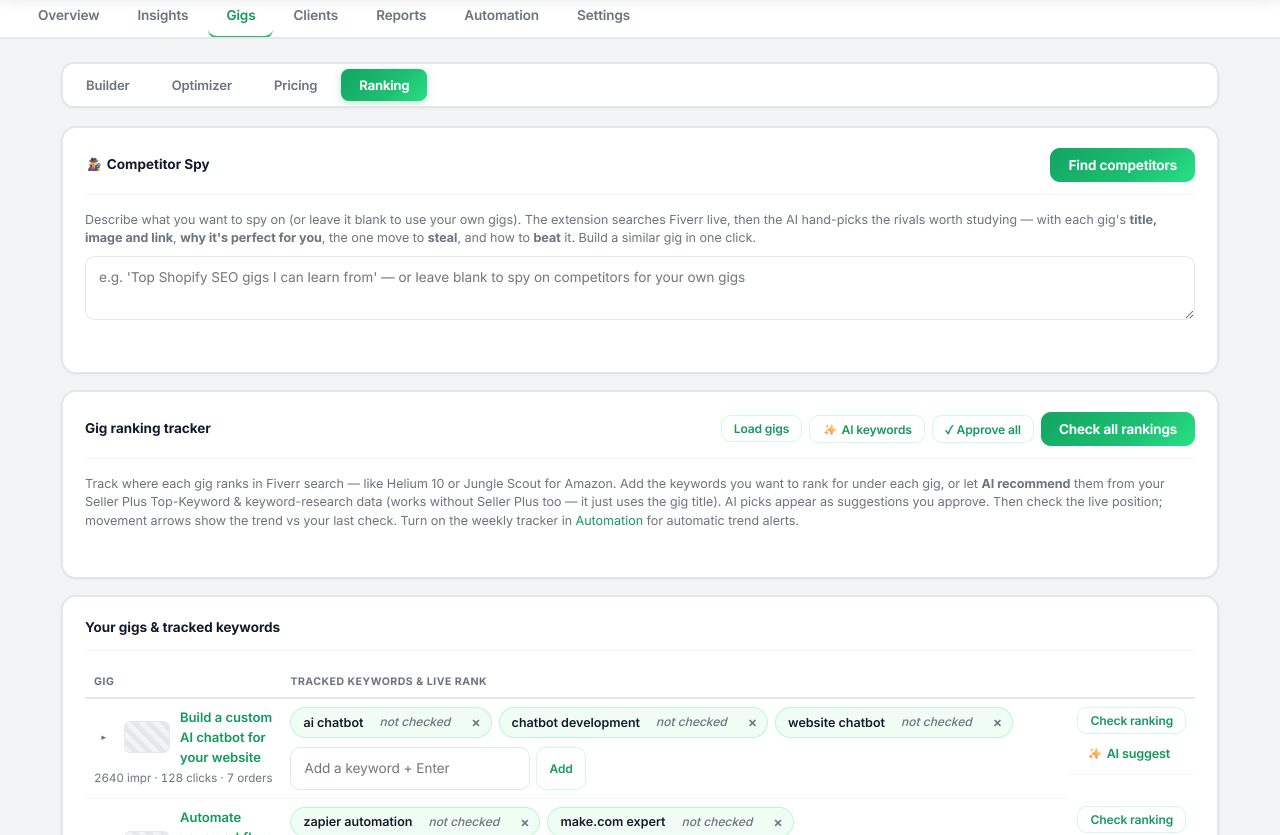
Seller OS helps interior designers research the exact keyword phrases buyers use in your subcategory, track how your gig ranks for those phrases over time, and audit your gig copy and gallery against conversion signals. The Gig Builder can draft a structured gig from a competitor URL or a one-line idea, filling the Fiverr wizard so you only hit Save, Continue, and Publish.
It does not create renders, write shopping lists, or guarantee rankings. You still design, render, and decide every deliverable. The tool only organizes the research and draft work so you spend more time designing and less time guessing keywords.
Fiverr SEO for Interior Designers questions
What keywords should I use for my interior design gig?
Combine room type, style, and deliverable: modern living room design, boho bedroom mood board, 3D kitchen render, Airbnb interior design package. Use all five tags and the positive keywords field for these combinations. Validate locally by searching each phrase on Fiverr and checking the results match your service.
Should I include 3D renders in my Basic package?
No. Renders are time-intensive. Keep Basic to mood board and 2D floor plan only. Put 3D renders in Standard (3 renders) and Premium (6+ renders, 4K, source files). This protects your hourly rate and lets buyers self-select by budget.
How many portfolio projects do I need for interior design?
Aim for 5–8 projects showing style range (modern, boho, minimalist, traditional) and room variety (living, bedroom, kitchen, office, Airbnb). For each project, show the mood board, floor plan, and final renders together. Pin your two strongest, most different projects first.
What is the biggest mistake interior designers make on Fiverr?
Pricing renders as if they were design work — putting 3D renders in the Basic tier or offering unlimited revisions on render-heavy packages. This leads to earning below minimum wage on small orders. Cap revisions, keep renders in higher tiers, and define what counts as a revision in your description.
Research your category keywords
Use the rank tracker to see which interior design phrases buyers search and where your gig stands.