 Seller OS
Fiverr SEO for 3D designers: rank by use case and file
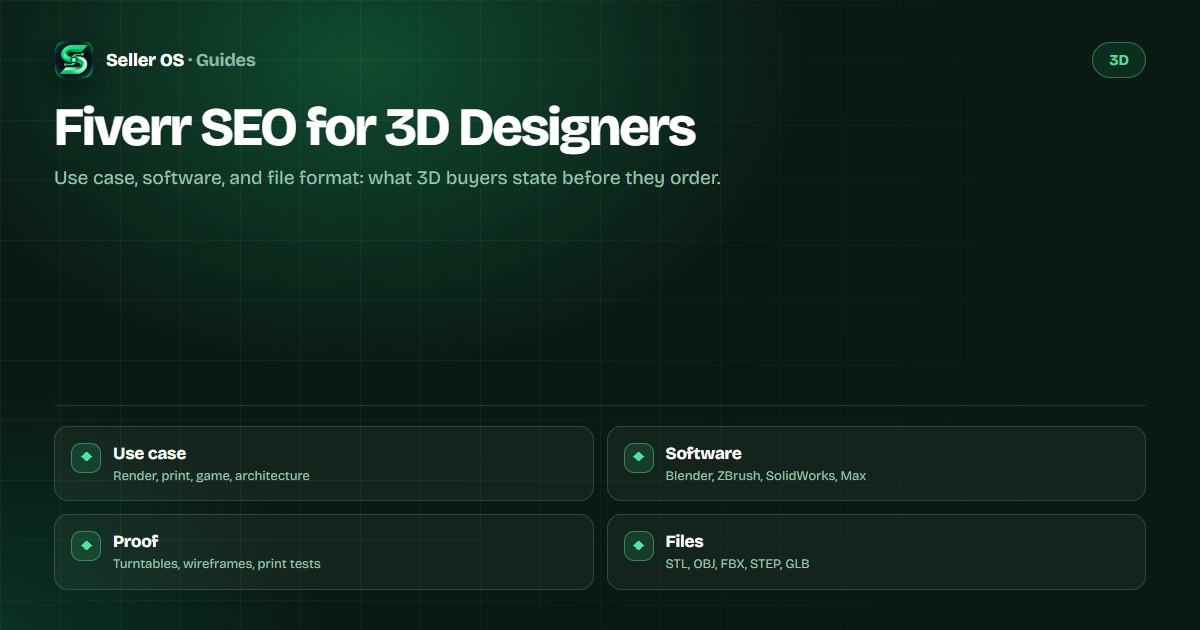
3D buyers search by what they will do with the model: a product render for a launch, a printable file for a printer, a low-poly asset for a game, a walkthrough for a building. The use case decides the deliverable, the software, and the file format, so it belongs in the title rather than in a list of services.
This guide covers use-case phrasing, the software and file-format qualifiers buyers add, the proof that reassures them (turntables, wireframes, printed parts), and the mistakes that turn a 3D order into a revision loop. The tables below are examples to validate in your subcategory, never platform data.
Free plan available. Local-first data. Human review on every change.
How 3D buyers search: use case first
3D model is a category, not a query with intent. Buyers add the purpose: 3D model for printing, product render for a product page, low-poly game asset, architectural visualization. Each use case carries technical requirements such as watertight geometry, clean topology, or real-world scale, and naming the use case shows you know which ones apply.
Fiverr's help center reads a listing starting with the title, ahead of the keyword field and the description. Lead with the purpose, then let the description carry the technical requirements where a careful buyer will read them.
Use-case keyword examples to test
Group candidate phrases by use case rather than by software, then validate each one in a private window: type it into Fiverr search, read what autocomplete adds, and check whether the top gigs deliver what your phrase implies.
The table is one product-render seller's starting set. Your mix will change with your niche; what stays the same is validating every phrase against the listings already ranking for it.
| Role | Example keyword | Use case behind it |
|---|---|---|
| Primary | 3d product rendering | Marketing images for a launch or listing |
| Supporting | stl file for 3d printing | A physical part the buyer will print |
| Supporting | low poly game asset | A game-ready model with a budget |
| Long-tail | 3d floor plan rendering | Real-estate and interior buyers |
| Long-tail | blender 3d model | Software-qualified buyers who work in Blender |
Software and file formats buyers ask about
Software names work as qualifiers the way platforms do on a web gig: a buyer searching Blender 3D model wants compatibility with their own pipeline, not a lecture. Claim a software only where you can show work made in it, because the first message usually asks how you built the file.
File formats are the second qualifier. Print buyers need a mesh a slicer can open; game and AR buyers need interchange formats with clean topology and a stated poly budget; render buyers may never open the source at all. Name the formats inside each package so the handover does not become the negotiation.
| Use case | Typical delivery | What buyers check first |
|---|---|---|
| 3D printing | A watertight mesh file | Wall thickness and printability |
| Game asset | A game-ready model with textures | Topology and polygon count |
| Product render | Finished images, source file optional | Lighting and material realism |
| Architectural viz | Model plus presentation views | Scale and proportions |
Title patterns for a 3D design gig
Titles arrive pre-filled with I will, and Fiverr's guidance is to keep them short and clear without special characters such as ampersands and slashes. Lead with the use case, then the software or the format, because those are the words buyers add to 3D model.
The fill-ins below stay readable as sentences while carrying the exact phrase a buyer would type. Adapt the pattern to the work in your portfolio rather than copying a competing gig's wording.
| Pattern | Example fill-in | Fits when |
|---|---|---|
| [Use case] + [input] | I will create a 3D model from your photos | Buyers arrive with reference images |
| [Deliverable] + [software] | I will design a 3D printable STL file in Blender | Printing buyers with a slicer |
| [Deliverable] + [asset type] | I will model a low poly game asset with textures | Game developers on a poly budget |
| [Outcome] + [style] | I will render your product in photorealistic 3D | Marketing buyers who need images |
Proof: turntables, wireframes, printed parts
A turntable answers what a still render cannot: does the model hold up from every angle? Fiverr's gallery holds up to three images, one video, and two PDFs, and the video slot is made for a short rotation. The help center's video article allows up to 75 seconds, which is enough for one clean loop plus a wireframe pass.
Pair the beauty render with a wireframe or a viewport screenshot so topology-conscious buyers can see the structure. If you do print work, a photo of the printed part is the most persuasive file you can upload, because it closes the gap between a render and a physical object. Portfolio projects hold one to five files, so a render, a wireframe, and a print photo make one complete project.
Package 3D work by scope, not software
Buyers compare 3D offers by scope: a single hero object, a scene, an animated turntable, a print-ready assembly. Build the ladder from geometry time and revision rounds, and state what the source file costs. Fiverr's three package slots each carry their own delivery time, revision count, and price, and the help center lists a $100 minimum starting price for the 3D Product Animation category.
Worked example: Basic is one object with a single render angle; Standard adds a second angle and a turntable clip; Premium adds the source file and a wireframe pass. For print work, make the printability check part of the base offer, because no revision round fixes a failed print.
The list below restates the same ladder in one line per tier, ready to adapt to your own pipeline. The exact split matters less than making each tier's scope obvious at a glance, because vague scope is what turns a clean order into an argument about extras.
- Basic: one object, one render angle, cleaned mesh
- Standard: multiple angles plus a turntable clip
- Premium: source file, wireframe pass, one extra revision round
3D gig mistakes that cause revision loops
The first mistake is a gallery of beauty renders with no wireframe, which technical buyers read as hiding the topology. The second is a title listing five software packages, which reads as none mastered. The third is leaving file formats unnamed, so the handover becomes the negotiation.
The fourth is selling print work without a printability check, which turns a failed print into a support conversation. The fifth is bundling tasks you never priced; if a render package starts including listing uploads, the virtual assistants guide covers how that work is searched.
For neighboring categories, the illustrators guide and the graphic designers guide cover their own proof conventions, and the how to rank a Fiverr gig guide covers testing title and package changes over time.
Where Seller OS helps
Seller OS supports a 3D business at both ends: the listing and the follow-through. The Gig Builder turns a one-line idea or a competitor URL into a structured draft with a title, tags, description, and three packages, and fills Fiverr's wizard while you complete Save and Publish. The Gig Performance Optimizer reviews the live gig's copy and gallery against the gig's own performance data.
On the follow-through side, client records keep project notes and asset history in Chrome local storage, which helps when a buyer returns for a second angle or a repaint. Keyword tracking keeps a local position history for the use-case phrases you sell against. It drafts and records; every quote, edit, and publish decision stays with you.
Fiverr SEO for 3D Designers questions
How do I rank a 3D modeling gig on Fiverr?
Lead with the use case and one software: a 3D printable STL file designed in Blender targets printing buyers, while a photorealistic product render targets marketing ones. Put the strongest phrase in the title, close variants in the five keyword slots and tags, and give any change at least 30 days.
Which file format should I deliver?
It depends on the use case, and the package should say so. Printing buyers usually need a mesh a slicer can open; game and AR buyers need interchange formats with clean topology; render buyers may only need images. Name the formats per tier and price the source file as part of the offer.
What proof should a 3D portfolio include?
A turntable, a wireframe or viewport shot, and a printed part for print work. Those three answer the questions this category asks: does the model hold up from all angles, is the topology clean, and does it survive contact with reality. Fiverr portfolio projects hold one to five files each.
Should one gig cover modeling, printing, and rendering?
Only where the buyer is genuinely the same. Printing and rendering attract different buyers with different first questions, so separate gigs usually earn more specific searches, subject to your level's active gig limit. Where you keep them together, name each service clearly and store matched samples in the portfolio.
Sell the use case, not the software
Put one use case and one format in the title, show a turntable beside a wireframe, and keep the packages priced by scope.