 Seller OS
Fiverr SEO for illustrators: get found for the styles you draw
Illustration buyers on Fiverr search by style and subject, not by job title. They type character design, children's book illustration, line art portrait, or concept art, and they scan results for a gallery that already looks like the thing they imagined. The gig that names their style in the title enters the search with the strongest possible match.
This guide covers style-name keywords, how usage rights shape the package ladder, the process proof illustration buyers now check, and the mistakes that keep good portfolios invisible. Keyword examples are illustrative; validate each one in your own subcategory before building a gig around it.
Free plan available. Local-first data. Human review on every change.
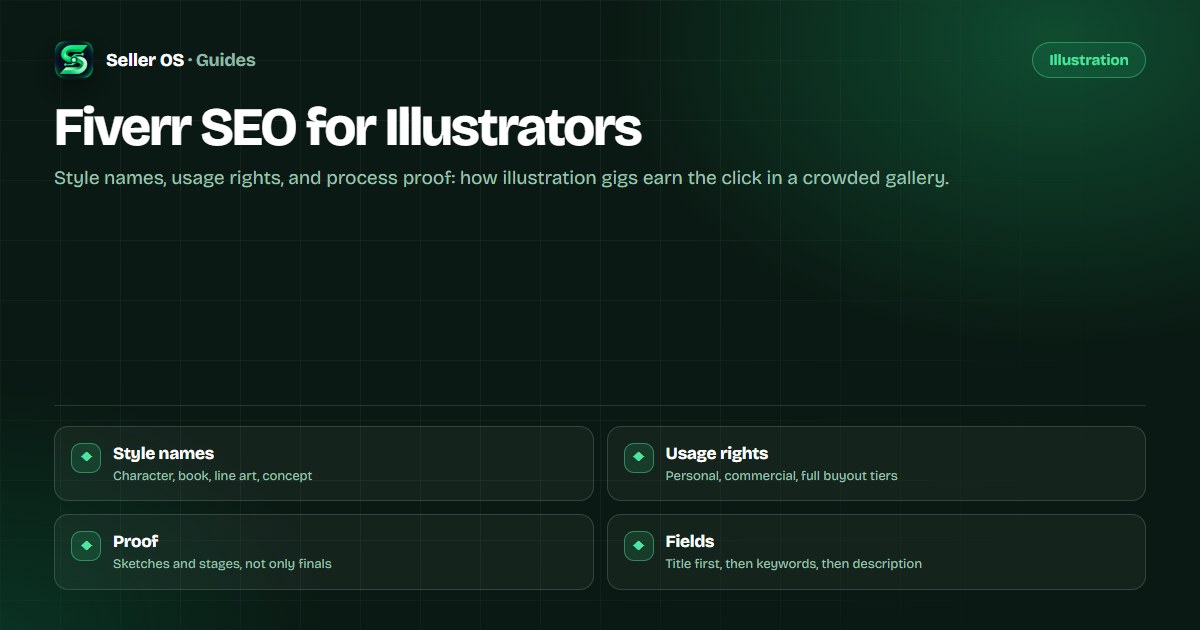
How illustration buyers search by style
Few buyers search for an illustrator. They search for the picture in their head, and the style name decides the click: character design, children's book illustration, line art, concept art, portrait illustration. Fiverr's Seller Plus analytics documentation describes a reading order of title text first, then the positive keywords field, then the description, so the style phrase does the most work from the title.
Write five phrases a buyer would type for the work you most want to draw, then sort them by whether each names a style, a subject, or a use. The table shows a starting set for one character illustrator, mapped to the field that fits; treat every example as illustrative and validate it in your subcategory.
| Role | Example keyword | Why it fits |
|---|---|---|
| Primary | character design | The style-first phrase the gig is built around |
| Supporting | cartoon character illustration | Style variant buyers type directly |
| Supporting | childrens book illustration | A second deliverable with its own searcher |
| Long-tail | line art portrait from photo | Style plus source material; narrow and specific |
| Long-tail | fantasy concept art character | Genre-qualified phrase you can back with samples |
Title patterns that name the style
Fiverr pre-fills every title with I will, and the help center asks for a title that is short, clear, and to the point, without special characters such as ampersands and slashes. No title character limit is published, so spend the visible words on style and subject rather than on adjectives.
Fill the patterns below with subjects you have actually drawn, because the title, the tags, and the gallery should tell one story. A style claim without a matching portfolio piece is the fastest route to a refund conversation in this category.
| Pattern | Example fill-in | Fits when |
|---|---|---|
| [Style] of [subject] | I will draw a cartoon character of your pet | The subject is the search |
| [Format] for [audience] | I will illustrate a children's book spread for ages 4 to 8 | Publishing buyers with a manuscript |
| [Style] from [source] | I will create line art portraits from your photo | Buyers who send a reference first |
| [Genre] art for [project] | I will design fantasy concept art for your game | Studio and game buyers |
Package illustration work by usage rights
Illustration pricing is about usage as much as hours. A personal piece for one profile, artwork printed on merchandise, and a full campaign with exclusivity are three different licenses, and the package ladder is where that difference lives. Fiverr allows up to three packages, each with its own delivery time, revision count, and price.
Name the license inside each tier instead of burying it in the FAQ, and answer the question every license raises: who may use the image, where, and for how long. The worked ladder below is an example structure; set the prices from your own process.
| Tier | Usage included | Question the tier must answer |
|---|---|---|
| Basic | Personal use for one project | May the buyer post it publicly? |
| Standard | Commercial use for one brand | What counts as one brand? |
| Premium | Full buyout with layered source files | Is exclusivity part of the deal? |
Portfolio proof: show the process behind the final
Buyers no longer take a polished image at face value. Show the stages: thumbnails, a cleaned line pass, a color study, the final frame. A sketch underneath the finished piece is proof of authorship that no caption can replace, and it also demonstrates range to a buyer who is choosing between styles.
Fiverr's portfolio article states that Live Portfolio is enabled by default for each gig, and that it cannot be disabled for gigs in the Logo design and Illustration subcategories. Delivered files can therefore appear on your gig page, so deliver work you are happy to have public and keep a curated project order for the range you want buyers to see.
Answer the AI question on the gig page
Many illustration buyers now wonder whether a portfolio was generated, which makes the trust question part of SEO: the buyer is checking whether you are the person who draws. Answer it in the gig description with your process — thumbnails, line passes, color stages, and a timelapse on request. Show the work being made and the question answers itself.
Keep the statement specific and honest. If you draw everything by hand, say so and prove it with stages; if tools play a role in your workflow, describe where they sit. Slogans convince nobody, while a concrete process note is easy to check against your gallery. The wider shift is covered in Did AI kill graphic designers?.
Illustration SEO mistakes to fix
The first mistake is one gig covering every style. Character work, children's book spreads, and editorial line art attract different buyers with different phrases, and a listing that tries to hold all three reads as a generalist to each. Split where your portfolio is deepest, and use new gig slots as your level allows.
The second is naming a technique instead of a subject; buyers search for what they want drawn. The third is usage terms that surface at delivery instead of checkout. The fourth is judging a change from a single search check: the how to rank a gig guide explains why positions need a window, and the 3D designers guide is the sibling page for modeled work.
Where Seller OS helps
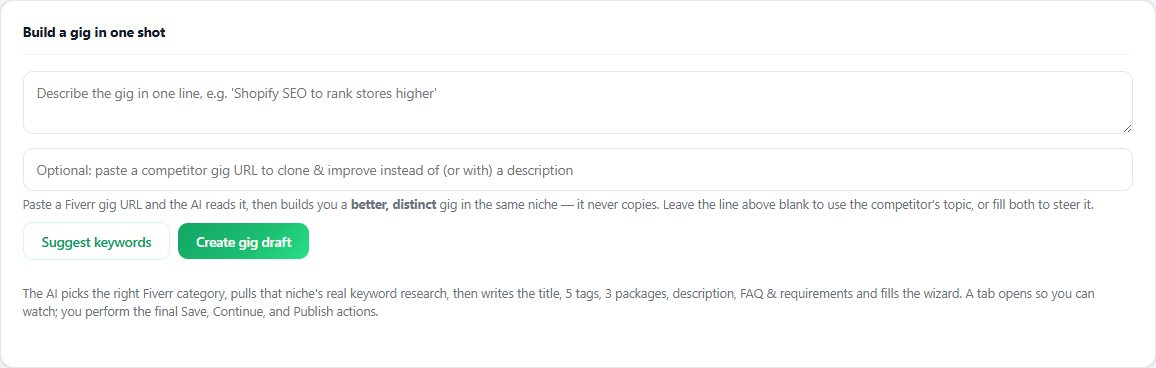
Seller OS supports the style-first habit in two places. The Gig Builder turns a style and a one-line brief into a draft gig — title, tags, three packages, description — and hands you the filled Fiverr wizard to finish, while keyword suggestions help when a style phrase needs a neighbor word.
After publishing, keyword rank history stays local, so a style that climbs reads as a trend rather than a memory, and the Pro keyword monitor refreshes positions while Chrome is open. Client records keep notes on buyers who return for a second piece. It drafts and records; every edit, save, and send stays with you.
Fiverr SEO for Illustrators questions
What keywords should an illustration gig target?
Style and subject phrases: character design, children's book illustration, line art portrait, concept art. Write five a buyer would type for the work you most want, put the style phrase in the title, and check it in a private window against autocomplete and the gigs already ranking. Validate before you build a tracking list.
Should I charge extra for commercial use?
It is common practice to price personal and commercial licenses differently, and the package ladder is the clearest place to do it: personal use in the entry tier, commercial use above it, full buyout with source files at the top. State exactly what each tier permits so the terms are agreed before delivery, not after.
How do I show that my work is human-made?
Show the process, not a badge. Sketches, thumbnails, a line pass, and a color stage make authorship visible, and many buyers appreciate a timelapse on request. Describe your workflow plainly in the gig description, including where any tools sit, because a specific and honest process statement answers the trust question better than an absolute claim.
What is the biggest illustration gig SEO mistake?
Building one gig for every style. Each style has its own buyer language, and a listing that tries to cover character work, book spreads, and editorial art matches none of them well. Put your strongest style in a focused gig, validate its phrases locally, and add separate listings as your portfolio and gig limits allow.
Get found for the style you draw
Draft the style-first gig, set the usage ladder, and let the process in your gallery do the trust work.