 Seller OS
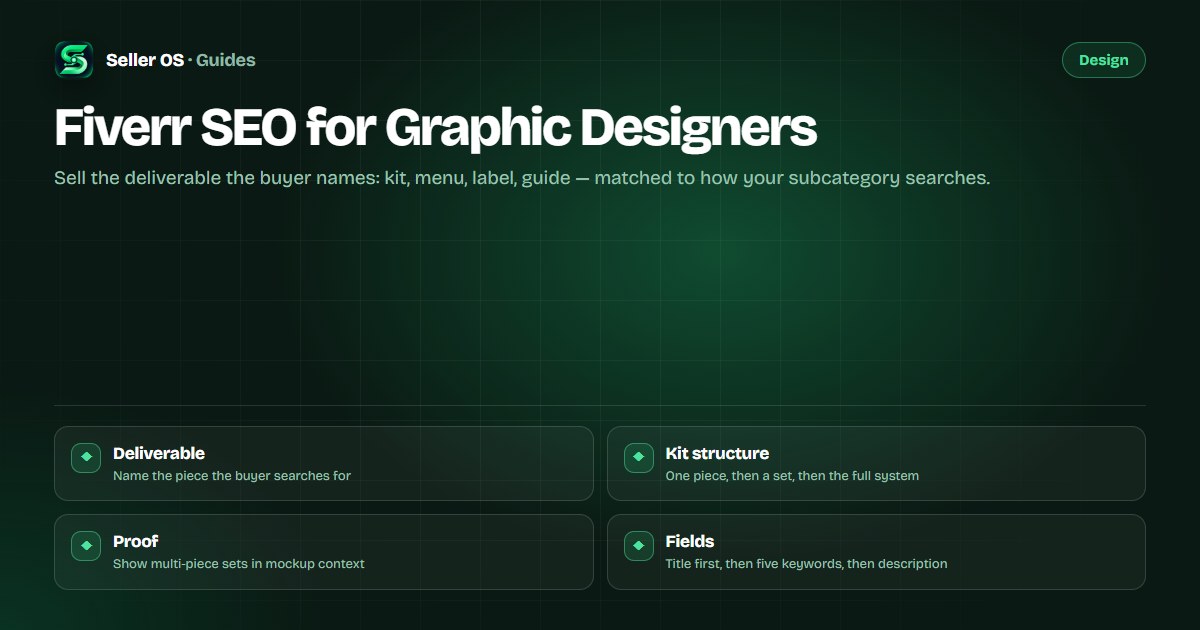
Fiverr SEO for graphic designers: rank for what you deliver
Graphic design buyers on Fiverr search by deliverable, not by job title. They type the piece they need: a social media kit, a restaurant menu, a packaging label. Your gig enters those searches by naming the piece in the words the buyer already uses, instead of describing a general design service.
This guide covers the phrases that fit graphic design gigs, how to structure titles and tags around deliverables, what proof buyers check, and where Fiverr reads your keywords. Every keyword table below is an illustrative example to validate in your own subcategory, not platform data.
Free plan available. Local-first data. Human review on every change.
How graphic design buyers search
Few buyers search for a graphic designer. They search for the artifact: social media templates, a restaurant menu, a product label, a pitch deck, a brand style guide. The closer your title and tags sit to that artifact, the more of those searches your gig can enter, because Fiverr's Advanced Analytics article states that the algorithm prioritizes title text first, then the positive keywords field, then the description.
Start by writing five phrases a buyer would type for the exact piece you want to sell most. Then group the rest by whether each phrase is a deliverable, an industry, or a style. The title carries the phrase with the clearest buyer intent; the supporting fields carry close variants of it.
| Role | Example keyword | Why it fits |
|---|---|---|
| Primary | social media templates | The deliverable buyers type when they need a set |
| Supporting | instagram templates | Platform-qualified version of the same need |
| Supporting | brand style guide | A second deliverable you can serve from one system |
| Long-tail | restaurant menu design | Industry plus artifact; narrower and easier to enter |
| Long-tail | canva social media kit | Tool qualifier buyers add when they edit later |
Title patterns that match deliverable searches
Fiverr pre-fills every title with I will, and its help center guidance is to keep the title short, clear, and to the point while avoiding special characters such as ampersands, slashes, and plus signs. No character limit is published, so precision beats stuffing. One pattern fits most graphic deliverables: name the piece, then narrow the audience or the format.
A pattern is only a frame; the fill-in is what matches the search. The four shapes below read as natural sentences and still put the buyer's phrase near the front of the title.
| Pattern | Example fill-in | Fits when |
|---|---|---|
| [Deliverable] for [audience] | I will design social media templates for skincare brands | You serve one buyer type closely |
| [Deliverable] in [style] | I will design a minimalist pitch deck for investors | Style is the deciding factor |
| [Deliverable] with [format] | I will design a print-ready restaurant menu | The delivery format is part of the search |
| [Tool] + [deliverable] | I will design a Canva social media kit for coaches | Buyers want to edit the files themselves |
Package design work as kits, not one-offs
Graphic buyers price-shop by scope, so the three package slots map naturally to size: one piece in Basic, a small set in Standard, and the full system in Premium. Fiverr allows up to three packages, with a minimum starting price of $5 that is higher in some categories, and each package needs at least one revision option according to Fiverr's help center.
Worked example: a seller offers business card design. Basic is one card with two concepts. Standard adds a letterhead and an email signature. Premium delivers the full stationery set plus the layered source file. Every tier repeats the deliverable name, so the gig keeps matching the searches that brought the buyer in, and the upgrade reads as more of the same work rather than a different service.
- Social kits: think in pieces — posts, stories, covers.
- Print work: keep the print-ready PDF in the base offer.
- Source files: a natural premium inclusion with real value.
- Revisions: one per tier minimum, stated in the description.
Portfolio proof graphic buyers trust
Graphic buyers want to see a system, not a single mark. Show the set: three posts and a story frame, a menu photographed on a table, a label on a bottle. A portfolio project holds one to five files, and Fiverr allows between one and 20 projects, so the first few slots carry the most weight with a buyer who is skimming.
Fiverr's portfolio article sets project titles at 15 to 50 characters and descriptions at 120 to 1,400 characters, which is room to name the client type, the deliverables, and the outcome in the buyer's words. The portfolio guide covers ordering and which pieces to pin; here the point is that the sample and the gig should describe the same work.
What Fiverr reads, and in what order
Fiverr's Advanced Analytics article describes the reading order as title text first, then the positive keywords field, then the description. Five positive keywords and five tags are available, and the help center's best practice is to use all five tag slots. The description holds up to 1,200 characters, and an English description is required.
The order turns into a layout for your words: the strongest deliverable phrase in the title, close variants in the five keyword slots, distinct supporting phrases in tags, and the longer explanation in the description and the FAQ, which holds up to 10 questions. The keyword research tool guide covers how to source phrases; Fiverr's help center recommends giving any new or updated keyword at least 30 days before judging it.
A worked check: a menu designer puts menu design in the title, restaurant menu in the positive keywords, cafe menu and food menu in two tags, and the print-ready promise in the first line of the description. Each phrase has one home. Repeating restaurant menu in all five tags spends the slots on words the title already covers.
Designer mistakes that flatten visibility
The first mistake is the everything gig: a title like creative graphic design services names no deliverable and matches no specific search. The second is a gallery of final marks with no context, when graphic work sells through the set and the mockup. The third is copying a competitor's title and tags; when the words do not describe your actual deliverables, clicks arrive for work you do not sell.
A fourth is treating one gig as a full portfolio. A listing sells one deliverable family well, and the rest of your range lives in the portfolio or in separate gigs. The split test is buyer language: when two services get named with different words, they deserve different gigs. Marks and identity systems belong in the logo designers guide, and sites and landing pages in the web designers guide; the how to rank a gig guide covers the measurement loop.
Where Seller OS helps
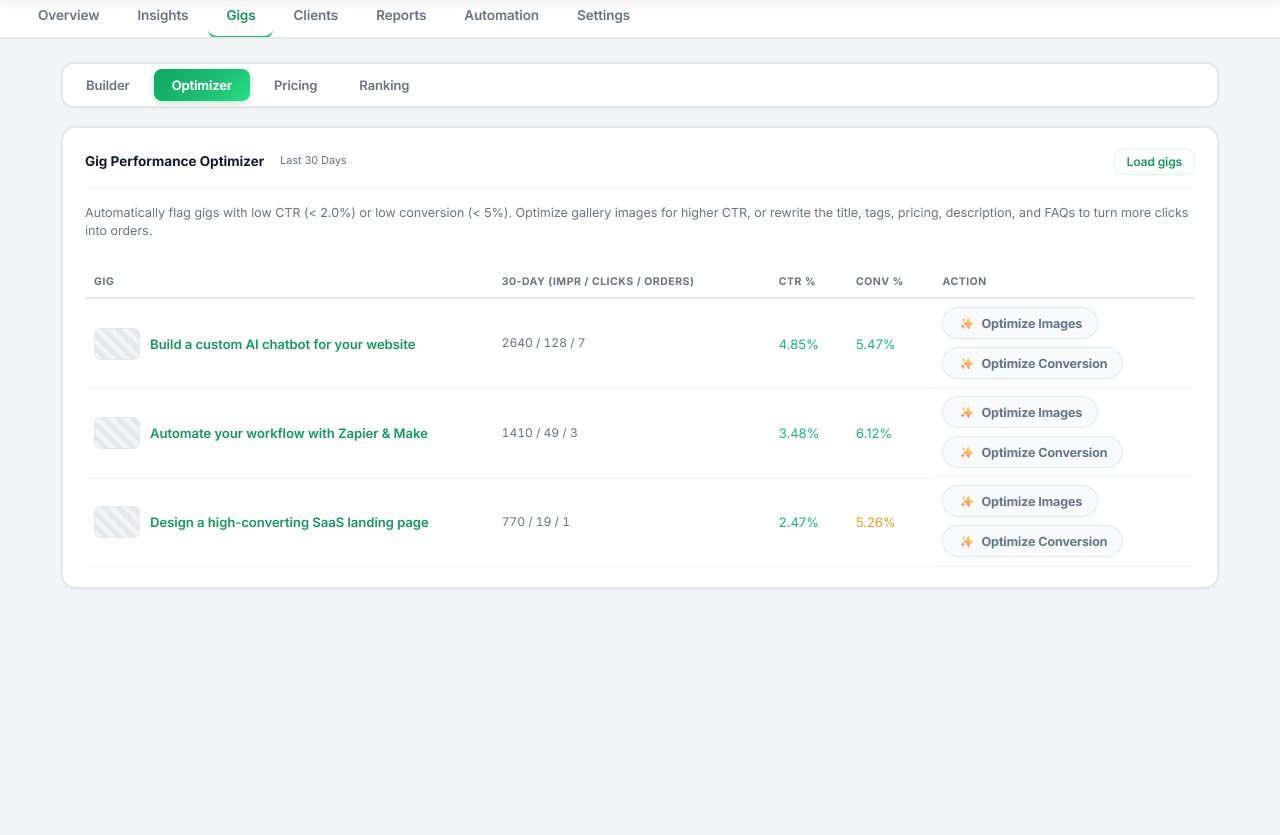
Seller OS helps at the two stages this guide cares about. The Gig Builder turns a one-line idea or a competitor URL into a structured draft with a title, tags, description, and three packages, and fills the Fiverr wizard while you complete Save and Publish. The Gig Performance Optimizer then reviews a live gig's copy and gallery against its own performance data and proposes changes.
For a deliverable-first approach, the keyword help and the local history are the useful parts: tracked keywords show movement over time, and the Pro keyword monitor refreshes positions while Chrome is open. It drafts and records only; it never edits, sends, or publishes on its own, and the judgment about which deliverable to sell stays with you.
Fiverr SEO for Graphic Designers questions
How do I choose keywords for a graphic design gig?
Start from the deliverable a buyer would name: social media templates, menu design, packaging label. Write five phrases for the piece you sell most, put the clearest one in the title, and use the rest for the keywords field, tags, and description. Then validate each phrase against search suggestions and the gigs already ranking.
Should I split different design services into separate gigs?
Usually yes. A gig that tries to cover logos, menus, and social kits reads as a general service and matches fewer specific searches. When two services get described with different buyer words, they belong in separate listings. Your active gig limit depends on your level, so split where the demand and your portfolio are strongest first.
What should a graphic design portfolio project include?
One to five files, a title of 15 to 50 characters, and a description of 120 to 1,400 characters, per Fiverr's portfolio article. Show the system rather than one flat file: a set of posts, the menu on the table, the label on the bottle. Naming the client type and the outcome helps buyers self-identify.
How long does a graphic gig change take to show in search?
Fiverr's help center recommends giving a new or updated keyword at least 30 days before reviewing its impact. Search results are also personalized and change with the buyer, so compare your own readings over equal windows rather than reacting to one day. Change one field at a time so any movement can be attributed.
Match the gig to the deliverable.
Write five phrases for the piece you sell most, put the clearest one in the title, and let the kit structure carry the rest.