 Seller OS
Fiverr SEO for AI automation specialists
Automation buyers search by tool more often than by discipline: n8n developer, Zapier expert, Make automation, custom GPT builder. The tool tells them you can work inside the stack they already pay for; the outcome tells them the workflow is worth building in the first place.
This guide covers tool-qualified phrasing, how to describe outcomes without inventing numbers, the process artifacts that work as proof, and what to explain before a buyer can order responsibly. The honest limit: every workflow needs maintenance, and no build should be sold as finished forever.
Free plan available. Local-first data. Human review on every change.
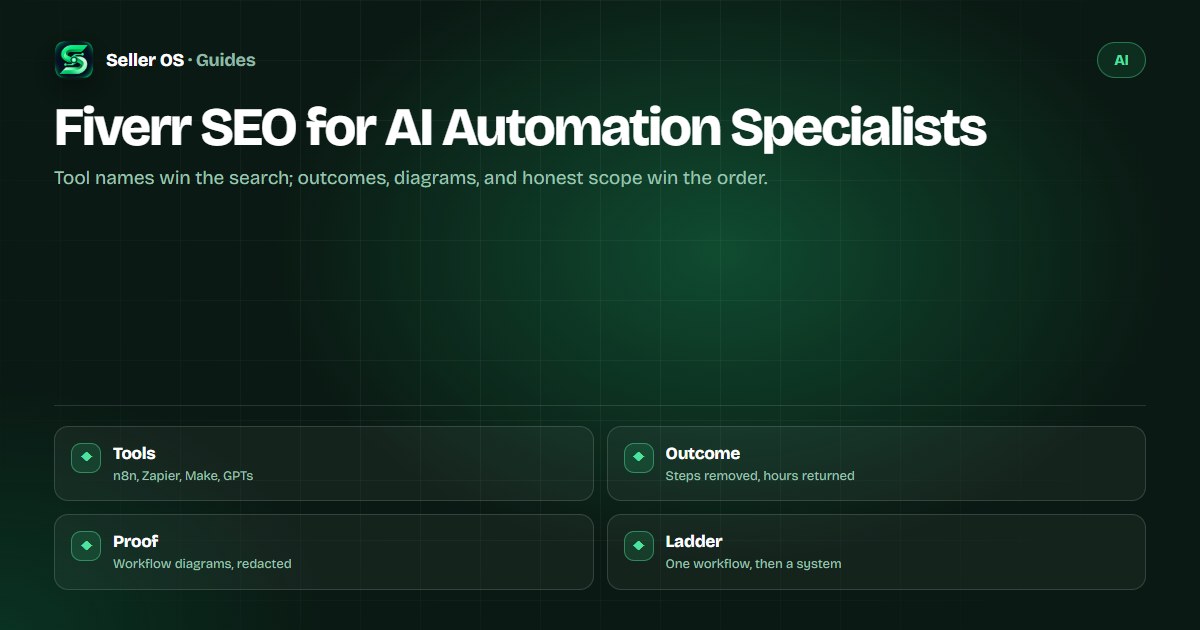
Buyers search for tools, not categories
The phrase automation specialist describes an identity, not a job. Buyers arrive already committed to a stack: a small business running Zapier, an agency on Make, a technical team self-hosting n8n, a founder who wants a private assistant built on their own documents. Each stack search carries its own expectations about how you build.
Name only the tools you can support in a delivery. A gig listing five platforms reads as a directory and invites questions you cannot answer, while one tool named honestly, plus the workflow type you build with it, matches a phrase someone actually types.
Tool-qualified keyword examples to test
Validate each phrase the same way in any category: search it in a private window, read autocomplete, and inspect what the ranking gigs actually deliver. The rows below show the shapes that exist in this category; they are examples to check, not marketplace data.
Map one phrase per gig and keep tool names in the title where they can do the most matching. Supporting phrases such as api integration or webhook setup can live in the tags and positive keywords fields.
| Phrasing example | The work behind it | Field to try |
|---|---|---|
| n8n automation | Self-hosted multi-step workflow builds | Title |
| zapier expert | Connecting tools a business already pays for | Title |
| make.com automation | Visual scenarios with branching logic | Positive keyword |
| custom gpt builder | A private assistant trained on documents | Title |
| ai chatbot for website | Lead capture or support conversation | Positive keyword |
| api integration specialist | Two systems exchanging data directly | Description |
Frame the outcome, then the tool
Buyers do not purchase workflows; they purchase the end of a chore. Strong gig copy names the manual process being replaced, the trigger that starts the new flow, and what the buyer receives: a populated sheet, a drafted reply, an alert where they already work.
Add one hypothetical scenario to make the scope concrete, clearly labeled as an example. A support inbox where each new message used to be read, copied into a tracker, and answered by hand becomes a form that files the request and drafts the response for review. The point is the shape of the change, not a promised saving.
Workflow diagrams are the portfolio
In this category the screenshot that sells is not a completed task; it is the map of how the task flows. Show the trigger, the steps, the branch conditions, and the destination, with credentials and client data blurred. A diagram lets a technical buyer audit your logic in a minute, which is exactly the reassurance a first order needs.
Pair the diagram with a short note for each build: what was manual before, what runs now, and what happens when a step fails. Failure handling is the part buyers forget to ask about and the part that separates a built flow from a demo. It also gives you something honest to show before you have long-term results.
- Blur credentials, tokens, client names, and live data
- Show the failure path, not only the happy path
- Label each diagram with the trigger and the destination
Titles and a build ladder that scales
Titles follow one order: tool, workflow type, and the business context if it helps matching. Fiverr's gig creation help allows up to 1,200 characters in the description, which is enough space to explain how the build works, what access it needs, and what the buyer receives at handover.
A strong title also names the trigger and the destination when they are short enough to fit: forms to a sheet, orders to an invoice tool, leads to a follow-up sequence. Buyers recognize their own process in that phrasing, and the phrase stays searchable as long as you keep it to one tool and one outcome per listing. Test any change the way every category does: one field per window, read over weeks rather than days.
| Tier | Scope example | Delivery example | Revisions |
|---|---|---|---|
| Basic | One workflow, up to five steps | 3 days | 2 |
| Standard | Multi-step workflow with error handling | 5 days | 2 |
| Premium | Connected system plus documentation and handover | 10 days | 3 |
- I will build an n8n workflow that syncs your forms to your spreadsheet — tool plus outcome
- I will connect your tools with Zapier to remove manual data entry — tool plus promise
- I will build a custom GPT for your internal documents — product plus use
- I will create an AI chatbot that qualifies website leads — outcome plus channel
Handover terms buyers rarely think about
Delivery is not the end of a build. Say what the buyer owns after handover: the workflow inside their own account, the documentation, and the connections you created during the build. Confirm that access is theirs and that you keep nothing once the final revision is approved.
Then set maintenance expectations in plain words. Platforms change, APIs deprecate, and a workflow that runs for months without attention is a hope rather than a guarantee. Offer a check-in window or a follow-up scope, state how post-delivery requests are handled, and let the buyer decide whether to buy that care.
- State who owns the workflow and the credentials at handover
- Name the support window and what it covers
- Quote changes after delivery before you start them
What to explain, and mistakes to avoid
Automation buyers often do not know what to provide. Say it in the requirements: which accounts exist, who can grant access, whether the tools have paid plans that allow the connection, and what should happen when the flow fails. A gig that front-loads these questions gets fewer support threads and cleaner first builds.
The common mistakes mirror that gap. Selling automation with no tool or outcome named matches nothing. Promising a build that never needs maintenance sets up a dispute the first time an API changes. And treating client credentials casually during a build is a security problem, not an inconvenience; request scoped access, and tell buyers exactly what you need and when you will hand it back. The gig description guide covers how to write those scope lines, and the neighboring marketing page shows the channel side of the same buyer.
One honesty note belongs in the copy too: which steps stay human. A drafted reply that someone reviews before it sends, or a classification with a fallback rule for the edge cases, is a design decision rather than a limitation. Buyers who understand where they remain in the loop trust the rest of the build more, and they ask better questions during the kickoff.
Where Seller OS helps
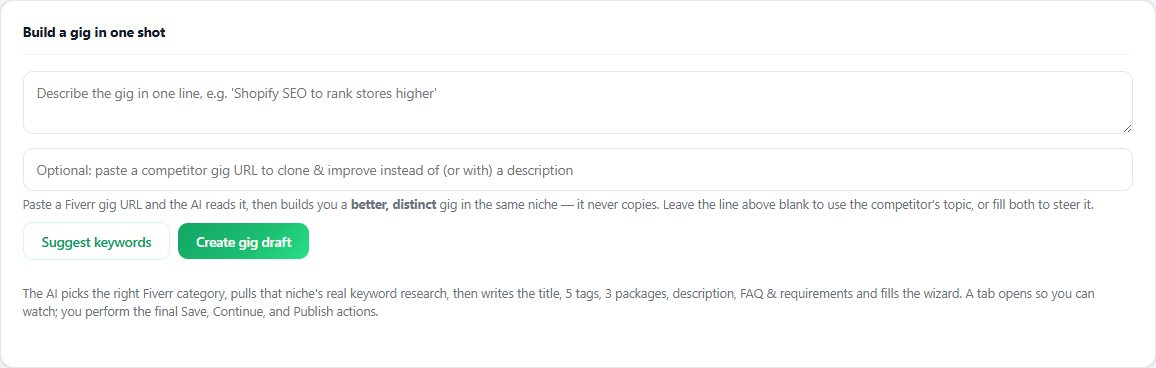
Seller OS helps around the build, not inside it. The Gig Builder drafts a tool-qualified listing from a one-line idea and fills Fiverr's wizard, which you complete through Save and Publish yourself, and client records keep each automation's scope, stack, and delivery history locally in Chrome.
The reports view and action queue keep several builds and follow-ups visible without a spreadsheet, and local keyword rank tracking follows the tool phrases you chose. It does not run, host, or monitor your clients' workflows, and it never stores the credentials you use during a build.
Fiverr SEO for AI Automation Specialists questions
How do I rank an AI automation gig on Fiverr?
Lead with the tool buyers search and the workflow you build with it, like n8n automation for syncing forms to a sheet. Keep one deliverable per gig, validate the phrase against autocomplete and the top listings, and change one field per two-week window. Tool phrases match better than discipline words like automation.
Which tools should I name in my gig title?
Name the tools you can support without extra help, and stop there. If you build in n8n and Zapier but only n8n has your samples, the title should say n8n and the description can mention the others as options. A directory of logos attracts briefs you cannot deliver well.
How do I prove automation work without client data?
Show diagram-based proof: the trigger, steps, branches, and destination of a workflow with credentials and data blurred, plus a note on what happens when a step fails. Build one demo on accounts you own to have a clean example. Failure handling proves more than a polished happy path.
What should an automation package include?
Scope it in steps and systems: a single workflow or a connected set, the number of tools involved, documentation, and a handover note. State what happens after delivery, since platforms and APIs change. Fiverr allows up to three packages, so the ladder can climb from one workflow to a documented system.
Sell the saved hours, not the stack
Name one tool in the title, frame the outcome in the copy, and let a clean diagram carry the proof.