 Seller OS
Best AI tools for Fiverr gig SEO: choose by job
No single product does everything a Fiverr gig needs, and marketing labels rarely match what a tool actually does. The useful question is which job you are hiring it for: expanding keyword candidates, producing title and tag variants, drafting description copy, or sketching thumbnail annotations. Name the job first, then judge the tool against it.
Below: four gig-SEO jobs, the checks that separate a useful tool from a decorative one, and the review gate every draft passes before it touches your listing. No tool can promise a ranking; the honest wins come from better language and cleaner tests.
Free plan available. Local-first data. Human review on every change.
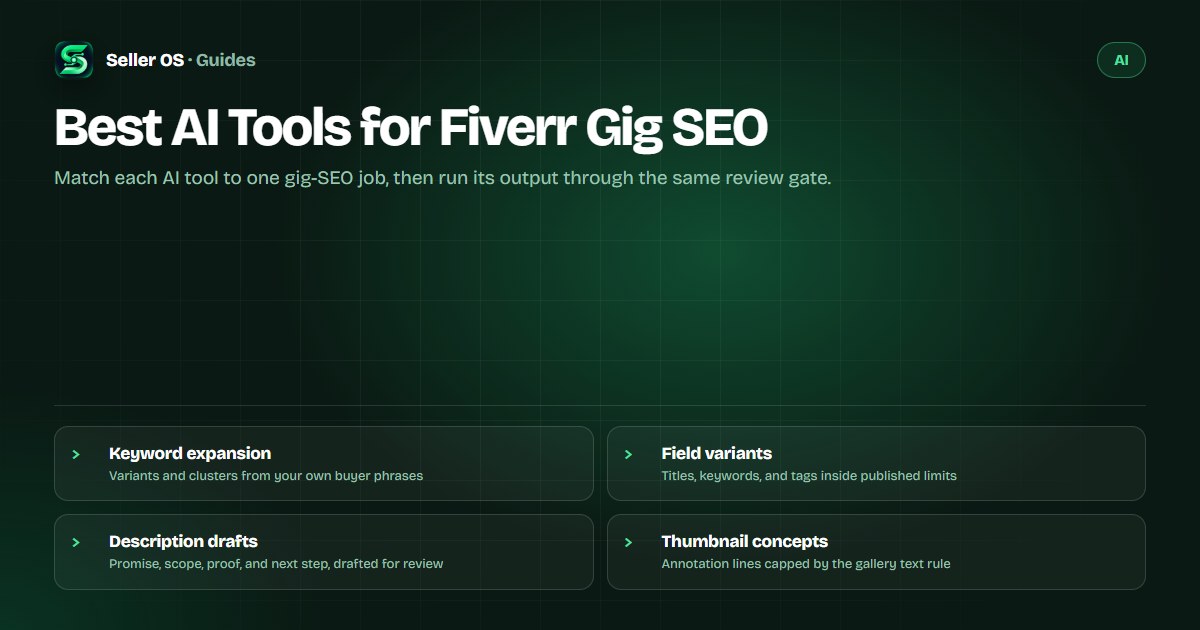
Pick the tool by the job, not the label
No single product covers every part of gig SEO, and category pages rarely explain what a product actually does. The useful question is which job you are hiring it for: expanding keyword candidates, producing field-ready variants, drafting description copy, or turning a thumbnail idea into annotation lines you can design around.
Four checks sort useful from decorative. Does the tool work from your own gig fields and buyer language, or from nothing? Does it respect the limits Fiverr publishes for each field? Does it stop at a draft you review? And can you keep client material out of it? A tool that fails the last two checks is not worth the time, however strong the output looks.
AI for keyword expansion and clustering
This is where AI earns its place. A chat assistant can take phrases you already know buyers use and expand them into variants, group them by intent, and remove near-duplicates. What it cannot do is tell you which phrase has demand, because no outside tool can read Fiverr's internal search data. Fiverr's own marketplace keyword metrics are part of Seller Plus.
Treat expansion as the first half of a loop, never the answer. Verification comes from sources you can inspect: autocomplete suggestions, the titles and tags of the top gigs in your subcategory, and the words buyers use in your inbox. The keyword research guide covers that loop step by step, prompt included.
- Role — You are helping me cluster Fiverr buyer phrases. Do not invent search volumes.
- Input — 10 to 20 phrases pasted from my inbox, order requirements, and reviews.
- Task — Group them by intent: deliverable, platform, format, audience, or problem solved.
- Output — One table, plus a one-line note on which phrases I can honestly serve.
- Rule — Flag anything I should verify against autocomplete before using it.
Title, tag, and keyword variants that fit
Field limits turn a promising phrase into a filter. Fiverr pre-fills the title with "I will" and asks sellers to keep it short, clear, and free of special characters such as &, /, ", and +. The gig also has up to five positive keywords or short phrases, up to five tags, and a description capped at 1,200 characters.
Ask for candidates in the shape each field allows, then cut them yourself. Request five title options, tag candidates that are single phrases, and a keyword list ordered by how close each phrase sits to a purchase. The gig SEO checklist is the gate a candidate passes before it touches a live gig, and it uses only limits Fiverr publishes.
Worked example: a tool returns five titles for a Shopify-focused web gig. Two stuff in platform names, one breaks the form with a slash, and two survive. One names the buyer and the outcome; the other names the format. You keep the first for the title and promote the second as a supporting keyword, which is the kind of trade a list alone never makes.
| Job | Give the tool | You keep |
|---|---|---|
| Keyword expansion | Inbox and review phrases | The demand question |
| Title variants | Current title and category | The final wording |
| Tag candidates | Top gigs in your subcategory | Which five slots to fill |
| Thumbnail concepts | Offer, audience, deliverable | The design and the text count |
Descriptions, FAQs, and gallery copy
For descriptions, treat AI as a drafting partner rather than an author. Supply the buyer, the deliverable, what is included, and the proof you can honestly claim, then ask for two versions in the promise-scope-process-proof order. The prompt-to-rewrite workflow shows the input list and an edited example; specifics and honesty stay your job.
FAQ drafting is more mechanical: feed the tool your last twenty buyer questions and ask it to merge duplicates and flag questions you cannot answer yet. Gallery concepts are the narrowest job of all. Fiverr's gallery guidance caps text on an image at ten words and adds badges automatically, so you ask for annotation lines, never logos, ratings, or level badges.
A concrete ask for that last job: three annotation lines, each under ten words, each aimed at a different buyer objection. The tool supplies the wording; the layout, contrast, and file size decisions stay with you, because the image is doing the clicking and no model can see how it looks at search-result size.
The review gate every draft passes through
Every job above ends the same way: draft, review, edit, publish. Review means reading the output against four questions. Is every claim true and deliverable at the price shown? Are the names, numbers, and formats current? Does the copy still sound like you? And is the buyer's private material kept out of the tool entirely, with no names, order files, or contract details pasted in?
That privacy line matters more with SEO work because prompts feel harmless. You can optimize a gig without exposing anyone: work from your own fields, rewrite client quotes in your own words, and keep identities and files out of third-party tools. Check Fiverr's help center for the current rules, and treat every output as untrusted until you have verified it. No model knows which words will read oddly to your buyer, which is why the last read is always human.
Tool categories and the mistakes to avoid
Three categories cover most sellers. General AI assistants are flexible, and you supply the Fiverr context. Fiverr-specific extensions bring gig context, and their data handling varies by vendor. Fiverr's own keyword research is the only source of marketplace demand data; Fiverr states it is available to Seller Plus Standard and Premium members and is web-only, separate from the free analytics views.
Whichever category you pick, a few mistakes repeat. Pasting a full client brief into a chat tool to harvest keywords. Shipping a title a tool wrote without checking it against the category. Trusting a search volume nobody can verify. And letting a draft promise a turnaround or package feature you have not priced.
Tool choice is also a data question. Anything you paste into a hosted assistant leaves your machine; anything a local extension drafts from your own storage does not. That difference deserves a place in the decision next to output quality, especially if your gig work touches client names or order files.
Where Seller OS helps
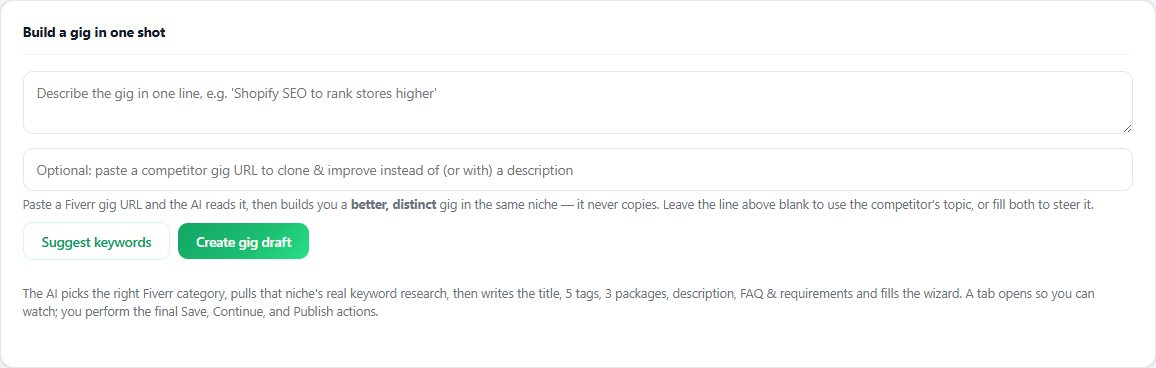
Seller OS is the workflow layer, not the AI. The Gig Builder can start from a one-line idea or a competitor URL and produce a structured gig draft with title, keywords, tags, description, and packages, then fill the Fiverr wizard while you complete Save and Continue. The Gig Performance Optimizer reviews a live gig's copy, gallery, and conversion signals against that gig's own performance data and proposes changes.
AI steps run through your own provider account or an eligible browser session; the plans do not include AI credits. Every output is a draft that waits for your review, and gig and client data stays in Chrome local storage rather than on a server.
Best AI Tools for Fiverr Gig SEO questions
What is the best AI tool for Fiverr gig SEO?
There is no single best tool, because gig SEO splits into different jobs: keyword expansion, field variants, description drafts, and gallery concepts. Judge each option on three things: whether it works from your gig and buyer language, whether it respects Fiverr's published field limits, and whether it stops at a draft you review before anything is published.
Can AI find the best keywords for my Fiverr gig?
AI is good at expanding and clustering phrases you already have; it cannot measure demand, because Fiverr's internal search data is not public. Verify candidates against autocomplete, the titles and tags of top gigs in your subcategory, and your own inbox language. Marketplace keyword metrics, where Fiverr provides them, sit inside Seller Plus.
Is it safe to paste my Fiverr gig into an AI tool?
Your own gig copy is far less sensitive than client material, but check the provider's data terms first and keep buyer names, order files, and private briefs out of every prompt. Rewrite what you need in your own words instead of pasting it. Treat the output as untrusted until you verify the facts.
Do AI tools guarantee better Fiverr rankings?
No tool can guarantee a ranking. Fiverr publishes search guidance but no formula that converts field text into positions, and its own pages checked in September 2026 do not promise rankings for any tool. What AI can improve is the language you test and the speed of your review; the measurement discipline stays yours.
Pick the job, then pick the tool
Choose by workflow, verify every candidate against real buyer language, and publish only what you can stand behind.