 Seller OS
Fiverr SEO for digital marketers
Digital marketing covers paid search, paid social, email, funnels, analytics, and more, which is exactly why the phrase converts poorly as a gig title. Buyers rarely shop for an umbrella. They shop for the person who runs their Google Ads account, builds their email sequence, or plans a launch campaign.
This guide shows how to specialize far enough to be found, which channel-qualified phrases buyers type, and how to separate a campaign plan from the execution of it. The limit to name up front: one broad gig cannot compete with a specialist in every channel at once.
Free plan available. Local-first data. Human review on every change.
The umbrella phrase cannot rank for you
Search results for digital marketing fill with agencies, full-service studios, and sellers who do a little of everything. That field is expensive to enter and hard to win, because the buyer behind the phrase has not decided what they need yet. Broad phrases attract browsing, not ordering.
Specializing is not a downgrade; it is a match. A buyer searching for a Google Ads manager wants campaign structure, bidding habits, and reporting cadence, and a listing that mentions all three answers the query. If you also build automations, the AI automation page describes that separate specialization.
Channel-qualified phrases to test locally
Each row pairs a channel with the work or the outcome. Run the phrase in a private window, read the completions, and open the top gigs to see what they deliver before you commit a field. The examples below illustrate the pattern; they are not demand data.
Keep one primary phrase per gig. If you serve paid search and email, that is two gigs with two cards and two sets of samples, not one listing pretending the two services are interchangeable.
| Phrasing example | The work behind it | Field to try |
|---|---|---|
| google ads manager | Ongoing paid search builds and optimization | Title |
| facebook ads specialist | Creative testing and audience setup | Title |
| email marketing specialist | Sequences, campaigns, and list hygiene | Positive keyword |
| marketing strategy consultant | A written plan a team executes | Title |
| funnel building | The path from ad click to purchase | Positive keyword |
| launch campaign manager | A dated campaign with named deliverables | Description |
A campaign plan and its execution diverge
Two buyers hide inside the same channel phrase. One has an in-house team and wants direction: messaging, channel mix, a calendar, a measurement frame. The other has no capacity and wants hands: campaigns built, monitored, and reported. Name which one your gig serves before the order starts.
The plan offer has a finite deliverable, which makes it easy to scope and easy to review. Execution runs over time, so it suits subscriptions or a clearly bounded first month. Blurring the two is how a strategy buyer ends up asking why you have not touched their ad account yet.
One question tells you which offer fits: ask who presses the buttons. If the buyer has a team that implements, sell the plan. If nobody internally can run the work, sell execution or a first managed month. Saying that out loud builds more trust than stretching a single listing to cover both, and it keeps scope questions from arriving after payment.
Proof structure for marketing work
Dashboards make tempting proof and dangerous proof, because a graph without a baseline explains nothing. Present the starting point, the window, and your exact role, and redact anything the client has not cleared in writing. A modest, contextual result reads as competence; a floating percentage reads as a red flag.
Process artifacts often work harder than metrics. An ad copy matrix, a campaign calendar, a funnel map, or a welcome sequence outline shows how you think before results exist, which matters for gigs without a long history.
- Baseline, window, and role next to every number
- Redact client names and account identifiers
- Show the artifact when the metric belongs to someone else
Titles and a ladder for one channel
After the I will prefix, the title carries the channel, the outcome, and the shape of the engagement. Fiverr's gig creation help allows up to 1,200 characters in the description, which is where channel detail, tools, and reporting cadence belong rather than in a title that is trying to say everything.
| Tier | Scope example | Delivery example | Revisions |
|---|---|---|---|
| Basic | Channel audit and one-page plan | 3 days | 1 |
| Standard | Plan plus campaign setup | 7 days | 2 |
| Premium | Plan, build, and first month managed | 14 days | 2 |
- I will manage your Google Ads campaigns for lead generation — channel plus outcome
- I will build a launch campaign plan for your product — planning offer, stated plainly
- I will write and set up an email welcome sequence — execution with a named deliverable
- I will audit your funnel and map the drop-off points — diagnosis as the product
Set the measurement frame first
A channel engagement needs a success definition before it needs a budget. Decide with the buyer what the work is for: leads at a workable cost, sales from a specific audience, signups, or steady publishing while a launch builds. The definition decides which numbers appear in the report and which ones are noise.
Then agree where those numbers come from, because platforms each count differently and last-click views can flatter a channel. State what you will report, how often, and what you need from the buyer's side to read the account accurately. Measurement drift is the quiet reason marketing relationships end.
Digital marketing SEO mistakes to avoid
Claiming every channel is the first one. A card that lists SEO, ads, email, and social signals a generalist, and the buyers who value specialists scroll on. The second is borrowed results: an agency's case study or a client's dashboard presented as your own ends the relationship when the client notices, and clients compare notes.
The third is pricing strategy like execution. A plan is sold once and reviewed once; a managed channel consumes hours every week, and pricing the two the same way trains buyers to expect running work at planning prices. The neighboring pages help you route the work: SEO specialists, social media managers, and the mechanics of ranking a gig.
Where Seller OS helps
Seller OS keeps a campaign seller's context in one place. Client records hold each account's goals, channels, cadence, and order history locally in Chrome, so a returning buyer does not have to repeat the brief before you quote the next month of work.
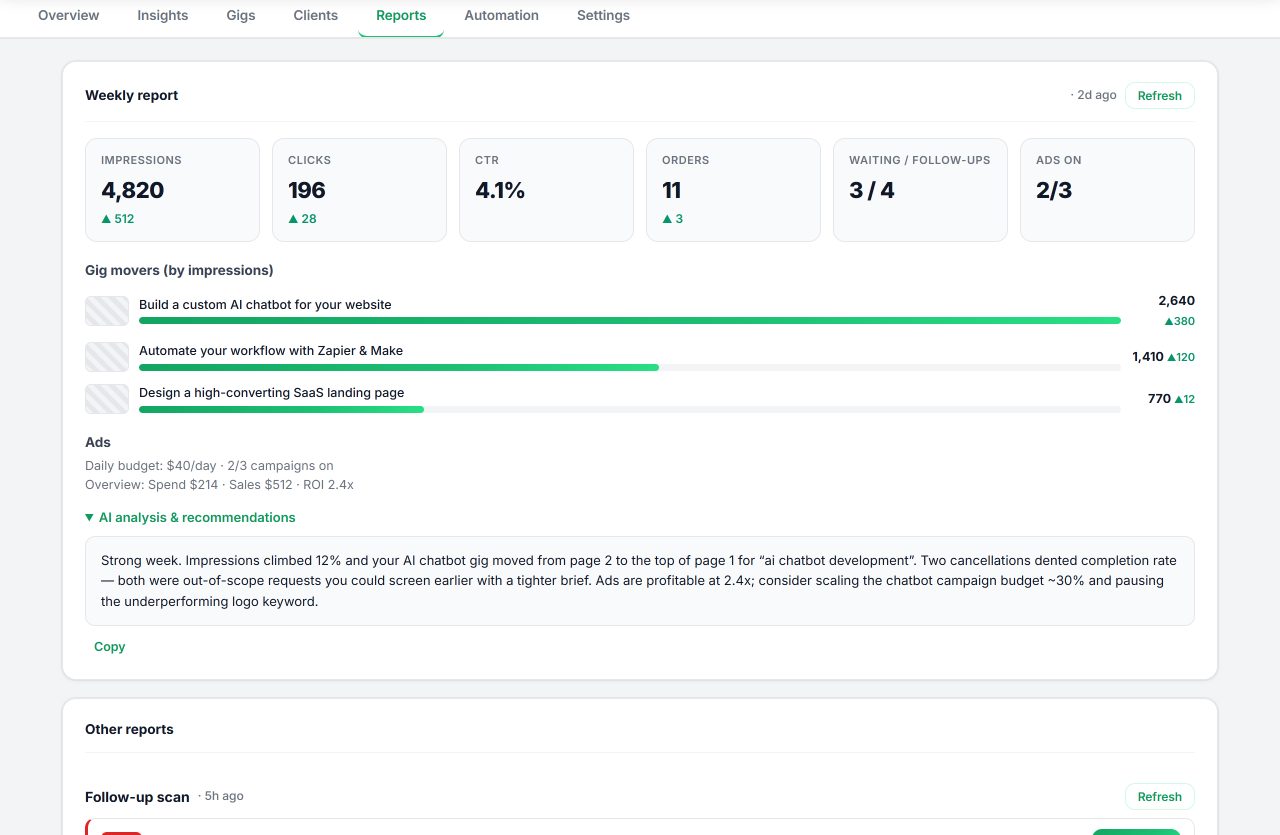
The reports view and action queue summarize what moved across your gigs and clients, and the Gig Builder drafts a channel-qualified listing from a one-line idea when you decide to split a broad gig into two. It organizes and drafts; nothing runs campaigns, spends budget, or publishes anything for you.
Fiverr SEO for Digital Marketers questions
Should I niche down as a digital marketer on Fiverr?
Yes, far enough to be findable. Pick one channel where you have proof, like paid search for local services or email for ecommerce stores, and give it its own gig. A broad listing competes with agencies and matches no specific search. You can widen later from a position of strength.
How do I choose which marketing channel to specialize in?
Choose the channel where you already have repeatable results and can explain your method out loud. Then check whether buyers search for it as a phrase: run it in a private window and read the top gigs. If the listings promise what you deliver, the channel has a market on the platform.
Can I sell a marketing plan without running the campaigns?
Yes, and it is a clean offer. A plan has a defined deliverable, a fixed window, and no access to client accounts, which removes most scope risk. Say clearly in the description what implementers receive and what you do not do, so the boundary is visible before the order rather than after it.
How do I prove results on a marketing gig?
Attach context to every number: the baseline, the window, and your role. Redact anything the client has not cleared. When metrics are thin, show artifacts instead, such as a campaign calendar, an ad copy matrix, or a funnel map. Process proof is legitimate proof, and it exists before results arrive.
Pick the channel, name the outcome
Split the broad gig, lead with one channel phrase, and let a specific promise do the selling.