 Seller OS
Fiverr vs Upwork for beginners in 2026
Fiverr and Upwork sell freelance work in opposite ways. On Fiverr you publish gig listings and buyers come to you through search; on Upwork you write proposals and bid for jobs clients post. That single difference shapes everything a beginner experiences: how fast the first payment arrives, what daily effort looks like, and which skills get traction first.
This pillar comparison walks through the selling model, the path to first payment, the fee shape, and which skills suit each platform, attributing platform facts to each platform's own published pages. A companion page compares fees side by side with worked take-home math.
Free plan available. Local-first data. Human review on every change.
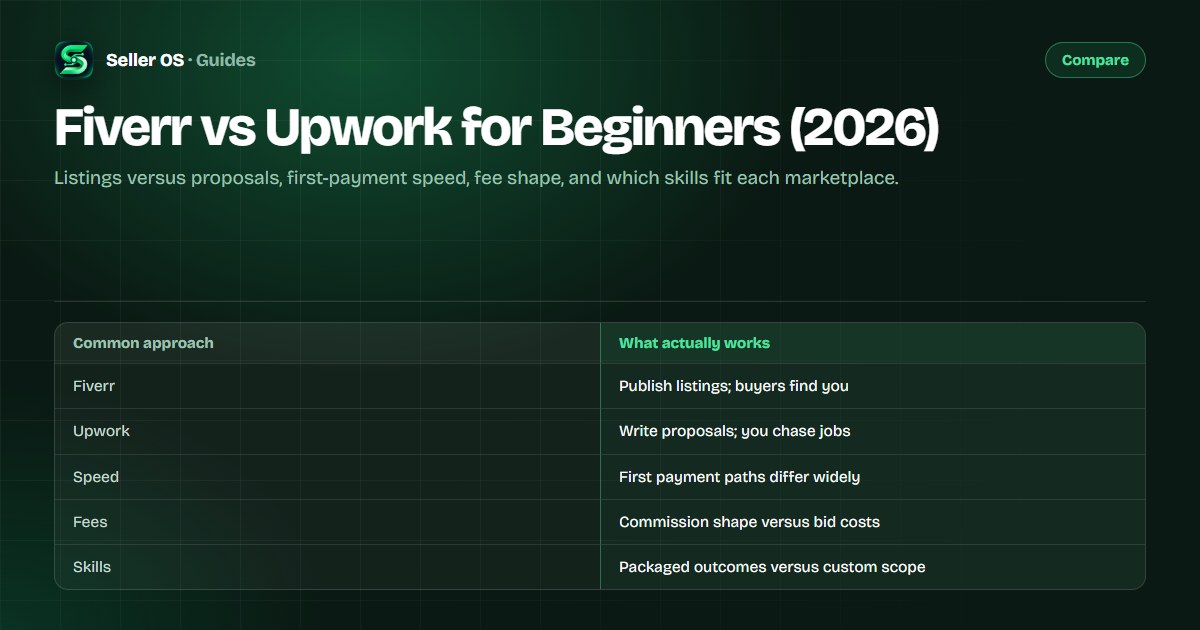
How each platform sells work
On Fiverr the unit of sale is the gig: a fixed listing with packages, prices, delivery times, and FAQs that buyers find through search and order directly. Fiverr describes this client flow in its Help Center guide to how Fiverr works. Your daily work as a seller is improving listings, answering inquiries, and delivering orders that arrive on their own.
On Upwork the unit of sale is the proposal: clients post jobs, freelancers apply with tailored pitches, and the client interviews before hiring. Your daily work is searching job feeds, writing applications, and attending calls. Beginners who enjoy packaging a repeatable outcome usually feel at home on Fiverr; beginners comfortable writing persuasive pitches and handling interviews often prefer Upwork's flow.
| Question | Fiverr | Upwork |
|---|---|---|
| What do you publish? | Gig listings with fixed packages | Profile plus tailored proposals |
| Who moves first? | Buyer searches and orders | Client posts; freelancer applies |
| Daily effort | Listing quality and delivery | Applications and interviews |
| Best for | Repeatable packaged outcomes | Custom scoped project work |
Time to first payment
On Fiverr the wait is search-driven. A new gig with no reviews sits deep in results, so the first order typically comes after days or weeks of improving the listing, sharing it where allowed, and answering every inquiry fast. The first-order guide covers that grind honestly. Once orders arrive, delivery and review cycles compound, and later sales come easier.
On Upwork the wait is application-driven. You can apply from day one, so first contact can arrive quickly, but each application costs time and proposal credits, and clients favor freelancers with history. Beginners often send many proposals before one converts. Neither path is instant; Fiverr rewards listing patience while Upwork rewards application volume and pitch quality.
- Fiverr: publish, refine the listing, respond fast, and wait for search to notice.
- Upwork: apply daily with tailored pitches and expect many rejections first.
- Both: the first review changes everything, so over-deliver on job one.
- Neither platform publishes a guaranteed timeline to first earnings.
Fee shape in plain terms
Fiverr's seller model is commission-based: Fiverr deducts a share of each order from the seller, a rate Fiverr states in its seller Help Center pages, so confirm the current figure there before quoting. Buyers also pay a service fee on top, which affects what prices they accept. There is no cost to browse or to keep a gig listed.
Upwork's cost shape has two parts: a freelancer marketplace fee taken from earnings, whose current rate Upwork publishes on its own pricing pages, plus the cost of submitting proposals through its credits system. Check both current numbers on Upwork's published pages before comparing, because credit costs and fee tiers change. The detailed fee comparison works through take-home math on identical jobs.
Which platform suits which skill
Skills with repeatable, well-defined outcomes favor Fiverr: logo packages, video edits of fixed length, data cleaning with clear inputs, resume rewrites, and translation per word count. If you can describe the deliverable, price, and turnaround in one listing, Fiverr's search does your prospecting while you sleep.
Skills with custom, discovery-heavy scope favor Upwork: ongoing development, long-form strategy, complex integrations, and retainer-style support where each engagement needs scoping calls first. If every job starts with questions rather than answers, proposal-based selling fits better. Many sellers eventually run both, keeping packaged work on Fiverr and custom work on Upwork, as the together playbook describes.
- Fiverr-leaning: fixed deliverables with countable inputs and clear turnaround.
- Upwork-leaning: custom scope needing discovery calls and phased estimates.
- Either: writing, design, and admin work split by how packaged the offer is.
- Reconsider: if you cannot name the deliverable, neither listing nor proposal will convert.
A decision path for your first month
Start where your temperament and skill point, not where someone else's screenshot points. If you can package one outcome this week, publish it on Fiverr and spend the month improving it. If your work needs scoping conversations, build an Upwork profile and commit to a daily application habit. Judge after thirty days of real effort, not three days of hoping.
Whichever you choose, read the broader verdict on whether the marketplace still rewards new sellers in the 2026 worth-it assessment, which sets expectations without promising outcomes.
Package test
write the deliverable, price, and turnaround in one paragraph; if you can, start on Fiverr
Pitch test
write a sample proposal for a real posted job; if that felt natural, start on Upwork
Thirty-day commit
one platform, daily effort, tracked applications or listing tweaks
Review
first review or first interviews decide whether to double down or add the second platform
Where Seller OS helps
Seller OS is built for the Fiverr side of this decision. If you start on Fiverr, the gig builder drafts packages and requirements from your offer, the optimizer reviews the live listing against its own performance data, and monitors watch for changes while you focus on delivery.
If you start on Upwork instead, nothing here pushes you back; the extension simply waits. It never touches either marketplace on its own, never messages buyers, and never publishes listings. Everything it drafts stays local for your review, and a person completes every publishing action.
Fiverr vs Upwork for Beginners questions
Should a beginner start on Fiverr or Upwork?
Start on Fiverr if you can package one fixed outcome with a price and turnaround this week, since search then prospects for you. Start on Upwork if your work needs discovery calls and custom scoping, and you can commit to daily tailored applications. Judge after thirty days of genuine effort on one platform.
Which platform pays a beginner faster?
Neither is fast by default. Fiverr first orders wait on search visibility and often take weeks of listing refinement, while Upwork first hires wait on proposal volume and often take many applications. The first review accelerates both paths, so over-deliver on the first job wherever it lands.
Can I use Fiverr and Upwork at the same time?
Yes, many sellers run both once one platform produces steady work. A common split keeps packaged, repeatable offers on Fiverr and custom, discovery-heavy work on Upwork. Start with one for your first month so your effort stays focused, then add the second deliberately rather than splitting attention from day one.
Do fees decide which platform is better for beginners?
Rarely on their own. Fiverr takes a published commission per order while Upwork combines a marketplace fee with proposal credit costs, but take-home differences matter less than where you can actually win work. Compare effective earnings on identical jobs in the fee comparison, then choose by selling model fit.
Pick the model that fits your work.
Packaged outcomes start on Fiverr; custom scope starts with proposals.