 Seller OS
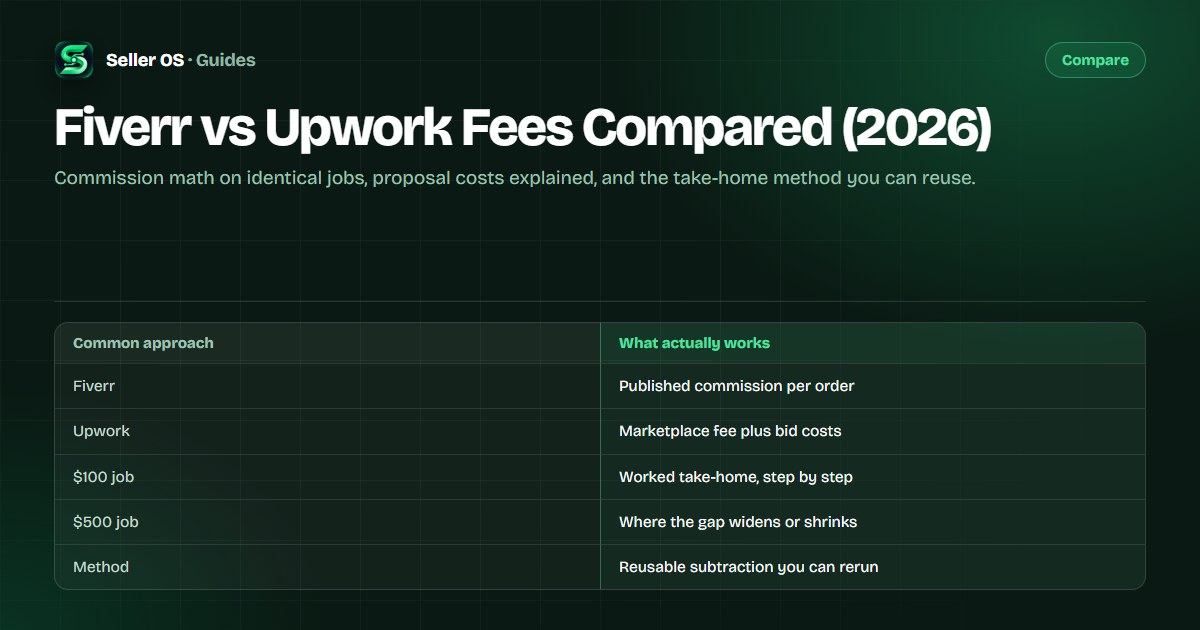
Fiverr vs Upwork fees compared for 2026
Fee arguments between Fiverr and Upwork usually compare the wrong numbers: one platform's commission against the other's headline rate, while bid costs, buyer-side fees, and withdrawal charges sit quietly offstage. A fair comparison subtracts every cost on both sides from the same job value and looks at what reaches the seller.
This page does that subtraction step by step, with Fiverr rates attributed to Fiverr's own Help Center pages and Upwork mechanics described as Upwork publishes them. All worked figures are illustrative examples to teach the method, not promises of your earnings. The beginner-level platform comparison covers which selling model fits you.
Free plan available. Local-first data. Human review on every change.
The two fee structures side by side
Fiverr charges sellers a commission on each order, a rate Fiverr states in its seller Help Center pages and which you should confirm there before quoting, since published rates can change. Buyers pay a separate service fee on top of the order price, so the buyer experiences a higher total than your listed package. Sellers face no charge to list gigs or browse; costs arrive only when orders do.
Upwork charges freelancers a marketplace fee on earnings, at whatever rate Upwork currently publishes on its pricing pages, and separately charges for submitting proposals through its credits system. That means Upwork costs you money before you earn anything, while Fiverr costs you nothing until an order lands. The table below keeps both structures visible so the worked examples make sense.
| Cost point | Fiverr | Upwork |
|---|---|---|
| Seller commission | Published share per order, per Help Center | Published marketplace fee on earnings |
| Cost before earning | None; listings are free | Proposal credits cost per application |
| Buyer-side fee | Service fee added to order total | Client marketplace fee on some contracts |
| Withdrawal | Method-dependent charges may apply | Method-dependent charges may apply |
Worked example: a $100 job
Take a $100 order on Fiverr. Subtract Fiverr's published seller commission from the $100 first; the remainder is your pre-withdrawal earnings, before any payment-method charges your withdrawal route adds. Because the commission is proportional, the arithmetic is one multiplication and one subtraction, which is why the fee calculator can estimate it instantly. Run your own numbers there with the current published rate.
Now take a $100 contract on Upwork. Subtract Upwork's currently published marketplace fee from the $100, then subtract the credit cost of the proposals you sent to win it, spread across your win rate: if winning one job takes ten applications, each job carries the cost of ten. Beginners with low win rates carry the heaviest per-job bid cost, which is the number most comparisons leave out.
- Fiverr $100: order value minus the published commission equals pre-withdrawal earnings.
- Upwork $100: contract value minus the marketplace fee minus your per-win proposal cost.
- Per-win bid cost equals applications sent times credit cost, divided by jobs won.
- Withdrawal charges apply on either platform depending on your payout method.
Worked example: a $500 job
Scale both to $500 and the shapes diverge. On Fiverr the commission scales proportionally, so the take-home is the same fraction as the $100 case, just larger in absolute terms. A $500 Fiverr order therefore keeps its arithmetic simple: one rate, one subtraction, one remainder to compare.
On Upwork the $500 case improves the bid-cost ratio, because the same proposal spend that won the job now spreads over five times the value. This is why experienced Upwork freelancers with strong win rates and larger contracts report thinner effective fee drag than beginners chasing small jobs. Deal size and win rate, not the headline rate alone, decide which column wins at $500.
| Factor | $100 job | $500 job |
|---|---|---|
| Fiverr commission drag | Proportional, same fraction | Proportional, same fraction |
| Upwork bid-cost drag | Heavy for low win rates | Spread thin over larger value |
| Deciding factor | Win rate and credit costs | Contract size and repeat work |
| Repeat-client effect | Same math every order | Proposals stop; fee math improves |
Proposal costs versus gig extras
Upwork proposal credits are a prospecting cost Fiverr sellers never pay: every application spends credits whether or not the client replies. Track applications per win monthly and multiply by the current credit price to get your real customer-acquisition cost. If that monthly total exceeds the commission gap on your typical job, Fiverr's model is cheaper for you regardless of headline rates.
Fiverr's counterpart is not a fee at all but gig extras: add-ons like faster delivery, source files, or additional revisions that raise order value without raising acquisition cost, since the buyer was already on your page. Extras widen the Fiverr column from the revenue side while proposals narrow the Upwork column from the cost side. Price extras deliberately instead of treating them as decoration.
Which platform keeps more of your earnings
For small one-off jobs won after many applications, Fiverr usually keeps less in practice, because proportional commission beats a marketplace fee plus heavy bid spend. For large contracts with established clients where proposals have stopped, Upwork's shape can win, since no further acquisition cost accrues. Your win rate, average contract size, and repeat-client share decide the answer more than either published rate.
Rerun the subtraction quarterly with current published rates from both platforms, your actual applications per win, and your real average job value. The beginner comparison helps you weigh the selling model alongside the math, and the fee explainer details Fiverr's side alone.
Collect
note both platforms' current published rates and your last month of applications per win
Subtract
run the $100 and $500 math above with your own figures, including withdrawal charges
Weigh
add the selling-model fit: packaged work favors Fiverr, custom scope favors proposals
Repeat
rerun quarterly, because rates, credit prices, and your win rate all move
Where Seller OS helps
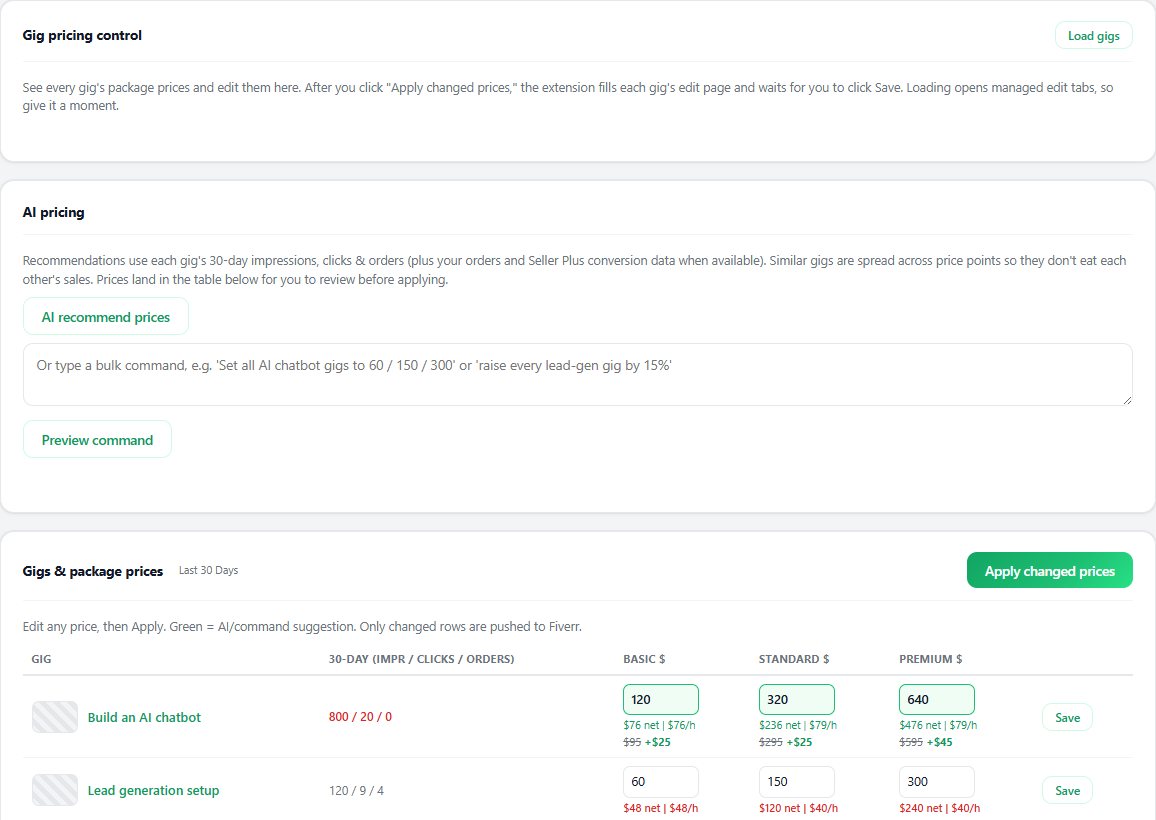
Seller OS helps on the Fiverr side of this math. The fee calculator route estimates take-home on any package price instantly, and the gig optimizer reviews whether your extras and tiers actually lift order value or just decorate the page.
The extension never moves money, never withdraws earnings, and never touches either marketplace account. It drafts and estimates locally for your review, keeps records in Chrome local storage, and leaves every financial decision and every Publish click to you.
Fiverr vs Upwork Fees Compared questions
Which has lower fees, Fiverr or Upwork?
It depends on job size and win rate. Fiverr takes a published commission per order with no upfront cost, while Upwork combines a marketplace fee with proposal credit costs. Small jobs won after many applications usually cost more on Upwork; large repeat contracts can favor Upwork once proposal spending stops.
How much does Fiverr take from a $100 order?
Subtract Fiverr's currently published seller commission, which Fiverr states in its seller Help Center pages, from the order value; the remainder is your pre-withdrawal earnings. Confirm the current rate before quoting, since published rates can change, and use the fee calculator route for an instant estimate.
What do Upwork proposal credits cost a beginner?
Every application spends credits whether the client replies or not, so your real cost is applications sent times the credit price, divided by jobs won. Beginners with low win rates carry the heaviest per-job cost. Check Upwork's published credit pricing and track your monthly applications per win.
Do Fiverr gig extras change the fee comparison?
Yes, from the revenue side. Extras like faster delivery or source files raise order value without acquisition cost, since the buyer is already on your page. Well-priced extras widen Fiverr take-home against Upwork's bid-cost drag. Treat extras as deliberate revenue design, not decoration.
Subtract everything, then decide.
Run both columns on your own numbers before choosing a platform.