 Seller OS
How Fiverr levels are calculated in 2026
Fiverr levels are not a mystery, but they are not a formula you can compute either. Fiverr publishes the six metrics that decide your level, the thresholds for each level, and the rules for moving up, down, and into a grace period. What it does not publish is the Success Score formula sitting inside those rules.
This guide walks through the mechanics as published in 2026: the six metrics, the current thresholds, how evaluations and grace periods work, and the parts of the system that circulate online without an official source.
Free plan available. Local-first data. Human review on every change.
The six metrics that decide your level
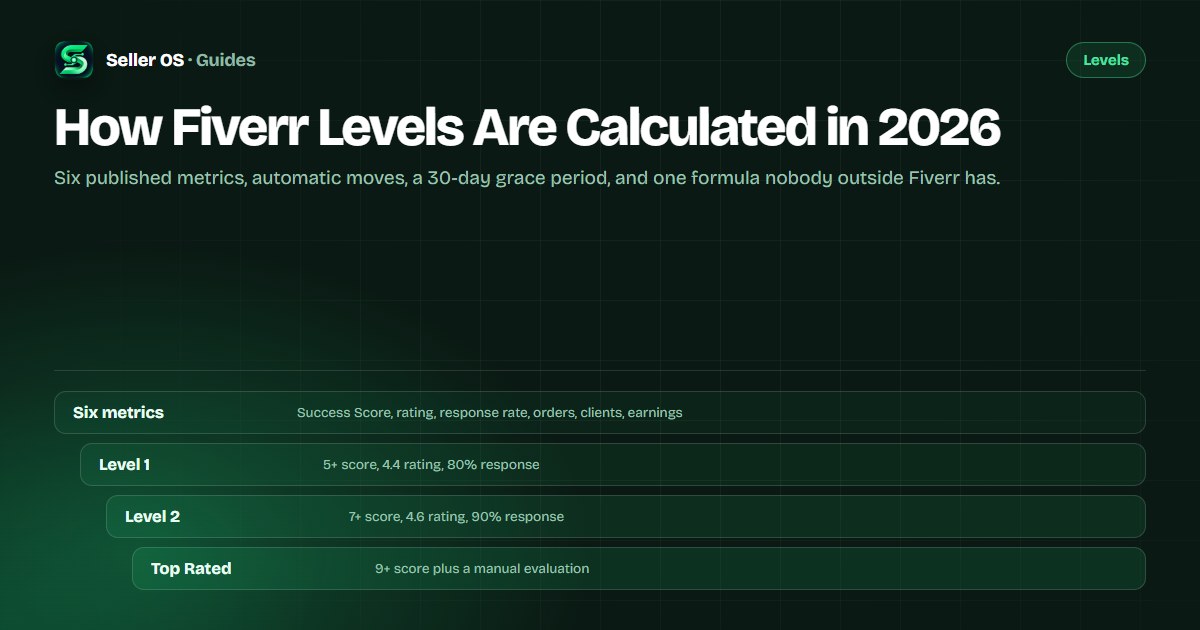
Fiverr's Help Center describes a level system that tracks your progress across key metrics and automatically assigns you a level. Six metrics decide it: Success Score, rating, response rate, orders, unique clients, and earnings. Level 1 and Level 2 advance automatically once you meet all six criteria; Top Rated also requires a manual evaluation to confirm eligibility.
Two measurement windows are published for individual metrics. Rating looks at the past two years, and response rate looks at the last 90 days. Fiverr does not publish equivalent windows for orders, unique clients, earnings, or the Success Score, and the score's formula is not public either. Anyone quoting exact weights is guessing.
Benefits follow the badges rather than the other way around. Subscriptions and Fiverr Ads unlock at Level 1, Seller Plus Standard is available from Level 1 and Premium from Level 2, and Top Rated adds early payout and priority support. Fiverr Pro is a separate vetted designation that does not replace your level badge.
The current published thresholds
As of September 2026, Fiverr's published criteria table lists the numbers below. Every one of the six metrics must be met for a level; there is no averaging and no partial credit. Treat the table as the baseline and always compare it against the Level Overview page in your own account, because Fiverr updates its pages from time to time.
Read the orders, unique clients, and earnings columns as a package: they are three separate metrics, not one blended volume target. A seller with plenty of orders but few unique clients can miss Level 2 just as easily as a seller with low earnings.
| Level | Success Score | Rating | Response rate | Orders · clients · earnings |
|---|---|---|---|---|
| Level 1 | 5+ | 4.4+ | 80% | 5 · 3 · $400 |
| Level 2 | 7+ | 4.6+ | 90% | 20 · 10 · $2,000 |
| Top Rated | 9+ | 4.7+ | 90% | 40 · 20 · $10,000, plus manual review |
How evaluation and the grace period work
The system is not a once-a-year exam. Fiverr states your level may change at any time due to periodic evaluations, and that once you qualify for Level 1 or Level 2 you move up automatically within 24 hours. Top Rated is the exception on both ends: it adds a manual evaluation before the badge appears.
If your performance drops below the criteria for your current level, you enter a 30-day grace period. The grace period is time to bring the failing metric back over the line, not a deadline to rewrite every gig you own. Fiverr also states that if your Success Score drops to a critically low level, the account is labeled low performance and visibility is affected, so a grace period is worth using immediately rather than watching.
One more published detail answers a common worry directly: Fiverr's FAQ states that it is easier to move up and more difficult to be moved down. Read that as permission to build slowly, because a level you grow into with steady metrics is less fragile than one you sprint toward in a single busy month.
“Yes, it is easier to move up and more difficult to be moved down.”
— Fiverr's Help Center, Understanding Fiverr's freelancer levels, September 2026
What is no longer part of level decisions
Fiverr's FAQ is explicit that seniority, days without warnings, order completion rate, and on-time deliveries are no longer directly related to your level status. They still matter operationally, because cancellations and late deliveries feed areas of the Success Score, but they are not separate gates in the criteria table any more.
Pro and Agency freelancers are evaluated on the same six metrics as everyone else. Becoming a Fiverr Pro does not directly alter your seller level, and the Pro badge does not exclude or replace any existing level badge. If you are weighing Pro, do it for the client mix and positioning, not as a level shortcut.
This distinction matters because old advice still tells sellers to protect order completion rate as if it were a level metric. Protect it anyway where it touches the score areas, but plan your level progress around the six published metrics.
Worked example: checking your own thresholds
Suppose you are at Level 1 and want Level 2. Read each of the six numbers on your Level Overview page and mark it against the published table. The point of the exercise is to find the one row that fails, because that row is the only thing a level evaluation can act on. Five passing rows buy you nothing if the sixth stays below its line.
Here is what a Level 2 check looks like row by row. If all six pass and nothing changes, the automatic move happens within 24 hours of qualification; if exactly one fails, the plan is that one row and nothing else.
- Success Score — 7 or higher overall; expand Scores by Gig to see which areas drag the number
- Rating — 4.6 or higher, measured over the past two years
- Response rate — 90% or higher, measured over the last 90 days
- Orders — 20, as Fiverr counts them for leveling
- Unique clients — 10 distinct buyers, per the published table
- Earnings — $2,000 or more, per the published table
What changed, and what was never announced
The current six-metric system came out of Fiverr's Winter Product Release in January 2024, which introduced the new ratings, reviews, and leveling system. Fiverr's rollout page described the change as private in mid-February and fully effective in mid-March 2024. As of September 2026, no newer official level-system overhaul has been published, so the 2024 system is the one to plan around.
This is where most confusion enters. Third-party guides circulate active-days requirements, usually 60, 120, or 180 days, that do not appear in Fiverr's published criteria table or FAQ. If a requirement is not on Fiverr's own pages, do not schedule your work around it, and do not assume a demotion is coming because a blog post counted days.
The same caution applies to change rumors. No dated change log exists for the criteria table, and any claim of a 2025 or 2026 leveling overhaul lacks an official source. When in doubt, the Level Overview page and the Help Center table are the two things to trust.
Mistakes to avoid between evaluations
The most common mistake is gaming a single number. Taking on cheap orders to push earnings over a threshold can hurt the Success Score areas if the work is rushed or the buyers are mismatched, and every metric must pass at once. The second mistake is treating the table as permanent when Fiverr's own FAQ reminds sellers that levels may change at any time due to periodic evaluations.
The third is ignoring a grace period message. Thirty days is enough to fix one metric if you start immediately. A seller who sits at 87% response rate, for example, can cross the 90% line by answering the next several first replies inside 24 hours, since the metric counts first responses over the last 90 days.
The fourth is copying another seller's plan without checking your own board. The metric that fails for you is the only one worth engineering; the rest are maintenance you should protect while you work on it.
Where Seller OS helps
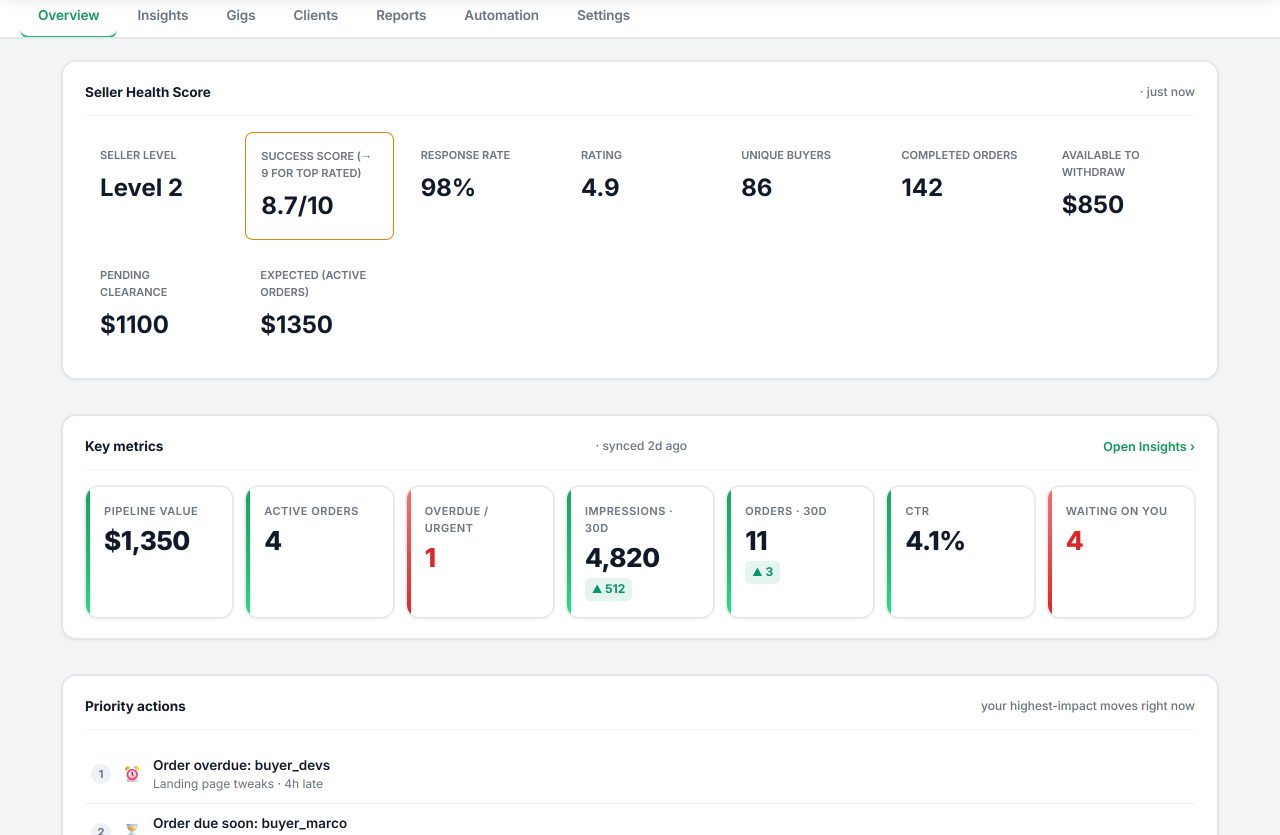
Level evaluation arrives on Fiverr's schedule, not yours, so the value is in knowing what your numbers look like before it does. Seller OS keeps a local, visible record of your orders, client history, and tracked gig performance, and the overview consolidates the signals that feed the six published metrics into one place.
On Pro, the Success Score guardian watch and the deadline guard run while Chrome is open, so the areas and deadlines behind your score surface before an evaluation does. It records and flags; it does not edit gigs or promise a level. You make every decision, and your data never leaves Chrome local storage.
How Fiverr Levels Are Calculated in 2026 questions
Does Fiverr still use the same level system in 2026?
As far as Fiverr's published pages show, yes. The six-metric system introduced in the 2024 rollout is still the one described on Fiverr's Help Center in September 2026: Success Score, rating, response rate, orders, unique clients, and earnings. No newer official overhaul has been published, so claims about a 2025 or 2026 change have no official source.
How often are Fiverr levels evaluated?
Fiverr does not publish an evaluation schedule. The Help Center says your level may change at any time due to periodic evaluations, and that once you meet all six criteria for Level 1 or Level 2 you move up automatically within 24 hours. Top Rated requires a manual evaluation on top of the metrics.
What happens if my metrics drop below my level?
You enter a 30-day grace period, per Fiverr's published rule, and the time is meant for bringing the failing metric back above its threshold. If your metrics fall below the criteria for Level 1, Fiverr states you move to Level 0. Levels can also change at any time through periodic evaluations.
Is the Success Score formula public?
No. Fiverr publishes the six areas the score evaluates plus a few calculation notes: a longer time period, more weight for gigs with more orders, and scoring relative to freelancers in your price range. The formula, the weights, and the mapping to the 1 to 10 scale are not published, so treat exact-weight claims as unofficial.
Know which row you need to fix
Check your six metrics against Fiverr's published table, then work the one row that fails.