 Seller OS
Fiverr AI Video Hub: what video sellers should do
Fiverr launched the AI Video Hub on March 23, 2026, a dedicated showcase where brands commission commercials, social content, and brand films from a curated roster of AI video directors. It sits at fiverr.com/ai-video, and brands submit their details for the team to respond. As checked October 2026, no self-serve seller application path is published.
This guide covers what the hub sells, what it means for video and editing sellers, and how to repackage deliverables so your gigs compete on craft instead of clip generation. It does not repeat our video SEO walkthroughs; those are linked instead.
Free plan available. Local-first data. Human review on every change.
What the AI Video Hub actually is
Fiverr's March 23, 2026 press release describes the hub as a curated roster of top AI video directors that brands can commission for commercials, social content, and brand films. The page groups work into categories including advertisements, short films, cartoons, animations, music video, movie trailers, UGC content, gaming, and educational content. Brands submit their details and Fiverr's team responds; there is no public price list on the page.
The launch also cited Fiverr's own Business Trends Index, which showed searches for AI video creation grew 66% in the second half of 2025. That figure is Fiverr's, from its press release, and it explains the hub's existence: demand is moving toward AI-assisted production, and Fiverr built a hand-picked storefront for it rather than a generic gig category.
Who can appear in the hub
The page found, checked October 2026, names directors already in the roster and routes brands to a submission form with a production-team contact address. It publishes no application flow for sellers, no vetting criteria, no commission terms, and no pricing. Fiverr has published nothing that lets any seller sign up, so treat forum claims about joining as unconfirmed.
That matters for planning. The hub is a curated showcase in the same spirit as Fiverr Pro, not a listing you can toggle on. If your goal is appearing there, the realistic question is what body of work would make a curation team notice you, and that answer lives in your portfolio and category reputation, not in a form you can fill today.
- No self-serve seller application is published on the hub page.
- No pricing, commission, or vetting details are published.
- Brands submit details; Fiverr's team responds.
- Named directors in the launch were presented as a curated roster.
- Do not assume any seller can join on request.
What buyers are being sold
Buyers land on commissioned work: a brief in, a finished piece out, produced by a director working with AI tools. The categories are deliverable-shaped, from UGC content to movie trailers, which tells you the buyer's frame. They are purchasing a result with a name attached, not renting editing hours.
Read that against what most video gigs sell. A gig priced per minute of finished edit competes in a different conversation than a commission for a brand film. The buyer choosing the hub wants speed, a point of view, and a finished asset; the buyer choosing your gig usually wants control over the edit, brand consistency, and a person they can message at 9 p.m. before a launch.
An illustrative example (not platform data): a footwear brand wants a 45-second launch film. Through the hub they are commissioning a director's take; through your Gig they are buying a structured process: brief intake, edit rounds, licensed sound check, and delivery in six aspect ratios. Same deliverable category, two entirely different risk calculations for the buyer.
Commodity clips versus brand-safe work
Here is an illustrative scenario (not platform data): a supplements brand needs fifteen short clips for a product launch. One path is generating them from templates in an afternoon; the other is hiring an editor who scripts hooks, cuts to the brand's existing footage, checks claims language, and delivers platform-specific aspect ratios with captions. The first path is cheap and fast; the second survives a legal review.
The sellers at risk are the ones whose entire offer is raw clip generation, because generation is exactly what buyers can attempt themselves. The sellers who hold ground sell the surrounding work: scripting, brand-safe editing, story structure, motion graphics, sound cleanup, versioning for each platform, and a revision process. That is also where pricing power lives, and it is a repositioning of your existing skills, not a new career.
| Buyer need | Generation handles | Your gig should sell |
|---|---|---|
| Fifteen launch clips | First-pass visuals | Scripts, captions, brand checks |
| Weekly YouTube edits | Rough assembly | Pacing, retention, thumbnails |
| Brand film | Mood drafts | Story, direction, final delivery |
Repackage your video deliverables
A common mistake is responding to a new AI surface by renaming your gig and changing nothing else. Buyers cannot see your process from a title. Rewrite the description so each stage is named: discovery questions, script or shot list, first cut, revision rounds, caption and format variants, and the final file bundle with the formats each platform wants.
Then make the proof visible. Put before-and-after frames in the gallery, state turnaround per version, and name the constraints you work under, such as brand guidelines or claim restrictions. Buyers comparing you against a generator are really comparing risk; your job is to make the risk difference obvious before they read the price.
Rename stages
script, first cut, revisions, platform variants
Show proof
before-and-after frames and real turnaround times
State constraints
brand rules, captions, aspect ratios, sound
Refresh the gallery
one project, start to finish, as a sequence
Where the demand signals are
If you sell video editing, the demand picture is wider than the hub. Buyers search in different language for different deliverables: YouTube editing, short-form edits, product demo videos, wedding films, and course captions each behave like their own sub-market with its own expectations. The hub covers commissioned AI productions; your category demand still runs through ordinary search and buyer requests.
For the keyword and title side of that work, use the category walkthroughs instead of re-deriving them here: video editors on Fiverr, YouTube editors on Fiverr, and learning short-form editing. Our AI survival guide covers the wider shift, and how Fiverr Go works covers the adjacent creation-model product.
Where Seller OS helps
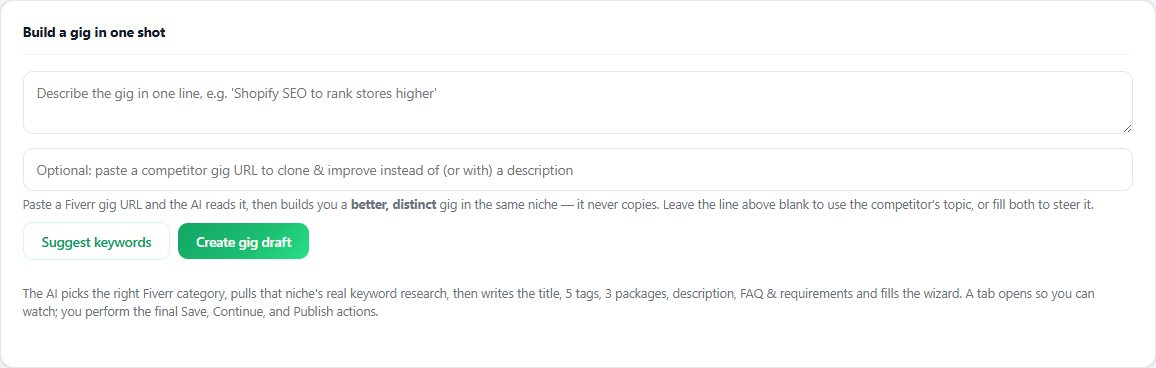
Seller OS is built for the repositioning work above. The Gig Builder drafts a structured gig from a one-line idea or a competitor URL, and the Gig Performance Optimizer reviews a live gig's copy and gallery against that gig's own performance data and proposes changes you decide on.
It drafts and fills; a person performs every final Send, Save, Continue, or Publish action. It does not generate video, edit footage, or apply to the AI Video Hub, and it cannot get you onto any curated roster.
Fiverr AI Video Hub questions
What is the Fiverr AI Video Hub?
Fiverr launched the AI Video Hub on March 23, 2026 as a dedicated showcase where brands commission commercials, social content, and brand films from a curated roster of AI video directors. Brands submit their details and Fiverr's team responds; the page covers categories from advertisements to UGC content, and no public price list appears on it.
Can sellers apply to join the AI Video Hub?
The hub page, checked October 2026, publishes no self-serve seller application path, no vetting criteria, and no commission terms. It routes brands to a submission form instead of sellers to an application. Treat any forum claim that sellers can sign up as unconfirmed until Fiverr publishes a route on its own pages.
Does the AI Video Hub mean video editing gigs are dead?
The hub sells commissioned productions from named directors; it does not replace demand for scripted, brand-safe editing work. Fiverr's press release cited its own index showing searches for AI video creation grew 66% in the second half of 2025, which describes demand for AI video, not the end of editing budgets. Deliverables built around process still sell.
How should video sellers compete with AI video tools?
Move the offer off raw clip generation and onto the work around it: scripting, brand-safe cuts, story structure, captions, platform versions, and a reliable revision cycle. Show that process in the description and gallery so a buyer can see the risk difference before comparing prices. Sellers whose only output is a first-pass clip are the most exposed.
Sell the process buyers cannot generate
Rewrite one video gig around scripting, revisions, and platform versions, then prove it in the gallery.