 Seller OS
Fiverr repeat business badge: how it works
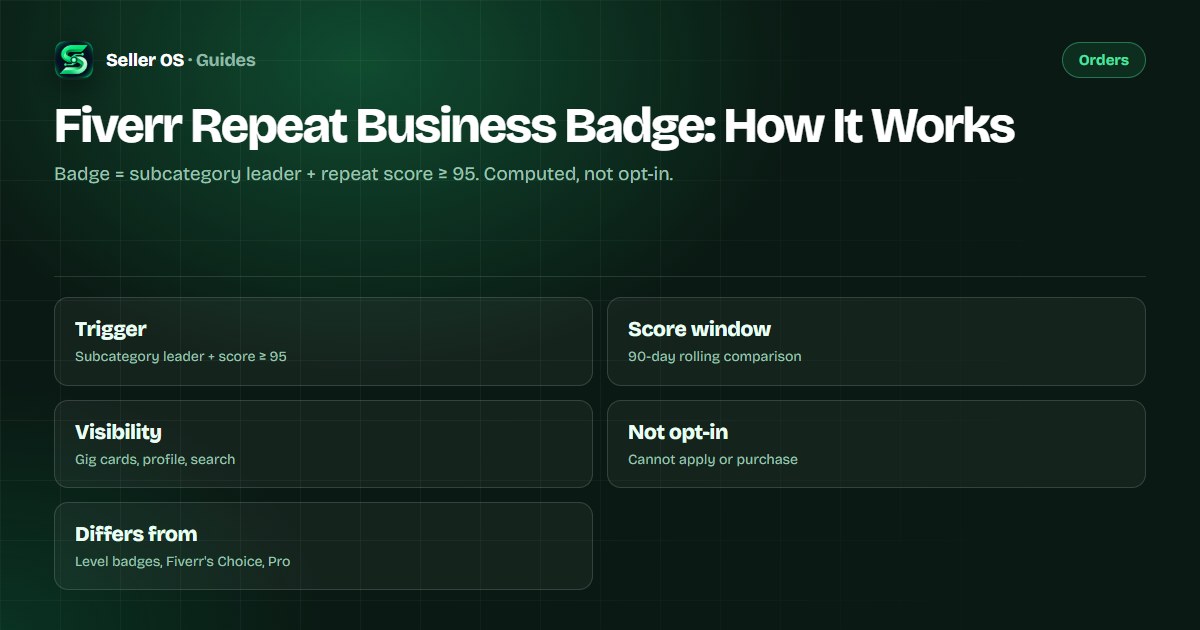
Fiverr's repeat business badge appears on gigs and profiles of freelancers who lead their subcategory and carry a repeat business score of 95 or above. The badge is computed by Fiverr — you cannot apply for it, buy it, or opt in. It signals to buyers that your clients come back, which is a stronger trust signal than a level badge alone.
This guide explains what the badge represents per Fiverr's published definition, how it differs from level badges and Fiverr's Choice, why buyers weigh it, and the honest levers — delivery quality, follow-up, re-engagement — that grow repeat work without gaming a metric you cannot directly control.
Free plan available. Local-first data. Human review on every change.
What the badge represents per Fiverr
Fiverr's help center defines the repeat business badge in one sentence: 'Freelancers leading their subcategories, and who have a repeat business score of 95 and above, will earn the repeat business badge.' The Repeat Business Score measures how your client retention compares to other freelancers in your subcategory over the last 90 days. The score updates weekly; the underlying factors update in real time.
A returning client is defined as an individual who has previously purchased your service and is now requesting to do so again. The client becomes a repeat buyer after an order completes, not when the order is created. The Number of Repeat Clients metric counts clients who have placed more than one order with you. These definitions come from Fiverr's analytics and repeat-business-score articles.
- Badge trigger: lead subcategory AND repeat business score ≥ 95.
- Score measures: your retention vs. subcategory peers over 90 days.
- Score updates: weekly; factors update in real time.
- Repeat client: purchased before, ordering again after completion.
- Not opt-in: no application, no purchase, no manual request.
How it differs from level badges and Fiverr's Choice
Level badges (New, Level 1, Level 2, Top Rated) track six metrics: Success Score, Rating, Response Rate, Orders, Unique Clients, Earnings. They reflect overall platform standing across all categories. The repeat business badge is subcategory-specific — you can lead in Logo Design but not in Brand Style Guides. Fiverr's Choice is awarded automatically based on quality signals like client feedback, order completion rate, and communication quality; its criteria are not published. The repeat business badge has a published threshold (score ≥ 95 + subcategory leadership).
A Top Rated freelancer may not have the repeat business badge if their subcategory is competitive and their retention score sits at 92. A Level 1 freelancer in a niche subcategory could earn the repeat business badge while still climbing toward Level 2. The badges measure different things: level = platform-wide performance; repeat business = retention dominance in a specific niche.
| Badge | Scope | Published threshold | Opt-in? |
|---|---|---|---|
| Level 1/2/Top Rated | Platform-wide | 6 metrics table | No (auto) |
| Fiverr's Choice | Per service | Not published | No (auto) |
| Repeat Business | Per subcategory | Score ≥ 95 + leader | No (auto) |
| Pro | Per freelancer | Vetted application | Yes (apply) |
Why buyers weigh the repeat business badge
Buyers see the badge on gig cards, gig pages, and your profile. It answers a specific question: 'Do this seller's clients come back?' A level badge says 'this seller performs well overall.' A repeat business badge says 'this seller's clients return for more.' For buyers planning ongoing work — monthly content, recurring design, retainer development — the repeat signal is more relevant than the level signal.
Fiverr's Orders Breakdown tab (Seller Plus) lists 'Repeat Business' as a traffic source. Orders from repeat clients tend to have higher conversion rates and lower friction because trust is already established. The badge makes that trust visible before the buyer messages you.
Honest levers that grow repeat work
You cannot directly set your repeat business score. You influence it through three levers. First, delivery quality: the work must meet or exceed the brief so the client has no hesitation returning. Second, follow-up: a brief post-delivery message asking if anything needs adjustment, sent before the review window closes, catches issues that would otherwise become silent dissatisfaction. Third, re-engagement: when a past client's need resurfaces (seasonal campaign, product launch, quarterly report), a concise, relevant check-in starts the next order.
Illustrative example: You deliver a blog post. Three days later you message: 'Delivered on [date]. Let me know if any tweaks are needed before the review window closes.' Two months later you see the client launched a new product. You message: 'Saw the [product] launch — congrats. If you need launch-week content, my calendar has space next week. Happy to pick up where we left off.' No pressure, specific context, easy yes.
- Delivery quality: meet or exceed brief, zero silent gaps.
- Follow-up: one check-in before review window closes.
- Re-engagement: timely, relevant, low-pressure check-in.
- Client records: track past briefs, dates, preferences for relevance.
- Do not: ask for reviews, promise metrics, game the score.
Common mistake: chasing the badge instead of the relationship
A common mistake sellers make is treating the badge as a KPI and asking clients to reorder to 'help my score.' Clients detect transactional language. The badge follows the relationship, not the other way around. Focus on making the next order genuinely easy for the client: clear scope, fair price, reliable timeline. The score will reflect the result.
Another mistake is neglecting the follow-up message because 'the work speaks for itself.' Silence after delivery feels like abandonment to clients who expected a partner. The one check-in message costs 30 seconds and prevents the 'I'll just find someone else next time' drift.
Tracking what you can see
Fiverr shows your Repeat Business Score in the Analytics Overview tab (standard for all freelancers). The Repeat Business tab (Seller Plus) adds the subcategory comparison and trend. The Number of Repeat Clients metric counts clients with two or more completed orders. Use these to gauge direction, not to obsess over the 95 threshold. A score moving from 80 to 88 over two quarters means your retention habits are working, even if the badge has not appeared yet.
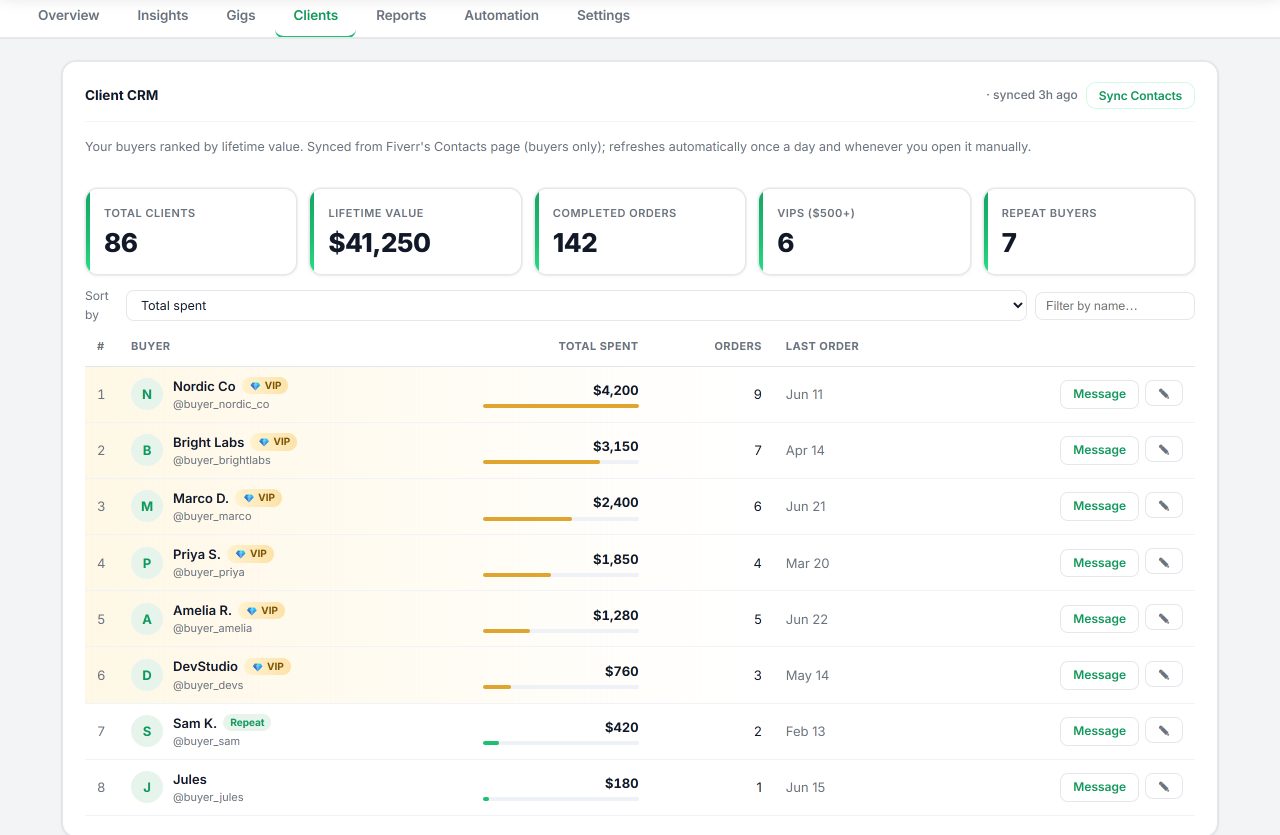
Seller OS local client records let you tag clients as 'repeat candidate' and set re-engagement reminders tied to their business cycle (quarterly, seasonal, product launches). The inbox assistant drafts the follow-up and re-engagement messages. The reports view surfaces clients with two-plus orders who have not ordered in 60 days — your highest-probability re-engagement list.
Where Seller OS helps
Seller OS local client records track every completed order, client notes, and re-engagement tags. The inbox assistant drafts the post-delivery follow-up and the timed re-engagement check-in. The reports view filters for clients with two-plus orders who have gone 60+ days silent — your highest-probability repeat list. The gig optimizer ensures your gig communicates the ongoing-work signal (subscriptions, retainer language) that attracts repeat buyers.
It cannot influence Fiverr's repeat business score calculation, cannot guarantee the badge appears, and cannot make a client reorder. The score is Fiverr's computed metric; the extension only helps you act on the habits that drive it.
Fiverr Repeat Business Badge questions
Can I apply for the repeat business badge?
No. Fiverr states the badge is earned automatically when you lead your subcategory and your repeat business score reaches 95 or above. There is no application, purchase, or request process.
What is the repeat business score based on?
Fiverr defines it as a measure of how your client retention compares to other freelancers in your subcategory over the last 90 days. The score updates weekly; underlying factors update in real time.
Do I need to be Top Rated to get the repeat business badge?
No. The badge is subcategory-specific. A Level 1 freelancer leading a niche subcategory with a score of 95+ can earn it while a Top Rated freelancer in a competitive subcategory may not.
How many repeat clients do I need for the badge?
Fiverr does not publish a client count threshold. The badge triggers on subcategory leadership plus a score of 95+, which is a relative measure against peers, not an absolute client number.
Build the habit, let the badge follow
Deliver to brief, follow up once, re-engage with context. The score reflects what you actually do.