 Seller OS
Fiverr gig description examples that convert
An example is useful only if you can see why each line earns its place. The descriptions below are written out in full, then annotated line by line so you can steal the move rather than the wording, because wording copied verbatim reads like everyone else in your category.
The structure behind these examples is covered separately in the description structure guide; this page is the annotated practice material, the openings that fail, and a skeleton you fill with your own service.
Free plan available. Local-first data. Human review on every change.
What a useful example actually shows
Fiverr publishes two numbers that frame every description: 1,200 characters, and a field priority that puts the title first, then positive keywords, then the description. The description is therefore not where you win the match; it is where you win the buyer who already arrived.
Each example below follows the five-part pattern this site documents in the structure guide — promise, scope, process, proof, next step — with the parts labeled in the margin instead of repeated as rules. Everything in them is illustrative: check wording, windows, and proof against what you can honestly deliver, and keep contact details and payment requests out of the text.
Example one: logo design, annotated
Full description: I will design a modern, memorable logo with the files your developer actually needs. You get three concepts in the first round, drawn from a short brief about your audience and the three competitors you name. I send a mood board within two days, then concepts on day four, so you are reviewing work by the middle of the week. Every delivery includes SVG, PNG, and a favicon set, plus one revision inside the package you choose. Recent work for a bakery and a logistics startup is in the gallery above. Send me your name, your audience, and one competitor, and I will start with concepts.
Why the opening works: it names the outcome and the handoff file in one sentence, so a buyer scanning at card size sees competence rather than an adjective. Modern, memorable describes a style the buyer can evaluate; high quality describes nothing at all.
Why the rest works: two dated beats convert an anxious wait into a schedule, and the revision line sets a boundary before the order starts. Proof sits just above the ask, and the final sentence requests three specific inputs, so a buyer who answers them has already begun.
- Promise — the deliverable and the handoff, no adjectives
- Scope — how many concepts, what the brief asks for
- Process — two dated beats the buyer can plan around
- Proof — a named recent project plus the gallery above
- Next step — three inputs to send, in one sentence
Example two: short-form video editing, annotated
Full description: I will edit your long-form footage into vertical clips built for retention. Send the raw file or the timestamped cut you already like, and you get three clips per video, each under 45 seconds, with captions burned in your brand font and a hook written from the first ten seconds of your own audio. Turnaround is three days for the first batch. If a clip misses, tell me which one and I will rework that clip rather than the set. Two of the edits in the gallery are for podcasts with no prior short-form presence.
The rework line is doing quiet conversion work. It tells the buyer there is a fix path without opening an unlimited revision door, and it matches the revision terms of the package rather than contradicting them.
The rework line is doing quiet conversion work. It tells the buyer there is a fix path without opening an unlimited revision door, and it matches the revision terms of the package rather than contradicting them.
Example three: virtual assistance, annotated
Full description: I will run the weekly admin that keeps your calendar, inbox triage, and invoice follow-ups from slipping. Each week you get a short summary of what closed, what is waiting on someone else, and what needs your decision, written so you can read it in two minutes. I work in your timezone for four hours a day, five days a week, inside the package you choose, and I escalate anything customer-facing before acting. Two clients have used this cadence for over a year, and one of their workflows is shown in the portfolio below.
The escalation sentence is the one to copy. For any service where the buyer fears an assistant replying on their behalf, naming the boundary in the description removes the objection before the buyer has to raise it in messages.
Before you adapt any of these, replace every claim with something you can evidence: two clients for a year must be true, and a vague trusted by hundreds is worse than no claim at all.
Before you adapt any of these: replace every claim with something you can evidence. Two clients for a year is a specific claim that must be true; a vague trusted by hundreds is worse than no claim at all.
Openings that fail, side by side
The first line decides whether the rest is read. These six openers come from the same kind of service; only one of them tells the buyer what arrives.
Every weak line below shares a defect: it describes the seller's attitude instead of the buyer's outcome, and attitude is unverifiable at the moment of scanning.
| Weak opening | What it says | Stronger version |
|---|---|---|
| I will provide high quality work fast | Nothing measurable | I will deliver three logo concepts in four days |
| Welcome to my gig, I am passionate | Seller biography | I will turn your podcast into six vertical clips |
| I am an expert with years of experience | Unverifiable claim | I have edited 40 episodes in this format, see below |
| I will do whatever you need | No scope at all | I will handle inbox triage, scheduling, and invoicing |
| Best prices on the market | Invites a price war | Three packages, starting with a single concept round |
The mistakes these examples are built to avoid
The common mistake is rewriting the title inside the description. Fiverr already reads the title and keyword field first, so repeating the same phrase in the first line spends your most valuable characters on information the buyer already clicked to read.
The second mistake is scope by adjectives. Thorough and dedicated do not tell a buyer what arrives, when, or what happens if they dislike it. Replace each one with a count, a date, or a boundary.
The third is burying the next step. Descriptions that end on a paragraph about process leave the buyer with nothing to do. Close with one request, keep it short enough to read on a phone, and make sure the FAQ section carries the objections that do not fit — the split is covered in the FAQ guide.
Write the promise line without any adjective you cannot measure
Add counts: concepts, clips, hours, rounds, days
Name two dated beats so the wait has a shape
Place one proof item directly above the ask
The skeleton to fill in
Use this order with your own service in the blanks. It maps to the five parts above and lands well inside the 1,200-character published limit, leaving room for the keyword mention at the end that Fiverr guidance recommends.
I will deliver your outcome and the files you need. You choose how many rounds and which package. I send milestone one on day two and milestone two on day five. Recent work in this exact format is in the gallery. Send me your three inputs and I will start.
After you fill it, check the promises against the package table the buyer will see, then read the whole thing once at phone width. If a sentence survives only because you enjoy it, cut it.
- Promise line names the outcome, not the seller
- Counts appear in scope and process
- Proof sits one line above the ask
- One closing request with named inputs
- Package promises match the package table
Where Seller OS helps
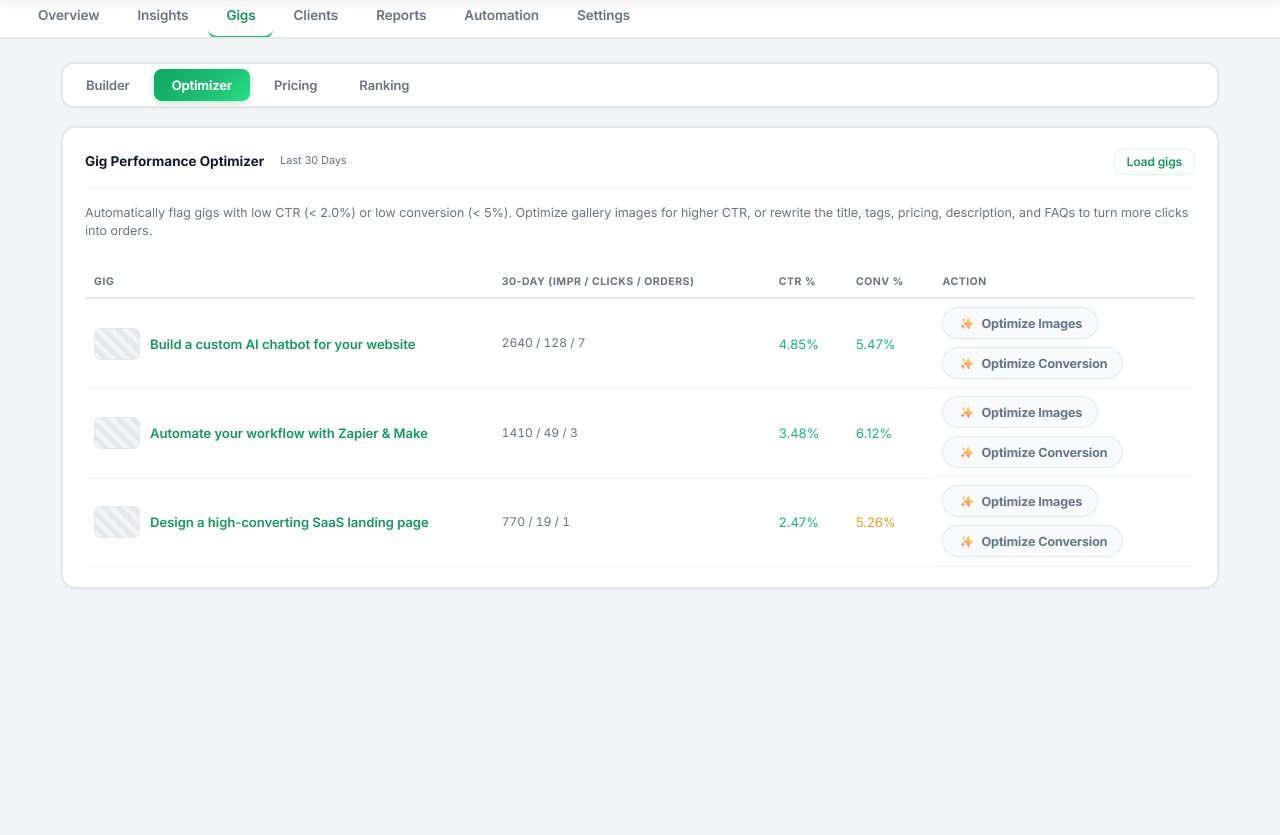
Seller OS drafts a description in this order from your service details, so the promise, counts, and closing request exist before you touch Fiverr's editor. The Gig Performance Optimizer then reads your live description alongside that gig's own impressions and orders and flags the lines that are not pulling weight.
Nothing goes live from the panel. A person performs every final Save, Continue, or Publish action, and the tool does not promise orders, rankings, or results it cannot produce.
Fiverr Gig Description Examples That Convert questions
How long should a Fiverr gig description be?
Fiverr publishes a 1,200-character limit, and these examples sit comfortably inside it. Length is not the goal; every line should carry a count, a date, a boundary, or proof. Anything doing none of those four things is wasting characters.
Should I repeat my main keyword in the description?
Mention the primary phrase once in natural sentences, near the start and once near the end, since Fiverr guidance recommends front-loading the keyword. Fiverr reads title and positive keywords first, so repeating it in every paragraph adds nothing and reads badly to a scanning buyer.
Can I copy an example description from this page?
Copy the moves, not the sentences. Verbatim descriptions read as duplicates across categories, and any figure you borrow has to be one you can honor in the order. Rewrite each example with your own counts, turnaround, and proof.
What should I put after the description?
Fill the FAQ with the questions your inbox already receives, and make sure the three packages reflect the tiers the description implies. Buyers read the description, then compare packages, then scan FAQ, so a mismatch between those three slows the order down.
Write your version before you open the editor
Fill the skeleton with your own counts and proof, then check it against the packages you actually sell.