 Seller OS
Fiverr sales dropped in 2026: recovery steps
A sales drop in 2026 can come from the platform or from your own gig, and the first days look identical either way. The recovery differs for each, so the first job is to separate them before spending a weekend on edits that cannot help.
This guide covers the 2026 context, a funnel diagnosis that finds the stage that broke, a recovery sequence you can run over a few weeks, and the repackaging that fits a platform moving toward larger projects.
Free plan available. Local-first data. Human review on every change.
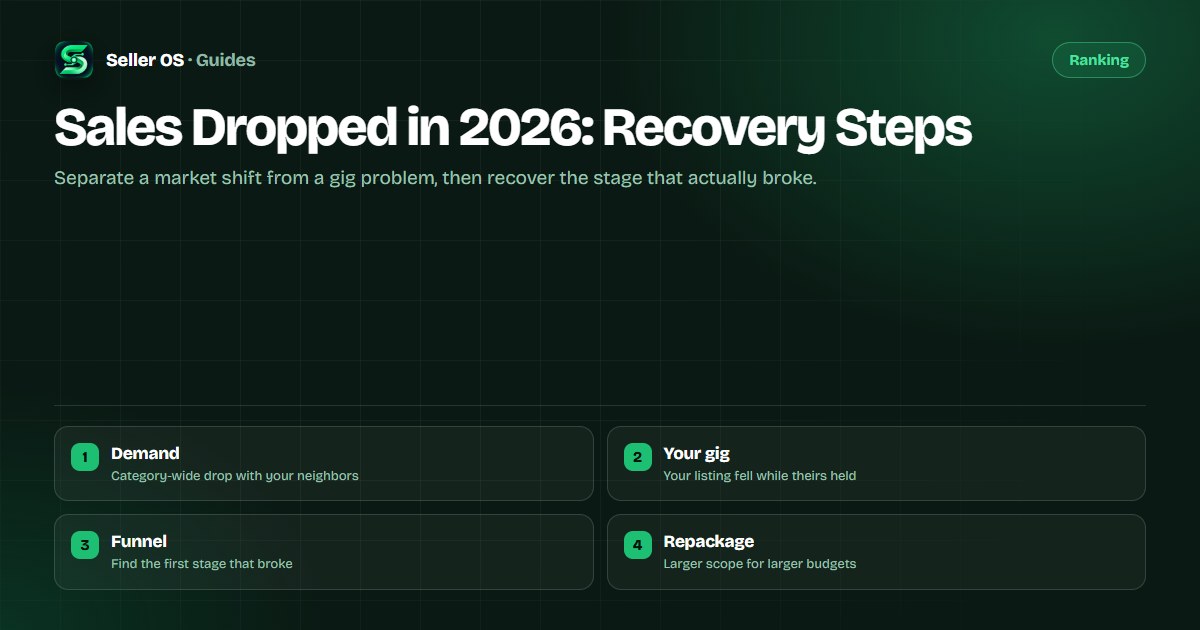
Two different things look identical
Every sales drop has a source, and the earliest evidence rarely distinguishes them. The way to tell is to compare your funnel stages with the gigs around you, because a demand shift moves everyone and a gig problem moves only your listing.
Read the table below as a set of questions rather than a verdict. Each row asks whether the change happened to your gig alone or to the neighborhood as well. Two or three rows pointing the same direction is a strong signal; one row on its own is not.
| Signal | Points to a demand shift | Points to your gig |
|---|---|---|
| Impressions | Flat or down across your category | Dropped for your gigs alone |
| Clicks | Down together with impressions | Down while impressions hold |
| Orders | Conversion steady where clicks land | Fell while clicks continue |
| Neighbors | Quiet in the same weeks | Still active around you |
The 2026 context, stated carefully
Fiverr's public reporting through 2026 describes fewer active buyers alongside higher spend per buyer and a move toward larger projects. In plain terms, the platform is shifting upmarket: more of its growth is coming from bigger engagements rather than a larger crowd of small orders.
That matters for small sellers because a strategy tuned for volume can look like it stopped working even when nothing in your gig changed. If the buyers who used to place many small orders are fewer, the same listing earns less. Treat this as market context, not a verdict on your work.
The practical takeaway is to neither panic nor ignore it. If your category is genuinely softer, the sellers who keep earning are the ones who adjust what they sell rather than pushing the old offer harder. The sections below handle that adjustment in order.
Diagnose which stage broke
Work the funnel in order: impressions, then clicks, then orders. Impressions are visibility, clicks are the card, and orders are the page and the offer. A drop that starts at impressions is not an offer problem, and a drop that starts at conversion is not a search problem.
Do not skip a stage because it looks fine at a glance. The first stage that fell explains the ones after it, and a small impression dip can drag clicks and orders down with it. Confirm each stage against the one before it before you assign blame.
Read four weeks
compare each funnel stage across whole weeks, not days.
Find the first stage that fell
impressions, then clicks, then orders.
Test visibility
sample two or three keywords from a private window.
Read the offer
check price, packages, and delivery time against your category.
Sample past conversations
look for repeated objections before the drop.
A recovery sequence for 2026
Once you know the stage, act on that stage and give it time. Broad rewrites across every stage at once destroy your ability to tell what worked, and a large edit can trigger a review that pauses the gig.
Order matters. Stabilize delivery before you change the offer, because on-time delivery and completion rate feed visibility, and visibility is what makes the later moves count. Repair the container before you pour more into it.
Stabilize delivery
protect on-time delivery and completion rate first, because those feed visibility.
Fix the first broken stage
visibility, card, or offer, whichever fell.
Re-engage past buyers
a checked-in note to clients you served well can restart demand.
Repackage upward
bundle small services into a larger scope that fits larger budgets.
Widen one surface
test a paid placement or an external post before scaling either.
Time-box the test
two to four weeks per change, then compare, then adjust.
Repackaging for larger projects
If the platform is moving upmarket, the listings that fit that move win more of the remaining demand. That usually means fewer, larger packages rather than more, smaller ones. A single well-scoped engagement is easier to sell than a menu of micro-services when buyers are spending more per decision.
Concretely: raise the entry package's scope and price, name the outcome rather than the task, and add the trust signals a larger buyer looks for, such as a clear process, a portfolio piece at the right scale, and a requirements set that protects both sides. The shift-to-large-projects guide covers the packaging detail.
Do not do this as a panic discount in reverse. Repackaging is a deliberate change to what you sell, made after you know which funnel stage broke.
Protect the good parts while you recover
A drop tempts sellers to cut prices, accept risky orders, and rewrite everything. Each of those can cost more than the drop itself. Hold your standards: decline work that carries a bad-review risk, keep response times inside the window, and keep the delivery promises you can keep.
Then let the numbers breathe. Analytics update on a lag and category demand moves in waves, so judge a recovery over weeks against the same measurements you used at the start. The stopped-getting-sales guide covers the slower, long-form version of this work.
Where Seller OS helps
Seller OS helps during a recovery without promising one. The gig optimizer reviews a live gig's copy and conversion signals against its own performance history, and the monitors keep an eye on deadlines and quiet clients while Chrome is open.
It records your tracked metrics locally so a recovery is measurable, and it never edits or publishes on its own. A person reviews every draft, save, and send, and your data stays in Chrome local storage.
Sales Dropped in 2026 questions
Why did my Fiverr sales drop in 2026?
It can be the platform or your gig, and both look the same at first. Fiverr's public reporting in 2026 describes fewer buyers alongside higher spend per buyer and a shift to larger projects, so small-order demand softened even for good sellers. Check whether your category fell with you before rewriting anything.
How do I tell a demand shift from a gig problem?
Compare your trend to the category around you. If impressions, clicks, and orders all fell for neighboring gigs in the same weeks, demand moved. If only your gigs fell, or conversion dropped while clicks held, the cause is local to your listing or offer.
Should I lower my prices when Fiverr sales drop?
Rarely as a first move. The platform is pushing toward larger projects, and a discount shrinks the value per order without adding demand. Diagnose which funnel stage broke first, then fix that stage. Reserve pricing changes for a genuine value or fit problem, not a demand wave.
How long does it take for Fiverr sales to recover?
There is no published timeline. Demand moves in waves and the analytics update on a lag, so judge recovery over weeks rather than days. Make one change per cycle, keep the rest steady, and compare the same measurements you captured at the start.
Separate the market from your gig
Find the funnel stage that broke, fix one thing, and package your work for the buyers who are still spending.