 Seller OS
Fiverr buyer requests: what happened and what to do
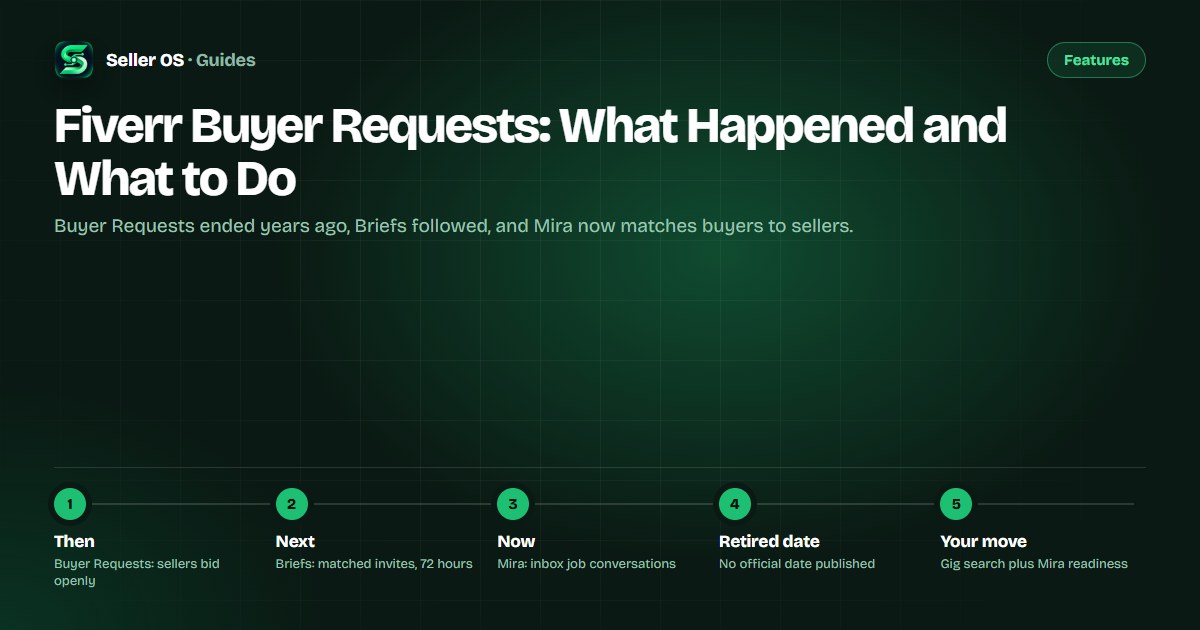
Current status first: no current official documentation mentions Buyer Requests as active, and both Fiverr Briefs help articles now display a banner stating Mira AI Headhunter has fully replaced the Briefs feature. Buyer Requests was phased out in favor of Briefs, and Briefs has now itself been replaced by Mira.
This guide explains what Buyer Requests was, what replaced it at each step, and the migration playbook for sellers who learned the platform on that old surface. Retirement claims follow official pages plus dated secondary sources where official dates are unverified.
Free plan available. Local-first data. Human review on every change.
Current status of Buyer Requests
No current official Fiverr page documents Buyer Requests as active, and the Briefs system that superseded it is itself retired: both Briefs help articles state Mira AI Headhunter has fully replaced Briefs, with previous briefs accessible through Your Briefs for the time being. Current client-side matching is Mira.
No official retirement date for Buyer Requests was found, so this guide does not state one as fact. Secondary sources describe the phase-out across 2022 and 2023, which you may treat as background context while relying on the official pages for everything about the current system.
What Buyer Requests was
Buyer Requests was the open board where buyers posted project needs and sellers submitted bids competing on price, pitch, and turnaround. For new sellers it functioned as a daily prospecting queue: check the board, write tailored offers, and convert a share of bids into first orders and first reviews.
Its weakness was the same as its appeal. Open bidding rewarded speed and low prices, buried careful proposals under volume, and taught sellers to chase posted demand rather than build discoverable gigs. Veterans of the board often needed weeks to unlearn bid-first habits after each matching upgrade replaced open competition with curated invitations. Understanding that trade helps you see why each replacement moved toward matching over marketplaces of bids.
The Briefs interlude that followed
Fiverr's freelancer article documents the historical Briefs mechanics even in retirement: matching by expertise, pricing, and profession, delivery to the Briefs page under Your matches plus email and app notice, a 72-hour answering window, and focus on services with stronger scores. The client article added that briefs could receive up to five tailored offers with 72-hour valid invitations.
Illustrative scenario: under Briefs you waited for a matched invitation, answered within three days with questions or an offer, and competed against at most a handful of sellers. That curation was the philosophical opposite of the old open board, and Mira continues the same direction with even tighter matching.
Mira today: where matches arrive
Fiverr's Mira article states that talent is matched on criteria such as previous projects completed on Fiverr and experience level, that invitations arrive through the inbox, and that sellers should respond to Mira's first message within 24 hours so the response rate is not affected. Each job description opens a new inbox conversation rather than a Brief page.
A common mistake sellers make is treating Mira like the old board and waiting passively for invitations as their only pipeline. Mira is one channel: gig search, repeat buyers, and custom offers still produce most orders, so build for search while staying ready for inbox matches.
- Keep inbox triage fast enough to catch a 24-hour first reply.
- Answer Mira follow-ups directly before attaching a full proposal.
- Track which gig data seems to attract matches and sharpen it.
- Opt out only deliberately by replying to Mira as documented.
Migration playbook for former board users
Replace the daily board check with a daily discoverability check: one gig title, tag set, or thumbnail proof improved per day, plus one past-buyer re-engagement draft where appropriate. Former board volume becomes gig-search surface, and former bid copy becomes custom-offer skill applied to Mira threads, where specificity matters more than speed.
Illustrative example: a seller who once sent fifteen board bids daily now spends that hour rewriting one gig's FAQ to answer the top pre-order question, sending two tailored custom offers to warm leads, and clearing new inbox threads first. After a month the asset compounds, while board bids never did.
| Old board habit | Current replacement | Where to learn it |
|---|---|---|
| Scanning open requests | Daily gig discoverability fix | Gig and profile guides |
| Mass bidding | Few tailored custom offers | Custom offer guidance |
| Price-first pitches | Proof-first Mira replies | Brief response guide |
| Waiting for postings | Search plus repeat buyers | Get-more-briefs guide |
Where to go next by situation
If you never used Buyer Requests and only want current work, start with the Briefs overview for the retired context, then the getting more briefs guide and the Mira assessment for positioning that still applies. If invitations never arrive, the briefs not showing guide troubleshoots visibility.
If you are a returning seller whose muscle memory still reaches for the board, accept that the surface is gone and rebuild around search-led gigs with inbox readiness. The platform moved from open bidding to curated matching twice, and sellers who moved with it kept their pipelines while board loyalists kept refreshing an empty page.
Where Seller OS helps
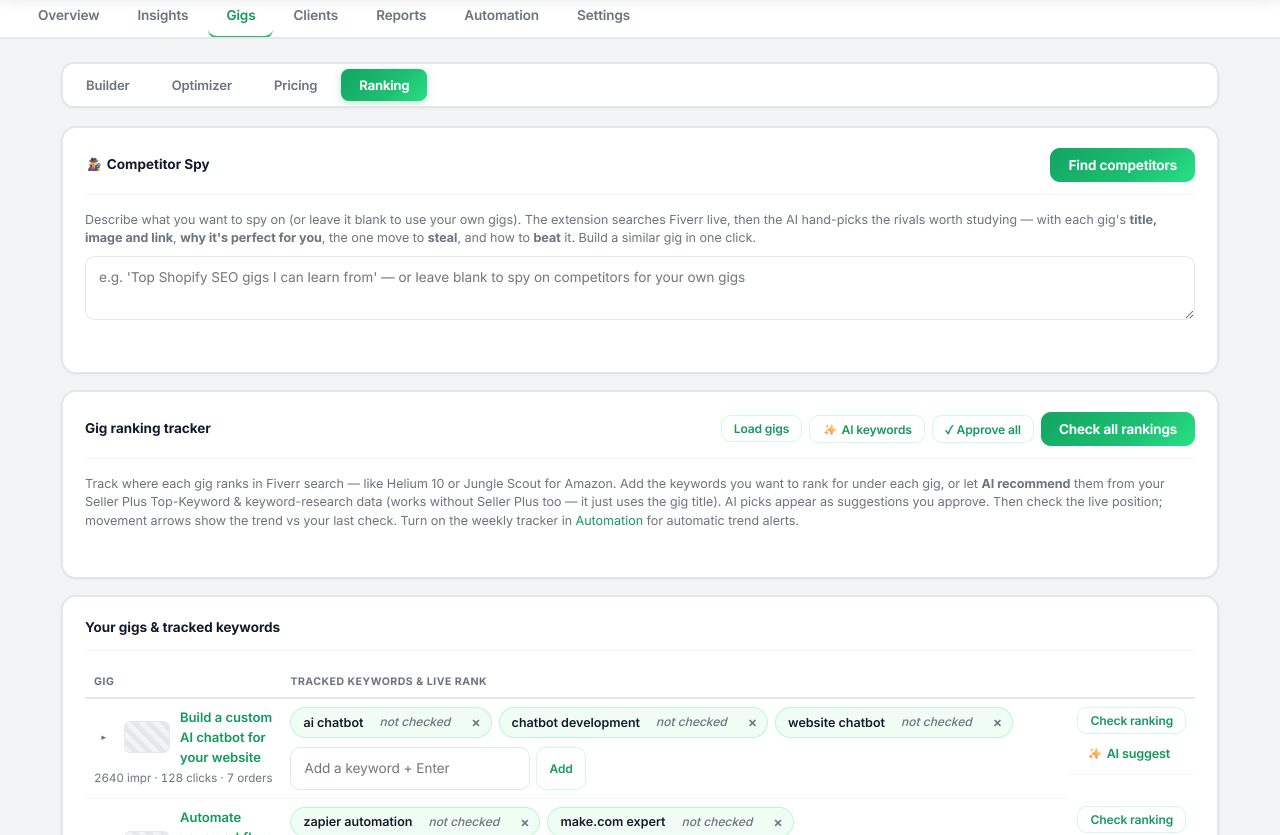
Seller OS fits the post-board workflow: keyword research help and rank tracking for the gig-search half, plus brief-response and inbox reply drafts you review before sending for the Mira half. Local client records keep past-buyer context beside each new thread so replies stay specific.
It does not recreate Buyer Requests, fetch briefs, or guarantee Mira invitations. It drafts and fills while a person performs every final Send, and matching itself remains the platform's decision based on your history and gig data.
Fiverr Buyer Requests questions
What happened to Fiverr Buyer Requests?
Buyer Requests was phased out and replaced by Briefs, which Fiverr's help articles now state has itself been fully replaced by Mira AI Headhunter. No current official page documents Buyer Requests as active. Secondary sources place the original phase-out across 2022 and 2023, but no official retirement date was found, so treat that range as context, not fact.
Are Fiverr Briefs still active in 2026?
No. Both Fiverr Briefs help articles display a banner stating Mira AI Headhunter has fully replaced the Briefs feature. Previously created briefs remain viewable through Your Briefs for the time being. New matching runs through Mira job descriptions that arrive as inbox conversations, not through the old Brief management page.
What replaced Buyer Requests for finding work?
Two successors in sequence: curated Briefs invitations with a 72-hour window and up to five offers, then current Mira inbox matching based on factors like previous Fiverr projects and experience level. Alongside Mira, gig search, repeat buyers, and custom offers carry the steady pipeline. Build discoverable gigs while keeping inbox replies fast and specific to each buyer thread.
How should former Buyer Requests users adapt?
Convert bidding time into discoverability work: sharpen one gig element daily, keep tags and titles in buyer language, and send a few tailored custom offers instead of mass bids. Answer any Mira first message within 24 hours to protect response rate. Skills from board bidding transfer directly to Mira replies and custom offers.
Stop looking for the board
Build search-ready gigs and answer every Mira thread within 24 hours.