 Seller OS
Fiverr Neo: how AI matching picks sellers
Fiverr announced Neo in January 2024 as its AI matching tool for buyers, asking follow-up questions on the homepage or in the inbox and suggesting a freelancer to talk to. As of October 2026, Fiverr's help center documents no feature called Neo; buyer-side matching now runs through Mira, Fiverr's AI headhunter.
This guide separates what Fiverr published about Neo from the system that runs matching today, then shows which parts of your gig data you control. It does not hand you a ranking formula, because Fiverr publishes none.
Free plan available. Local-first data. Human review on every change.
What the Neo name means in 2026
Fiverr introduced Neo through a team post on its official forum on January 11, 2024, calling it Fiverr's AI matching tool for clients. Buyers could start a Talk to NEO conversation from the homepage or inbox, answer follow-up questions, and receive a suggested match, with the conversation stored in the inbox. Fiverr's press material later documented Dynamic Matching on December 12, 2024, an AI-assisted tool that was in beta for Pro users with a full launch planned for early 2025.
The current help center does not document a feature named Neo. Buyer-side matching is now described through Mira, and Fiverr has published no statement saying Neo was retired or renamed. The only Fiverr page still using the Neo name, checked October 2026, is an undated resources guide about finding and hiring a recruiter.
- Fiverr's help center documents Mira, not Neo, as of October 2026.
- No official Fiverr statement says Neo was renamed or retired.
- Matching moved through Dynamic Matching, Briefs, then Mira.
- Old community posts are history, not current documentation.
- Treat third-party claims about Neo's fate as commentary.
How Neo-style matching worked for buyers
Neo sat on the buyer's side of the marketplace. A client described what they needed, answered a few follow-up questions, and got a suggested freelancer to contact, with the thread kept in the inbox so they could return to it later. The goal was narrowing a wide category browse into one or two sensible starting points.
Mira follows the same shape with more structure. Fiverr's help center states that Mira builds a job description, sends it to eligible talent, and returns up to three curated recommendations. When the client's budget is under $500, Mira does not send the job description out and gives the client a filtered list instead, and clients pick a shortlist window of 2, 4, or 12 hours.
What matching sends to your inbox now
For sellers, the current system arrives as a message. Fiverr's help center says Mira matches talent based on multiple criteria such as previous projects completed on Fiverr and experience level, and each job description opens a new conversation in the Inbox rather than a brief management page. There is no setup step, and you can ask Mira to opt out by replying to it.
One published rule touches your metrics: respond to Mira's first message within 24 hours so your response rate is not affected. Mira is rolling out gradually and runs on desktop and mobile web only, not the iOS or Android apps, so check it from a browser if you mostly work from your phone.
Open the job description
read it in the Inbox conversation, not a briefs page
Answer inside 24 hours
Fiverr ties the first reply to your response rate
Opt out cleanly
reply and ask Mira to stop sending invitations
What you can influence and what you cannot
Fiverr publishes coarse criteria and no formula. The older Briefs documentation matched on a freelancer's expertise, pricing, and profession, with an emphasis on services carrying a Success Score of 7 or higher. Mira's published criteria are previous projects completed on Fiverr and experience level. Nothing on Fiverr's pages explains how those inputs are weighted or how many invitations a single seller receives.
Consider an illustrative scenario (not platform data): two logo designers with identical ratings appear for the same job. Designer A keeps one tight category, five tags that mirror buyer phrasing, a description naming deliverables and turnaround, and twenty completed orders. Designer B has vague fields and mixed categories. The point is legibility, not a promised rank; Fiverr guarantees no invitations.
- Category and tags: pick the terms buyers actually type.
- Description: name the deliverable, format, and delivery time.
- History: completed orders and experience are published inputs.
- Communication: the first Mira reply counts toward response rate.
- No quota exists: Fiverr publishes no per-seller invitation count.
Make each gig legible to matching
A common mistake is treating matching like a keyword game, stacking synonyms in the title and tags until the gig reads like a search results page. Matching reads structured fields first, and inconsistent fields give it less to work with. Rewrite one gig so the title, tags, description, and portfolio all describe the same service in the same words.
Do the pass in order. Confirm the category and subcategory still fit, check each of the five tags against what a buyer would type, read the description for deliverables a client can picture, and make sure portfolio examples prove the promise. Small mismatches, like a title promising same-day work that the description never mentions, are what buyers trip over too.
Category check
confirm the subcategory still matches the service
Tag pass
keep five tags that mirror real buyer phrasing
Description read
name formats, revisions, and delivery time
Portfolio match
examples should prove the exact promise
Why the Neo name still shows up online
Search results mix several eras: Neo from 2024, Dynamic Matching from late 2024, Briefs, and now Mira. Fiverr's own site still uses the Neo name in an undated recruiter guide, which is why the term keeps surfacing. Reading an old announcement next to a current help article can make it look like two products are running at once.
For current mechanics, use Fiverr's Mira help article and the Briefs articles, which now carry a banner stating that Mira has fully replaced the Briefs feature and that older briefs stay visible under Your Briefs for the time being. Our Mira assessment covers the trade-offs, and how the algorithm is explained separates published facts from folklore.
Where Seller OS helps
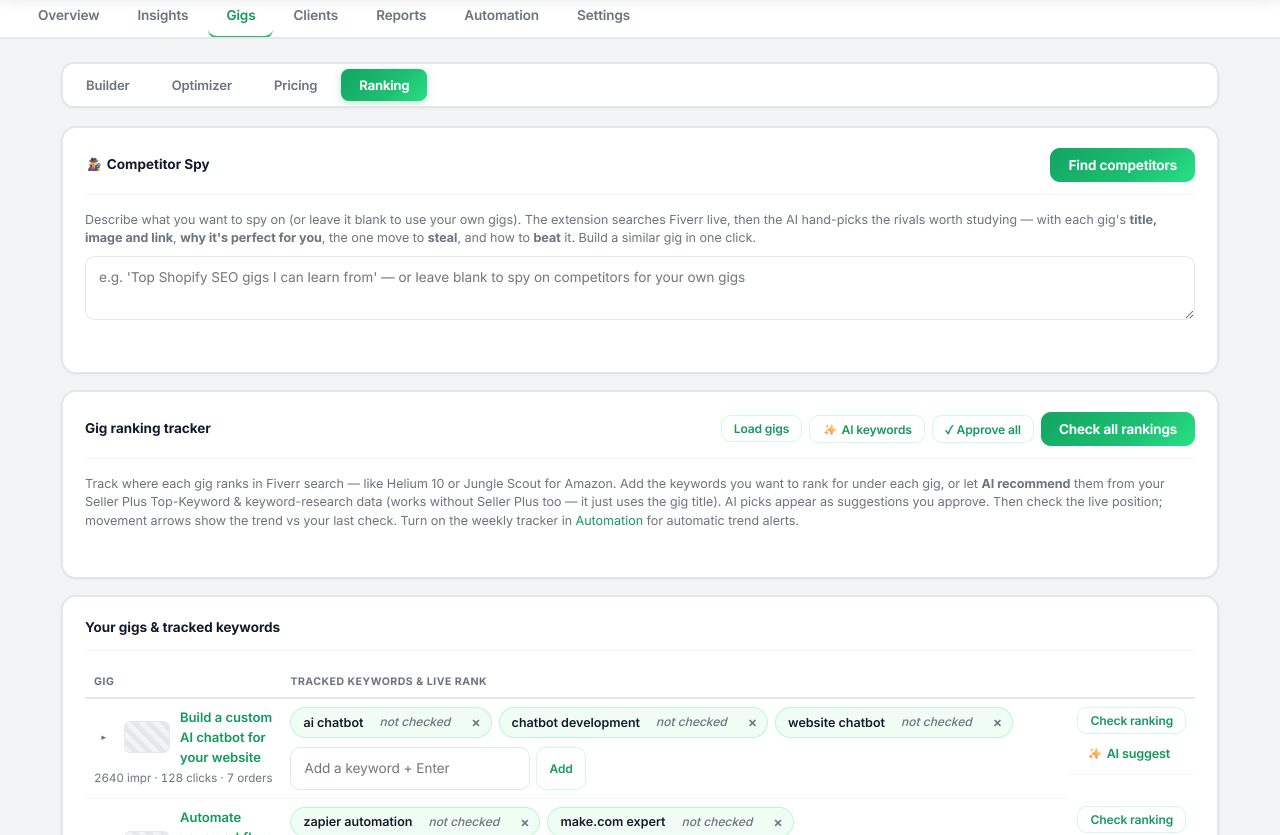
Seller OS keeps each gig's copy, tags, and performance notes in one local workspace, so the consistency pass happens in a single review instead of five open tabs. The Gig Performance Optimizer reads a live gig against that gig's own performance data and proposes changes you can accept or ignore.
It drafts and fills; a person performs every final Send, Save, Continue, or Publish action. It does not influence Fiverr's matching, buy invitations, or placement, and nothing is sent or published without your click.
Fiverr Neo: How AI Matching Picks Sellers questions
What was Fiverr Neo?
Fiverr Neo was Fiverr's AI matching tool, announced on its official forum on January 11, 2024. A buyer could start a Talk to NEO conversation, answer follow-up questions, and receive a suggested freelancer, with the conversation stored in the inbox. Fiverr's current help center does not document Neo as an active feature.
Is Fiverr Neo still available in 2026?
As of October 2026, Fiverr's help center documents no feature named Neo, and Fiverr has published no retirement or rename notice for it. Buyer-side matching is described through Mira, which is rolling out gradually on desktop and mobile web. Check what your own account shows before trusting older articles either way.
How does Fiverr's AI matching choose sellers?
Fiverr publishes coarse criteria only. The Briefs documentation named expertise, pricing, profession, and a focus on services with a Success Score of 7 or higher. Mira documentation names previous projects completed on Fiverr and experience level. No weights, quotas, or formula appear on Fiverr's pages, so treat detailed ranking lists you read elsewhere as unofficial.
Do I need to enable Neo or Mira to get invitations?
There is no setup step for Mira, according to Fiverr's help center. Invitations arrive as new conversations in your Inbox, and you can reply asking Mira to opt out at any time. The one published obligation is answering Mira's first message within 24 hours so your response rate stays unaffected.
Make one gig easy to read
Align the category, tags, and description on your strongest gig, then answer matching messages within 24 hours.