 Seller OS
Is Fiverr legit? protections with receipts
Yes, Fiverr is a real marketplace company: Fiverr International Ltd. of Tel Aviv, Israel, operating with Fiverr Inc. in New York for United States payments and Fiverr Limited in Cyprus for payments elsewhere, as its Payment Terms state. This guide is written by an independent tool maker with no affiliation with Fiverr, and every protection below comes from Fiverr's own published pages.
You will get buyer protections, seller protections, and the honest limits in plain language: off-platform deals that void your cover, chargeback reviews that favor no one automatically, and enforcement that sometimes misfires. No invented company numbers appear here, only what Fiverr publishes about itself.
Free plan available. Local-first data. Human review on every change.
What Fiverr is as a company
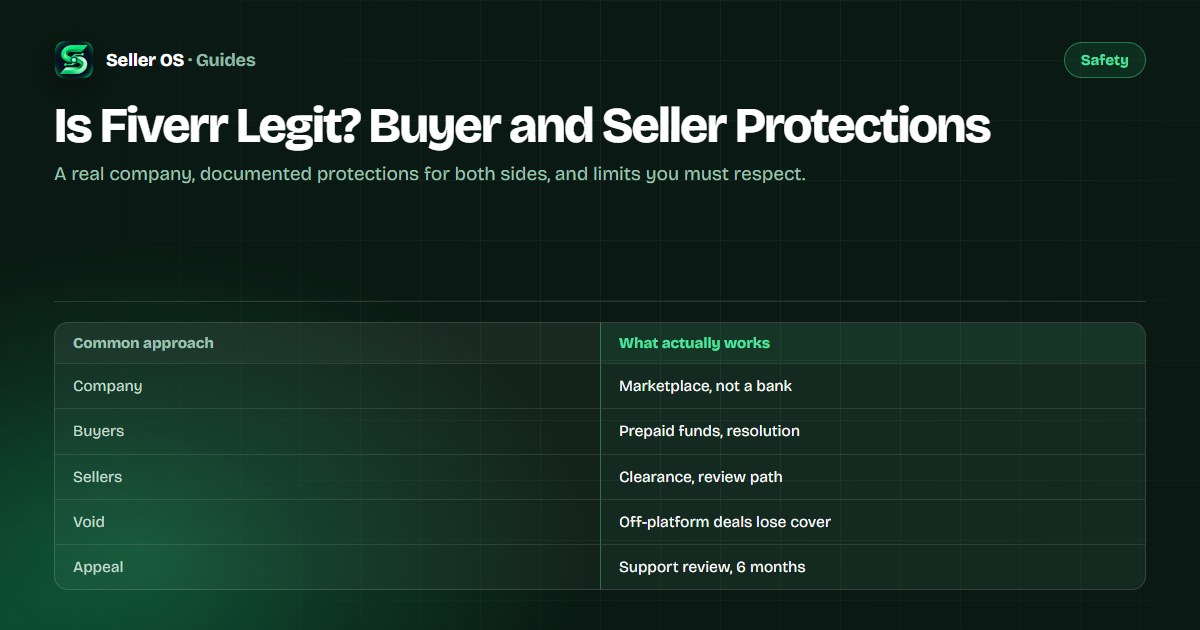
Fiverr describes itself as a marketplace that connects clients with freelancers, and its Payment Terms state plainly that it partners with payment service providers rather than acting as one itself. The published entities are Fiverr International Ltd. at 8 Kaplan Street, Tel Aviv, Fiverr Inc. at 26 Mercer Street in New York for US payments, and Fiverr Limited in Limassol, Cyprus for payments elsewhere. Its trust pages add that it holds Level 1 PCI-DSS service provider standing for transaction security.
Why does the corporate shape matter to you? Because it sets correct expectations: your money moves through a prepaid marketplace with published rules, not through a bank account with deposit insurance. Fiverr's invoicing article also publishes its vendor details, including incorporation in Tel Aviv in 2010, which you can verify yourself on its legal pages. Legit does not mean risk-free; it means rule-bound, not risk-free, and the rules below protect you.
Buyer protections as Fiverr publishes them
Buyers pay Fiverr when the order is created, so the freelancer never holds your money directly during the work. Fiverr's help center states that when an order is canceled, the funds paid return to the buyer's Fiverr Balance rather than automatically to the card. That prepaid structure is the core buyer protection: payment exists inside the platform, where its rules can reach it.
Disputes run through the Resolution Center, with a 48-hour response window and auto-accept on silence. Completed orders can still be reviewed by Customer Support up to 14 days after completion, or 7 days for Hourly Weekly Reports, for misconduct or Terms violations. Orders are not cancelable on quality alone where the service matched the gig, so buyers rate quality instead. Learn the resolution process before you need it.
- Prepaid orders keep funds inside the platform until completion or cancellation.
- Canceled order funds return to the buyer Fiverr Balance, not the card.
- Resolution Center requests carry a 48-hour response window with auto-accept on silence.
- Support can review completed orders within 14 days for misconduct or violations.
Seller protections as Fiverr publishes them
Sellers are protected by the same prepaid structure in reverse: the buyer has already paid, so completed work converts into earnings through a published clearance cycle. Fiverr's Payment Terms state the standard clearance period is 14 days after the order is marked complete, 7 days for Top Rated sellers, and 7 days after a Weekly Report for Hourly contracts. Unresponsive clients do not damage your Success Score, as Fiverr's success article states directly.
When payments go wrong after the fact, Fiverr's chargeback article states that it reviews payment-provider chargebacks for sellers, with two published outcomes: the seller bears service-related chargebacks, while fraudulent ones may be covered under Fiverr's sole discretion without any guarantee. Funds recovered in the seller's favor return to the account and become withdrawable after 45 days with metrics unaffected. Illustrative scenario: a $120 order completes on the 1st, clears on the 15th under the standard cycle, then moves to withdrawal.
The honest limits of every protection
Every protection above ends where the platform ends. Users who transact off-platform lose Fiverr's protections, including secure payments and dispute resolution, as the off-platform policy states, and violations can draw warnings or suspension. Chargeback cover is explicitly discretionary rather than guaranteed, enforcement decisions can misfire against innocent sellers, and canceled-order funds land in Fiverr Balance credit rather than cash back to the card.
A common mistake sellers make is treating marketplace protections like legal guarantees. They are platform policies with published windows: appeal enforcement decisions through a Customer Support complaint within 6 months of the notification, withdraw disabled-account funds after the 90-day safety period, and keep your own records of every order. The warning system guide explains how enforcement escalates, and the scam taxonomy maps the attacks protections cannot stop.
| Protection | What it covers | Where it stops |
|---|---|---|
| Prepaid order funds | Money inside the platform | Nothing off-platform |
| Resolution Center | Active-order disputes | Unavailable after completion |
| Chargeback review | Discretionary fraud cover | Service cases stay yours |
| Appeal rights | Complaint within 6 months | No promised outcome or date |
How scams abuse a legit platform
Scammers do not need a fake Fiverr; they exploit trust in the real one. Fiverr's own safety guide warns that official staff never ask for your email, login credentials, or payment details to process a payment, and never ask you to scan a QR code or verify with a credit card. Messages with misspelled brand names, suspicious domains, or urgent off-platform payment demands are the classic tells.
Your response drill stays simple: hover over links before clicking, enter credentials only in Fiverr's sign-in flow, report unsolicited messages from the inbox menu, and report spam within 24 hours so it cannot hurt your response rate. Illustrative scenario: a new buyer sends a document link plus a QR code ten minutes after first contact; you report it as spam instead of scanning, and your metrics stay clean within the published window. The fake buyer guide trains this reflex further.
The verdict for cautious users
Fiverr is legitimate in the sense that matters: a real company, published payment entities, prepaid fund flows, a documented dispute process, and stated seller safeguards with exact windows. It is not safe in the sense of effortless: off-platform deals void your cover, quality disputes follow narrow rules, and chargeback mercy is discretionary. Cautious users who keep everything on-platform, document each order, and respect the published windows get the full value of every protection.
Start small, verify each protection with one low-risk order, and scale only after the clearance cycle, review flow, and withdrawal path have all worked once in your own account. If anything goes wrong, the account warning guide covers enforcement survival, and this publication's tool pages help you track the numbers yourself. Legit platforms reward careful users; be one.
Where Seller OS helps
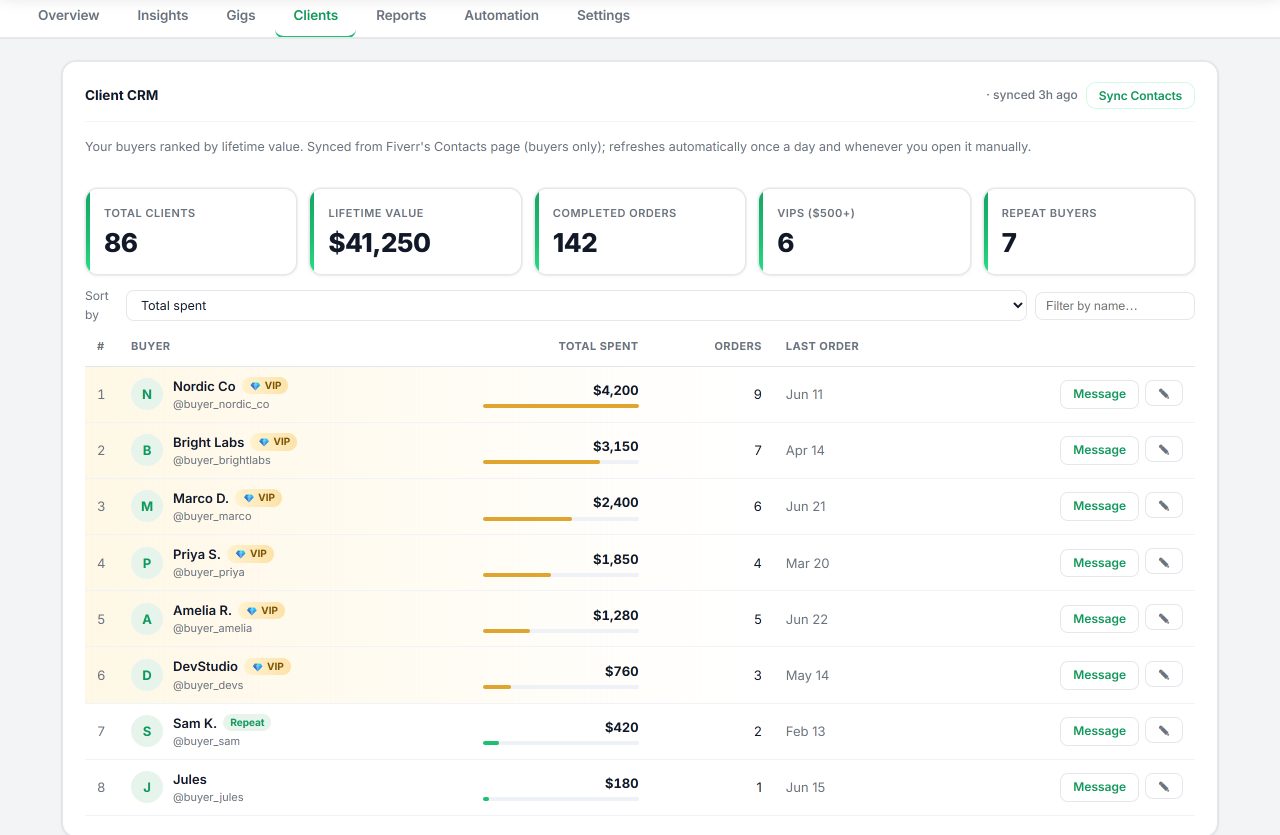
Seller OS is an independent Chrome extension for Fiverr sellers with no affiliation with Fiverr, and it helps cautious sellers keep the records protections depend on. Local client records with notes and history, order context in one workspace, package pricing review with guardrails, and reports with a short action queue keep your evidence organized in Chrome local storage. It drafts and fills; a person performs every final Send, Save, Continue, or Publish action.
The honest limit is that it cannot change Fiverr's decisions, win your disputes, or guarantee orders and income. It keeps your facts ready for the one message that matters, and you still make every case yourself.
Is Fiverr Legit? Buyer and Seller Protections questions
Is Fiverr legit or a scam?
Fiverr is a legitimate marketplace company, with Fiverr International Ltd. in Tel Aviv plus payment entities in the United States and Cyprus as its Payment Terms state. Scams still happen on it, mostly through off-platform payment lures and phishing that abuse trust in the real brand. Keep all payments and communication on-platform and you keep every published protection intact.
Is Fiverr safe for buyers placing their first order?
Buyers pay Fiverr when the order is created, and canceled funds return to the buyer Fiverr Balance under published rules. Disputes go through the Resolution Center with a 48-hour response window, and support can review completed orders within 14 days for misconduct. Start with a small order, keep everything on-platform, and never pay outside the order flow.
Is Fiverr safe for sellers doing freelance work?
Sellers work against prepaid funds with a published clearance cycle of 14 days, or 7 days for Top Rated sellers, and unresponsive clients do not harm the Success Score. Chargeback reviews are discretionary rather than guaranteed, and off-platform deals lose all protection. Document each order, withdraw on schedule, and appeal enforcement decisions within the published 6-month window.
What are the biggest risks of using Fiverr?
The biggest risks are off-platform transactions that void every protection, phishing that steals credentials, chargebacks on completed work, and enforcement mistakes against innocent accounts. None of these make the platform itself fake, but each one punishes careless users. Verify staff identity markers, report spam within 24 hours, and keep timestamped records of every order.
Use Fiverr like a careful user
Keep deals on-platform, document orders, and know the windows before trouble.