 Seller OS
Fiverr click-through rate: how to improve it
Fiverr click-through rate is the share of times your gig was seen that ended in a click. Fiverr describes it in Seller Plus reporting rather than on the standard per-gig panel, and defines it as how often clients clicked after seeing your gig. The higher the rate, the more compelling your gig card was in that placement.
This guide covers what actually moves CTR, from the thumbnail and title to the price shown and the proof beside the card, plus a one-change test plan and the reasons CTR alone can mislead you. It uses Fiverr's definitions and no invented benchmarks.
Free plan available. Local-first data. Human review on every change.
Where Fiverr shows CTR, and where it does not
The standard per-gig statistics panel lists impressions, clicks, orders, cancellation rate, current subscriptions, conversion rate, and delivery info. It does not list a click-through rate. To get one for yourself, divide the clicks by the impressions for the same window, then multiply by 100.
Fiverr's Seller Plus reporting does show CTR. The Advanced Analytics article describes the Top Keywords table as showing your click-through rate for each keyword, meaning how often clients clicked after seeing your gig, and the Gig Performance view defines CTR as the percentage of clients who clicked after seeing your gig in search results, adding that a high CTR means your gig card is compelling.
Those Seller Plus views are the only published CTR definitions, and the help center says the relevant tabs are not available on non-Seller Plus accounts. On the standard plan, the impressions and clicks you already have are enough to compute the same ratio manually.
What actually moves your click-through rate
The card is the whole argument: the thumbnail image, the title promise, the starting price shown, the rating and review count beside it, the level badge, and the position the card holds on the page. Fiverr adds badges automatically, and levels are visible to clients on gig cards, so those signals are part of the impression whether or not you manage them.
Placement matters as much as design. A card shown in a broad placement meets buyers with weaker intent than one matched to a specific query, so the same card can post a different CTR in each. A CTR read needs its placement noted beside it.
| Element | Buyer's decision | Testable change |
|---|---|---|
| Thumbnail | Is this worth opening? | One clearer visual per window |
| Title | Does this match my query? | Lead with the buyer's phrasing |
| Price | Can I afford this seller? | Test only in its own window |
| Proof | Has this worked for others? | Keep samples current and relevant |
| Position | How far must I scroll? | Record it; it is not fully yours |
A card test you can actually read
Prepare two versions of the image and change nothing else: same title, same price, same packages. Run the new image for a full 30-day window, because that is the panel's default period, then compare clicks and impressions against the previous window rather than against memory.
Hypothetical numbers: a baseline of 3,000 impressions and 45 clicks is a 1.5 percent click share. After the change, 3,200 impressions and 78 clicks is a 2.4 percent share. Clicks rose while impressions barely moved, which is the pattern a card change should produce. If impressions had tripled instead, the read would be about placement, not the image.
Fiverr's gallery guidance gives you boundaries to respect while testing: images render at a recommended 1280 x 769 pixels, text on the image should stay under ten words, and Fiverr adds badges automatically, so you should not add ratings or level badges to your own image.
- One change per window: image, title, or price, never two together
- Same window length: the previous 30 days against the next 30 days
- Note the placement, because a broad placement changes the read
- Keep the losing version, because you may need to revert
Title, price, and position together
CTR lives at the card, but the card does not live alone. A title that matches a buyer's wording earns more clicks from the same impressions, and Fiverr states that the algorithm prioritizes title text first, then the positive keywords field, then the description. The title checker guide covers that ordering in practice.
Price is the other card signal, and it moves two numbers at once: clicks and orders. A cheaper starting price can raise CTR while leaving conversion flat or worse, so a price test should be judged on orders and earnings across the window, not on clicks alone. The conversion rate guide explains how Fiverr defines that side of the path.
Position is the part you influence indirectly. Distribution is Fiverr's decision and results are personalized, so two buyers can see your card in different spots. Record where the card sat when you sampled it, and do not treat a position change as a design result.
Read CTR against your own baseline
Fiverr publishes no CTR benchmark for standard accounts. Seller Plus reporting shows your CTR side by side with the subcategory average, according to the Advanced Analytics article, which is the closest published comparison available; it is a paid view tied to eligible gigs and subcategories, not a universal target.
Without a benchmark, your own history is the only honest yardstick. Two or three undisturbed windows establish the normal range, and a change that lands inside that range has not been demonstrated yet, no matter how good the percentage looks.
Mistakes that make CTR data lie
Small samples swing wildly: nine clicks from 600 impressions and twelve from 600 impressions look like a breakthrough and can be luck. Comparing windows of different lengths, changing the title and image together, or reading a CTR drop from a broad placement as a card problem all produce confident, wrong conclusions.
Keep the discipline simple: log impressions, clicks, and placement for each window, change one element, and only call it a win when the movement survives a second window. When clicks rise without orders, the next read belongs on the page, not on the card.
Where Seller OS helps
Seller OS helps you keep the card honest. The Gig Performance Optimizer reviews a live gig's copy, gallery, and conversion signals against the gig's own performance data and proposes changes, so a thumbnail or title test starts from a review rather than a hunch. Reports and the action queue hold the result of each window in one place.
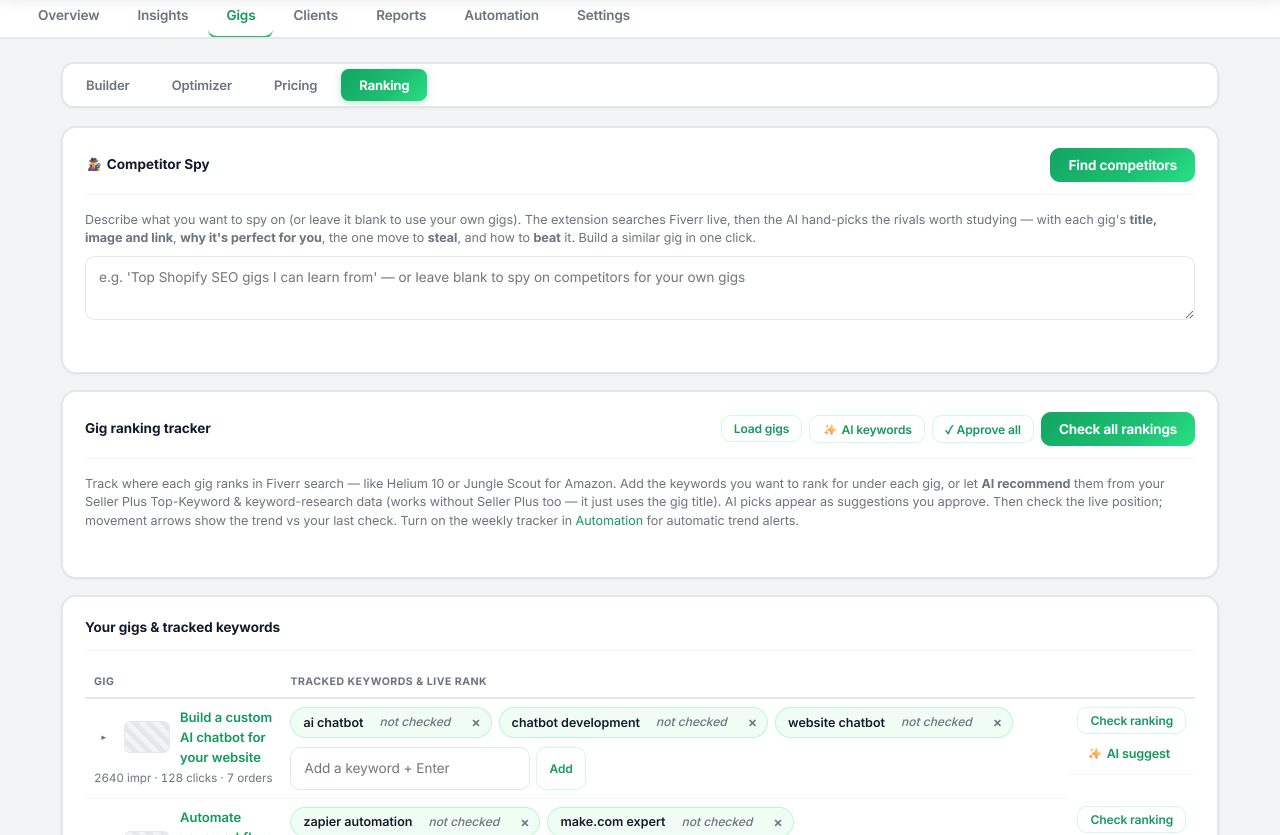
Keyword rank tracking supplies the placement context a CTR read needs: tracked keywords, position history, and movement over time, kept locally in Chrome. The optimizer fills nothing into Fiverr on its own; you approve every edit before it happens.
Fiverr Click-Through Rate questions
Where can I see my Fiverr click-through rate?
The standard per-gig panel does not show CTR. Seller Plus reporting does: the Top Keywords table lists a click-through rate per keyword, and the Gig Performance view compares your CTR with the subcategory average. Without Seller Plus, divide clicks by impressions for the same window to compute the same ratio.
What is a good CTR on Fiverr?
Fiverr publishes no benchmark for standard accounts, and a universal number would mislead across categories, prices, and placements. Seller Plus shows a subcategory comparison, which is more relevant than any figure quoted elsewhere. Otherwise, judge your own trend across equal windows and treat a single reading as noise.
Will changing my thumbnail hurt my ranking?
A card change alters how the gig performs with buyers who see it, and Fiverr's ordering depends on relevance and performance signals that change with every search. No tool or guide can promise an outcome. Change one element, keep a copy of the old version, and read a full window before deciding.
How long should a CTR test run?
Match the window to the panel's default period: 30 days before the change against 30 days after it, with nothing else edited in between. A gig with little traffic may need a longer window for the counts to be readable at all, and a quiet two weeks proves very little.
Let the card earn the click
Change one element, run a full window, and keep only the version that moves clicks.