 Seller OS
Fiverr proposal examples that win briefs
Sellers no longer pitch cold. Buyer Requests are gone, Briefs have been replaced by Mira, and new opportunities arrive as messages in your Inbox — so a proposal today is a response with a clock attached, usually the 24-hour window Fiverr names for keeping your response rate intact.
Below are two full proposals written for real situations, a side-by-side of weak and strong openings, and the habits that separate the replies buyers act on from the ones they scroll past.
Free plan available. Local-first data. Human review on every change.
Where a proposal gets written now
Two situations cover almost all of them. The first is a match: Mira, Fiverr's AI headhunter, describes a project and opens a conversation in your Inbox, and Fiverr tells sellers to respond to that first message within 24 hours so the response rate holds. The second is inbound: a buyer reads your gig and messages you first, with no window beyond the same 24-hour rule.
You cannot start a conversation with a new client, so there is no door-knocking version of this skill. Everything below is a reply to someone who already raised a hand, which changes the tone: you are confirming fit, not requesting attention.
The five-beat structure this site teaches — mirror, evidence, plan, price logic, question — is the skeleton behind both examples. Read the structure guide once, then use these as filled-in versions of it rather than as a competing framework.
Example one: replying to a matched project
Full proposal: You need twelve vertical clips from a weekly interview show, cut so each one stands alone in a feed. I edit this exact format: three clips per episode, captions in your brand font, hooks pulled from the first ten seconds of the guest audio, delivered in three days for the first batch. Two of the shows in my portfolio had no short-form presence before we started, and both are linked below. Pricing per clip depends on whether captions are burned in or delivered as a separate file — which of those do you need?
Why the opening works: it restates the project in the buyer's own numbers rather than in your biography. A buyer scanning a shortlist reads their own brief echoed back and treats that seller as the one who understood it.
Why the price question works: it is answerable in one word, and either answer changes the quote. A proposal that ends with a price alone forces the buyer to negotiate against a number; one that ends with a choice gives them a reason to reply.
- Mirror — their twelve clips, their weekly show, their feed
- Evidence — the format you already edit, two portfolio shows
- Plan — three clips, captions, three-day first batch
- Price logic — what changes the quote, stated openly
- Question — one word they can answer immediately
Example two: replying to a buyer who messaged you
Full proposal: Thanks for the details — a one-page site for a bakery, live within a week, with the menu and a booking form. That fits a single Basic package: five sections, mobile layout, and one revision round, delivered on day six so you have a day of buffer before the launch you mentioned. I build on a template you can edit yourself afterward, and the handoff includes a checklist. Do you already have the logo files and the copy, or should I draft the menu text from your photos?
Why this beats a greeting: it answers the buyer's actual question — can you do this, by when, for what — inside the first three sentences. Politeness is cheap; confirmation of scope is what the buyer is reading for.
The closing question does two jobs. It surfaces the two inputs that would otherwise stall the order, and it makes the next message from the buyer a reply rather than a fresh decision to keep shopping.
Weak openings next to strong ones
The opening line decides whether the rest is read. These pairs come from the same kind of project; only one side contains information the buyer can act on.
Read down the middle column. Every weak line is about the seller's availability, gratitude, or enthusiasm, none of which narrows the buyer's risk. The strong versions each carry a count, a date, or a restatement of the brief.
| Weak opening | Strong opening | What changed |
|---|---|---|
| Hi, I am available and interested | You need twelve clips from a weekly show | Brief echoed, not biography |
| I would love to work on this | Three clips per episode, delivered in three days | Plan with a date |
| I am an expert in this field | I edit this exact format; two shows are below | Evidence placed early |
| Please consider me for this job | What changes the quote: captions burned in? | Answerable question |
| I can start immediately | Day six delivery, a day before your launch | Timeline tied to their need |
The habits that get a proposal ignored
The common mistake is the universal paragraph: one well-written block sent to every opportunity, adjusted only in the greeting. Buyers compare shortlists side by side, and identical structure with identical claims makes you the middle of three indistinguishable options.
The second is burying the price question or omitting it. If the buyer has to ask what it costs, you have added a round trip to a conversation that already had a clock on it. State the logic, then let the reply set the number.
The third is letting the window close. Fiverr measures response rate on first replies within 24 hours across the last 90 days, and a proposal written beautifully on day two still counts as late. Drafts help: keep replies ready to review so the speed comes from preparation rather than from typing under pressure.
Where Seller OS helps
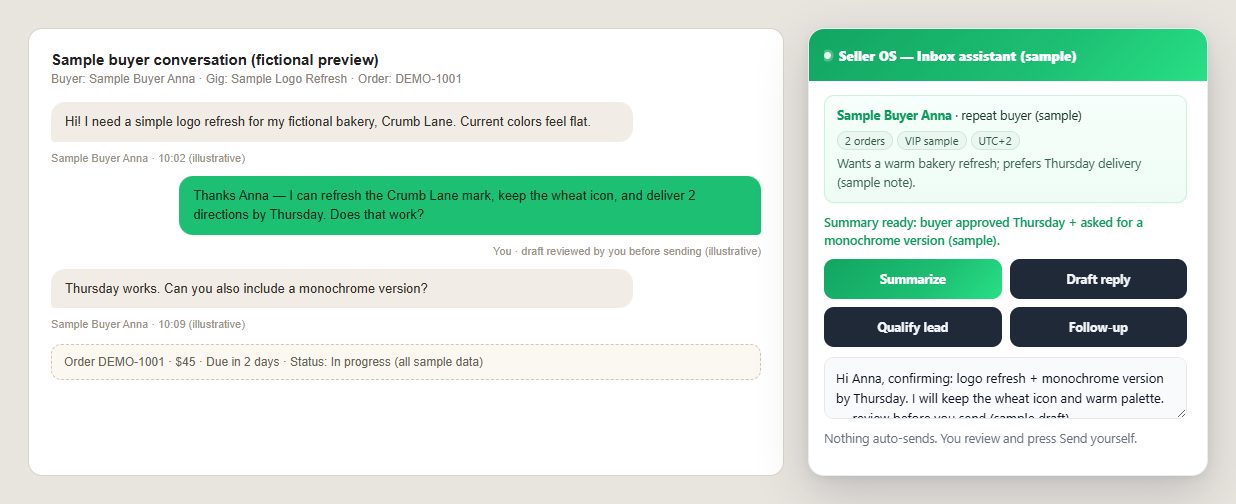
Seller OS drafts the reply from the opportunity text: it mirrors the buyer's nouns, places your closest evidence, proposes dates from your current queue, and offers a question you can send after one read. Inbox drafts and brief responses are written for review, so a 24-hour window does not mean a blank page.
Nothing is sent automatically. A person performs every final Send, Save, Continue, or Publish action, and the tool makes no claim about which reply will win.
Fiverr Proposal Examples That Win Briefs questions
How long should a Fiverr proposal be?
Short enough that the buyer can read it without scrolling twice. Four to six sentences carries the mirror, the evidence, the plan with dates, the price logic, and one question. Longer messages get skimmed, and a skimmed proposal loses the one detail that made it specific.
How soon do I need to reply to a matched opportunity?
Fiverr tells sellers to respond to Mira's first message within 24 hours to ensure the response rate is maintained, and response rate measures first replies sent within 24 hours over the last 90 days. A quick, specific reply beats a perfect one that arrives on day two.
Should I include my prices in the first message?
Include the logic rather than a bare number: what changes the quote, and the range you work in. That gives the buyer something to respond to immediately and keeps the negotiation in one thread instead of adding a round trip before they know whether you fit the budget.
Can I send my proposal outside Fiverr messages?
No. Conversations stay in the Inbox, contact details belong only in your profile, and moving business off the platform violates Fiverr's policies. Everything the buyer needs — scope, dates, price logic, question — fits in the message thread where the order protection lives.
Draft the reply against their words, not yours
Mirror the brief, add one piece of evidence, give dates, name the price logic, ask one question.