 Seller OS
Copycat stole your Fiverr gig: what to do next
A copied gig usually means the same title, tags, description wording, packages, and images appearing on another seller's listing. Because gigs are public pages, every word and image you publish can be seen and reused by anyone who opens it.
This guide separates the parts of a gig you can protect from the parts you cannot, walks through the report path Fiverr publishes, lists the evidence worth gathering before you report, and explains when a similar gig is ordinary competition rather than a copy.
Free plan available. Local-first data. Human review on every change.
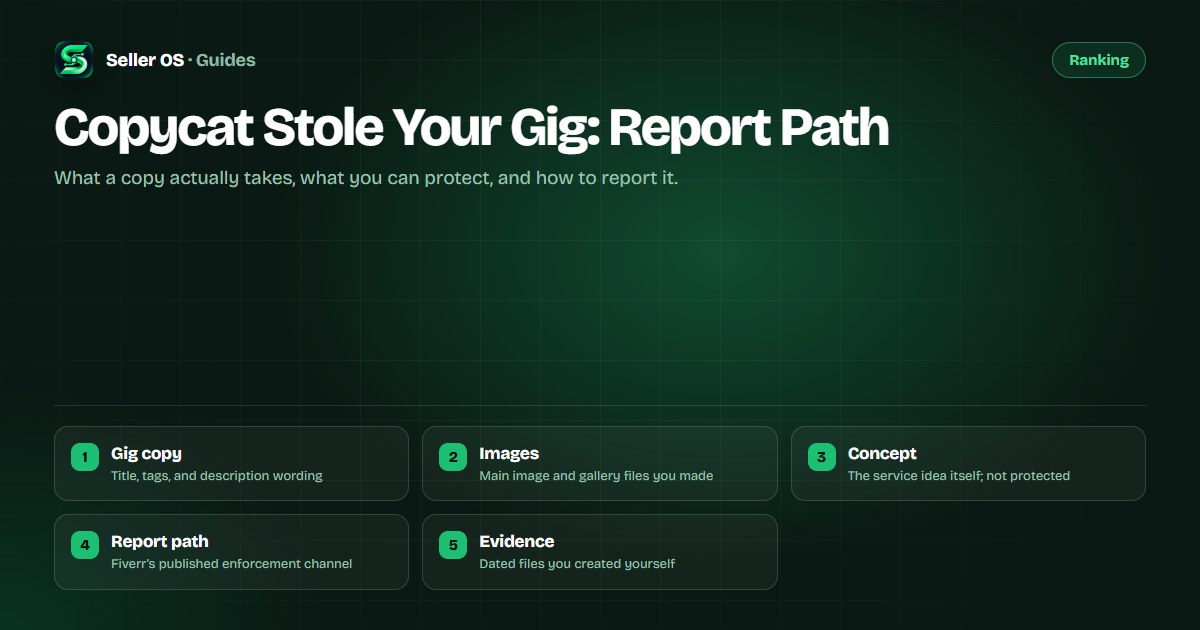
What a copycat actually takes
A cloned gig rarely copies one field. It tends to lift the title, the tags, parts of the description, the package structure, and sometimes the entire image gallery. All of those live on a public page, so they are visible to any logged-in user and to anyone who searches.
That visibility is the point of a marketplace listing, which is why the copy itself is not automatically a policy violation. What matters is whether the person reused work you created and whether the platform's rules were broken in doing it.
- Text: title, tags, and description phrasing lifted word for word.
- Images: your main image and gallery files reused without permission.
- Structure: the same packages, prices, and extras, rearranged.
- Delivery: the same promises and process steps, restated.
What you can and cannot protect
Copyright protects original work you made: the photographs, illustrations, video, and written description you created. It does not protect an idea, a service category, or a generic phrase such as a logo design gig described in plain terms. Another seller offering the same service is not, by itself, a copy.
Platform rules are separate from copyright. Fiverr's Help Center explains how it enforces its policies, and a report can be made for content that breaks those rules regardless of who wrote it. Keep the two ideas apart: one is a legal question, the other is a platform question.
| Element | Protected | Why |
|---|---|---|
| Your photos and video | Usually yes | Original creative work you made |
| Your description text | Usually yes | Original writing, not the idea |
| The service idea | No | Ideas and categories are not owned |
| Common industry phrases | No | Generic terms are free to use |
| Your brand name and logo | Trademark rules | Protected as a mark, not a service |
The report path on Fiverr
Reporting starts with the content, not with a message to the other seller. Fiverr's Help Center on how it enforces policies is the channel to use when a listing reuses your work or breaks a rule. Contacting the copycat directly usually leads nowhere and can pull you into an argument you do not need.
Gather your evidence before you submit anything. A report with dated originals is far easier to act on than a report that only describes what happened.
Document the copy
capture the other gig's URL, screenshots, and the fields that match yours.
Collect your originals
the source files, dates, and any upload history that predates the copy.
Use the report channel
follow the enforcement path Fiverr publishes in its Help Center.
Keep the thread together
submit once and add evidence rather than filing new reports.
Evidence worth gathering first
The strongest evidence proves that your version existed first and that you made it. Original design files with creation timestamps, camera originals with metadata, and dated portfolio uploads all do that. Screenshots of the other listing show what was taken, but they do not show ownership.
Keep everything in one folder and note the date of each item. If the case needs escalation later, a tidy record is faster for everyone to read.
- Source files with creation dates for images and video.
- Screenshots of both gigs, taken on the same day.
- Your gig's publish date and edit history.
- Dated portfolio uploads that predate the copy.
When a similar gig is not a copy
Two sellers can offer the same service in the same words and both be within the rules. Category pages are built around shared language, and buyers search with the same phrases everyone else uses. A template, a stock tool, or a widely taught format is not theft.
The test is simple: did the other seller reuse something you created, or did they arrive at a similar result on their own? If it is the second, the useful move is differentiation rather than a report.
Differentiate instead of chasing
A copy has to run on your original asset set. When your images, video, process proof, and wording are specific to how you work, a copy looks hollow next to the real thing. That is a better defense than any report, because it also converts better.
Start with the parts that are hardest to lift. A short video showing your process, a case study with the reasoning written out, and a portfolio built around one narrow specialty are all difficult to duplicate. The gig stand-out guide covers that work, the thumbnail guide handles the click, and the SEO tips keep you visible on the terms that matter.
Where Seller OS helps
Seller OS helps on the differentiation side, because that is where a seller can compound an advantage a copy cannot copy. The gig builder turns your offer into a structured draft and fills the wizard for your review, and the gig optimizer reviews a live gig's copy, gallery, and conversion signals against its own performance data.
Everything runs locally in Chrome and nothing publishes on its own; a person completes every Save, Continue, or Publish action. Client records and order history stay on your machine.
Copycat Stole Your Gig questions
Can I report someone for copying my Fiverr gig?
Yes, if the copy reuses work you created or breaks a platform rule. Fiverr's Help Center explains how it enforces policies, and that is the channel to use. Describe what was taken, attach dated originals, and submit once rather than filing repeated reports.
Is it illegal to copy a Fiverr gig description?
Copying original text or images you made can raise a copyright question, but offering the same service is not illegal on its own. Ideas, service categories, and common phrases are not owned by anyone. If someone reused your actual files or wording, that is the part worth reporting.
What evidence do I need before reporting a copy?
You need proof that your version existed first and that you made it. Source files with creation dates, camera originals with metadata, and dated portfolio uploads do that. Add same-day screenshots of both listings. A tidy, dated folder is easier for a reviewer to act on than a description alone.
Can two sellers offer the same service?
Yes. Marketplace categories are built around shared language, so many sellers describe similar services in similar words. The question is whether one reused work the other created. If both arrived at the idea independently, the healthier response is to differentiate your offer rather than treat it as theft.
Protect what is yours, then out-build it.
Report reused work through Fiverr's published path, and make the parts a copy cannot lift your real advantage.