 Seller OS
Fiverr removed professions: what sellers should know
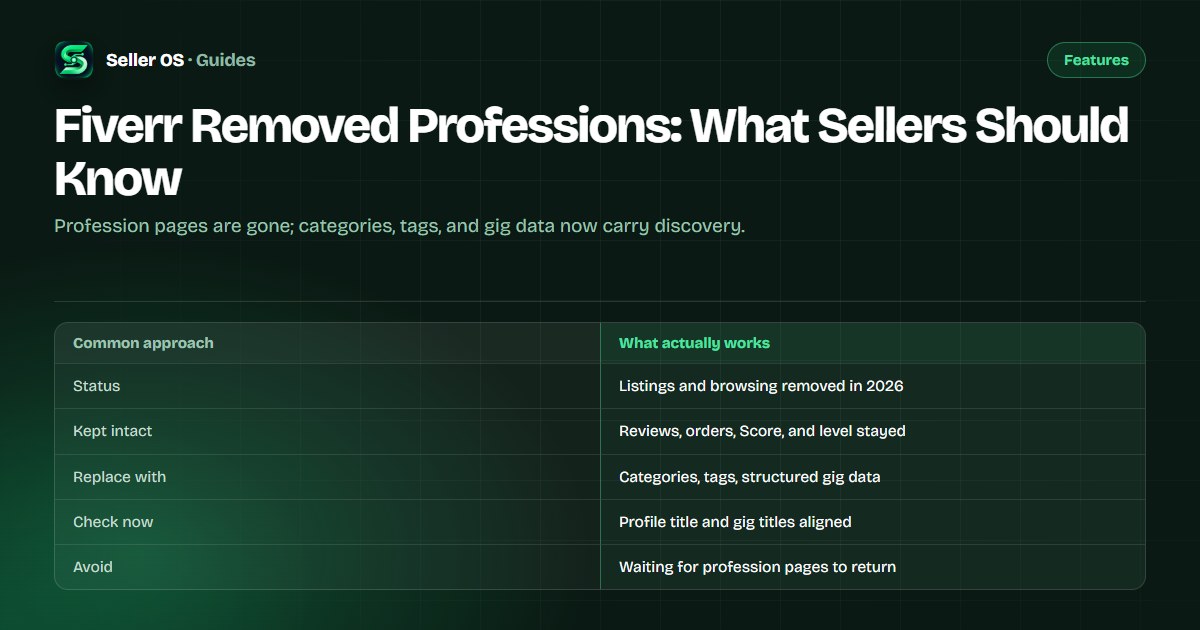
Current status first: seller notices and community reports from around July 2026 state that Profession listings, seller profession pages, and the Professions browsing experience would be removed, with clients no longer discovering sellers through Professions. No official help-center article documenting the removal was found as of October 2026.
This guide covers what Professions was, what the quoted notice states stayed intact, and the practical rebuild for sellers who relied on it. Removal timing is attributed to seller and community reports, never stated as an official Fiverr date.
Free plan available. Local-first data. Human review on every change.
Current status of Professions
Seller notices quoted in community discussion around July 2026 stated that Profession listings, seller profession pages, and the Professions browsing experience would be removed from the platform and clients would no longer discover sellers through Professions. The same quoted notice stated that reviews, ratings, order history, Success Score, and seller level would stay exactly as they were.
Treat the announcement timing as reported, not official: no surviving official help page was found, and the current Terms of Service page dated January 2026 still defines Professions, which suggests the legal text was not updated. Do not plan around a specific removal day, and do not expect the pages to return at any point.
What Professions actually was
Professions was a 2024 to 2025 era profile-layer feature that grouped sellers under professional identities with dedicated listing and browsing surfaces. For buyers it offered one more way to find people beyond search and category pages; for sellers who earned a profession slot it acted as a secondary storefront beside their gigs.
Its removal affected listing discovery only, according to the quoted seller notice. Nothing in the reports stated that gigs, orders, or reputation data were touched, which is why panicked advice about rebuilding reviews from scratch was wrong from the start and why your first audit should focus on traffic sources rather than reputation repair.
What carries discoverability now
With profession pages gone, discovery runs through the standard surfaces: categories and subcategories, gig titles, search tags, structured gig data such as packages and FAQs, and profile copy including your professional title. Each of these is fully in your control, unlike a platform-curated profession slot, which means the work you invest now compounds instead of depending on access you cannot reclaim.
Illustrative scenario: a seller who appeared under a voiceover profession page now competes purely on gig search. Rewriting the gig title to name the deliverable, aligning five tags to buyer phrasing, and adding a FAQ that answers the top pre-order question restores the relevance signals the profession badge used to imply.
- Confirm every gig sits in its most specific correct subcategory.
- Rewrite titles around buyer deliverables, not identity labels.
- Align tags, package names, and FAQs to the same keyword set.
- Sharpen your professional title per the title guide below.
Rebuild checklist for affected sellers
Start with measurement, not edits. Note current impressions and clicks per gig, list which traffic used to reference profession pages, and screenshot your profile as it stands. Then work gig by gig: category, title, tags, thumbnail proof, and description order, keeping one dated change log so you know exactly what moved the needle.
A common mistake sellers make is rewriting everything in one evening and then being unable to tell which edit helped. Change one gig fully, wait for fresh data, then roll the pattern across the rest. Rushing the rollout also risks tripping review filters on several gigs at once, which leaves you blind about both ranking and approval status. The profile optimization guide and the professional title guide sequence this work without repeating it here.
Record per-gig impressions and clicks before changing anything.
Fix category placement and buyer-language titles first.
Align tags, packages, and one proof element per gig.
Update the profile title and description to match the gigs.
Recheck dashboard data before touching the next gig.
Profile title versus gig title after removal
The profile title now carries more of the identity weight that profession badges once shared. Keep it to the outcome you sell and the buyer you serve, and let each gig title carry the specific deliverable. When both layers use the same buyer language, search and human skimming reinforce each other consistently across every surface.
Illustrative example: a profile title naming conversion-focused product descriptions plus gig titles naming Amazon listings, Shopify descriptions, and website copy reads as one coherent specialty. Three gigs with three unrelated title styles reads as three strangers, which is how sellers waste the focus Professions used to provide.
What not to do about the removal
Do not buy services promising to restore profession placement, do not stuff gig copy with the word profession hoping the old pages return, and do not open a second account to chase a vanished surface. Each of those trades a recoverable visibility dip for a policy risk that can cost the account itself.
If your level dashboard shifted at the same time, read it through the level system guide and the new seller dashboard guide before blaming the removal. Levels rest on Success Score, rating, response rate, orders, clients, and earnings, none of which the quoted notice stated were affected.
Where Seller OS helps
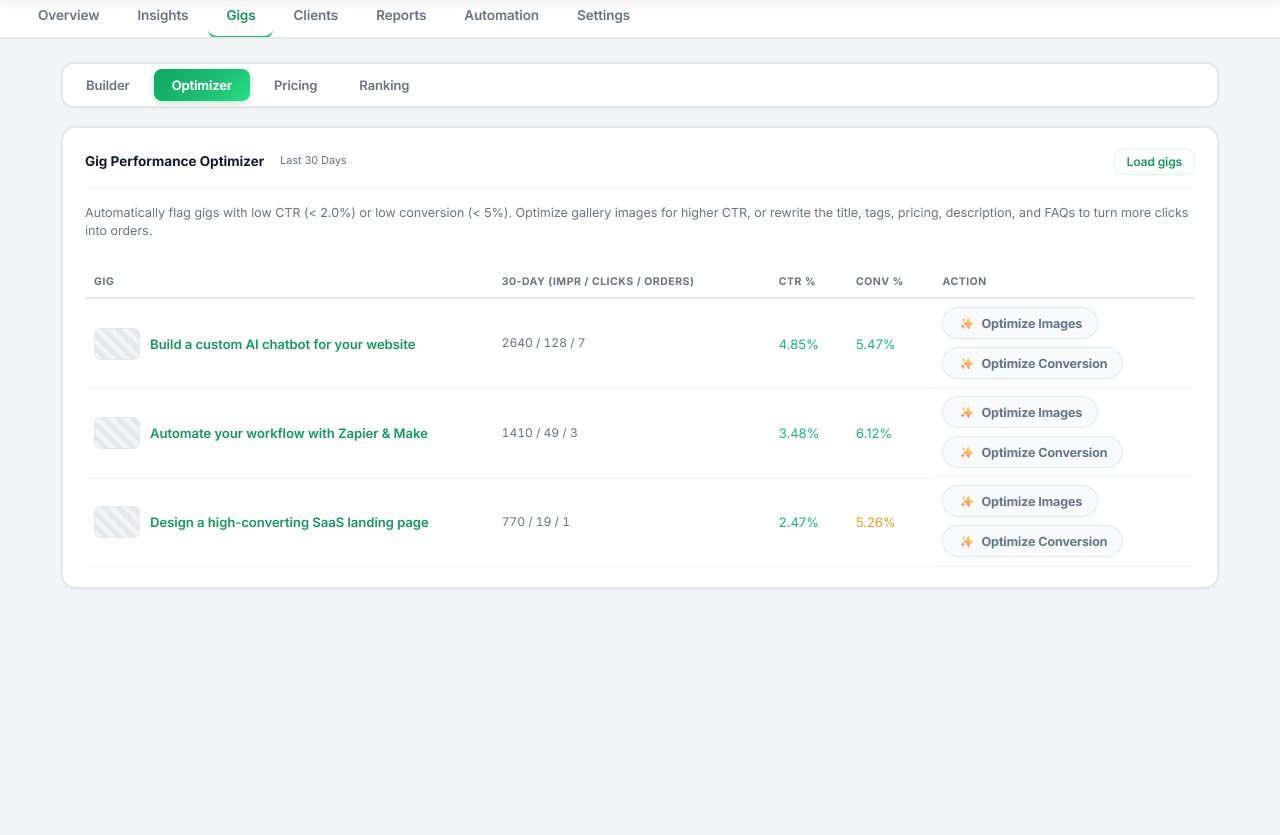
Seller OS helps the rebuild this removal forces: its Gig Performance Optimizer reviews a live gig's copy, gallery, and conversion signals against the gig's own performance data and proposes changes, while keyword research help and rank tracking show whether rewritten titles and tags are moving. A person completes every Save, Continue, or Publish step.
It does not restore profession pages, contact Fiverr about the removal, or promise ranking recovery. It drafts and fills; you decide what goes live and measure the result in your own dashboard data.
Fiverr Removed Professions questions
Did Fiverr remove Professions?
Seller notices quoted in community reports from around July 2026 stated that Profession listings, seller profession pages, and the Professions browsing experience would be removed. No official help-center article confirming the removal was found as of October 2026. Treat the removal as real and reported, but do not cite an exact official removal date.
Did removing Professions delete my reviews or level?
No. The quoted seller notice stated that reviews, ratings, order history, Success Score, and seller level all stay exactly as they are. The removal affected listing discovery only. If your metrics moved at the same time, look for separate causes such as late deliveries, cancellations, or response-rate slips rather than assuming the removal reset your reputation.
How do buyers find me now without Professions?
Through the standard discovery surfaces: category browsing, gig search, tags, packages, FAQs, and profile copy. As practical advice, align every layer to the same buyer language, keep gigs in their most specific correct subcategory, and give each gig one clear proof element. The change rewards sellers whose gig data is legible over sellers who relied on a badge.
Should I change my profile title after the removal?
Review it, yes. With profession badges gone, your professional title carries more identity weight, so make it name the outcome you sell and the buyer you serve. Keep it consistent with your gig titles rather than duplicating them. Small alignment edits beat a full rebrand unless your specialty itself has changed.
Replace the badge with better gig data
Fix categories, titles, and tags gig by gig, and measure before moving on.