 Seller OS
Fiverr profile title vs gig title: use each right
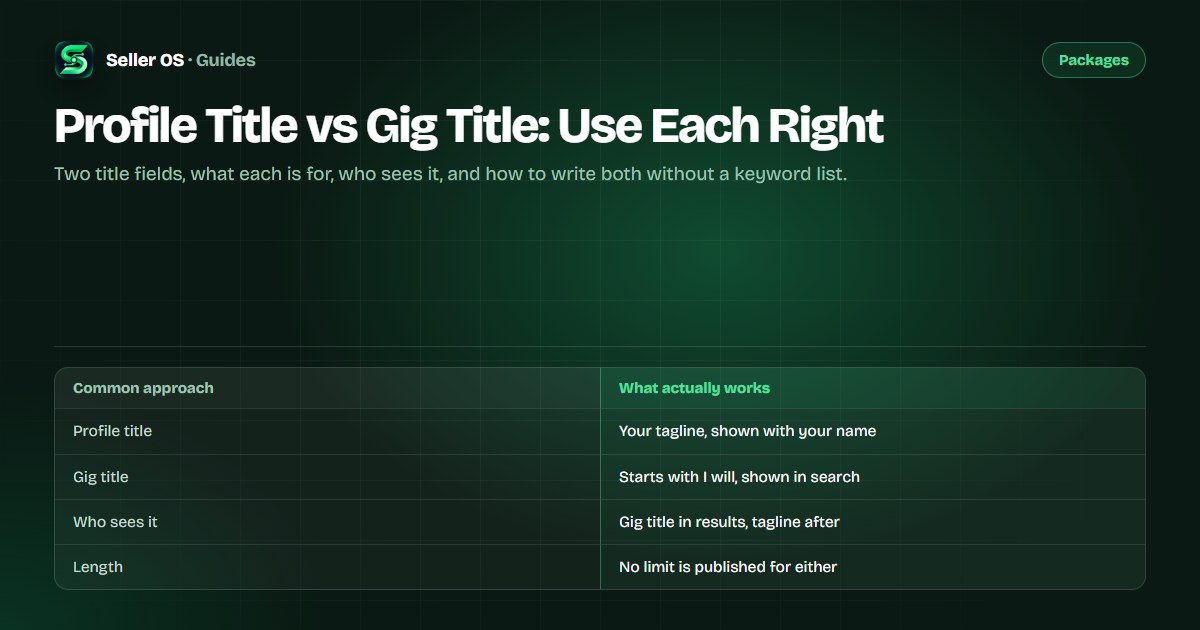
Fiverr asks you to write a title in two different places, and the fields are easy to confuse because both are short lines about your work. The profile title is your tagline, shown with your name on your profile. A gig title names one service and is what buyers see in search results.
They serve different readers and follow different rules, from the prefilled I will to whether the field appears in search at all. This guide separates the two, settles the length question without quoting a number Fiverr does not publish, and shows how to write each without turning it into a keyword list.
Free plan available. Local-first data. Human review on every change.
Two title fields with two different jobs
The profile title is the professional title, the short tagline displayed next to your name on your freelancer profile. Fiverr's profile article gives it one rule: keep it short and describe what you do, without words like expert, best, or Fiverr.
A gig title is the headline of one service listing. Fiverr's Creating a Gig article pre-fills the field with I will and asks you to keep it short, clear, and to the point, and to avoid special characters such as ampersands, slashes, quotation marks, and plus signs.
The quickest way to tell them apart: a gig title completes the sentence I will, and a profile title completes the sentence I am. One sells a service; the other positions a seller.
The length question, without the myth
You may read that gig titles are capped at 80 characters, but that figure does not appear in Fiverr's current help articles. Neither does a character limit for the profile title. Treat any published number as unverified and let the editor's own counter be the practical limit, because the field shows you exactly how much room you have.
Length still matters, just not as a rule to memorize. In search results a gig title is trimmed to fit a card, so a phrase that arrives late may never be read. Put the primary phrase near the front and let the rest of the sentence support it.
Set a working budget you can defend and measure it with a character counter. A gig title that stays short and complete, and a profile title that names one thing, will fit every layout Fiverr uses.
Who sees each title, and where
A gig title appears in search result cards, on the gig page, and across the category it sits in. That card is the first thing a buyer reads, and it decides whether they click. Search shows gigs rather than profiles, so the gig title does the visibility work.
The profile title is not a search element. A buyer reaches your profile by clicking through from a gig, a review, or a portfolio piece, and the tagline is read there, under your name, alongside your About and your portfolio. Its job is fit and positioning, not reach.
| Question | Profile title | Gig title |
|---|---|---|
| What it is | Tagline under your name | Headline of one service |
| Appears in search | No | Yes, as the result card |
| First prefix | None | I will |
| Its reader | Buyer already on your profile | Buyer scanning results |
| Its job | Positioning | Visibility |
How search treats the gig title
Search is where the gig title earns its keep. Because results are gig cards, the words in the title and tags are what match a buyer's query, and the phrasing decides whether they click. Fiverr's help center notes that your level is visible on gig cards, gig pages, and your profile, one of the signals that travels with the listing.
The profile title is not part of that search surface. Fiverr does not publish that profile fields change search ranking, so treat the tagline as conversion wording: it works on the buyer who already arrived, not on the one who has not.
That split tells you where to spend effort. If impressions are the problem, the gig title and its keywords are the lever. If visits arrive and do not convert, the profile title is one of the first lines to check. The ranking guide goes deeper on the first case.
Writing each title without stuffing
A stuffed title reads as a list of phrases rather than a sentence, and it helps no one: the buyer cannot tell what you actually offer, and a wall of close variants adds noise rather than coverage. Both fields reward the same discipline, one clear idea phrased the way a buyer would say it.
Write the gig title as a finished sentence after I will: one primary phrase early, then the outcome or the buyer. Write the profile title as service, buyer, and one true qualifier. Neither field needs a tool list or a chain of synonyms.
- Gig title: finish the I will sentence, with one primary phrase early.
- Gig title: skip special characters such as ampersands and plus signs.
- Profile title: name one service and one buyer, not your whole range.
- Both: cut stacked adjectives and tool names that filter nothing.
- Test each line by reading it aloud; if it sounds like a list, rewrite it.
Weak and strong versions of each
The lines below are hypothetical, written to show the pattern rather than to be copied. Each weak version is a keyword pile; each strong version answers a buyer's question in plain words.
The strong gig titles stay inside the prefilled I will sentence, name one service, and stop. The strong profile title drops every claim a competitor could also make and names the work this seller wants more of. Nothing was added to make them work; something was removed.
Run the same test on your own fields: underline the primary phrase, delete adjectives no one can verify, and reread the line as the buyer who will see it. The professional title guide covers the profile side, and the gig title checker covers the listing side.
| Field | Weak | Strong |
|---|---|---|
| Gig title | Logo design, brand identity, business card, and social media kit | I will design a minimal logo for your coffee brand |
| Profile title | Graphic Designer Expert 10+ Years Fast Delivery | Packaging labels for small food brands |
| Gig title | Professional stunning modern WordPress website design | I will build a fast WordPress site for your service business |
Where Seller OS helps
Seller OS does not write either title for you, and it never edits a field on Fiverr on its own. What it does is feed the decision: keyword research surfaces phrases buyers actually use, and the gig builder drafts a structured gig, title included, from a one-line idea so you have a starting line to rewrite rather than a blank field.
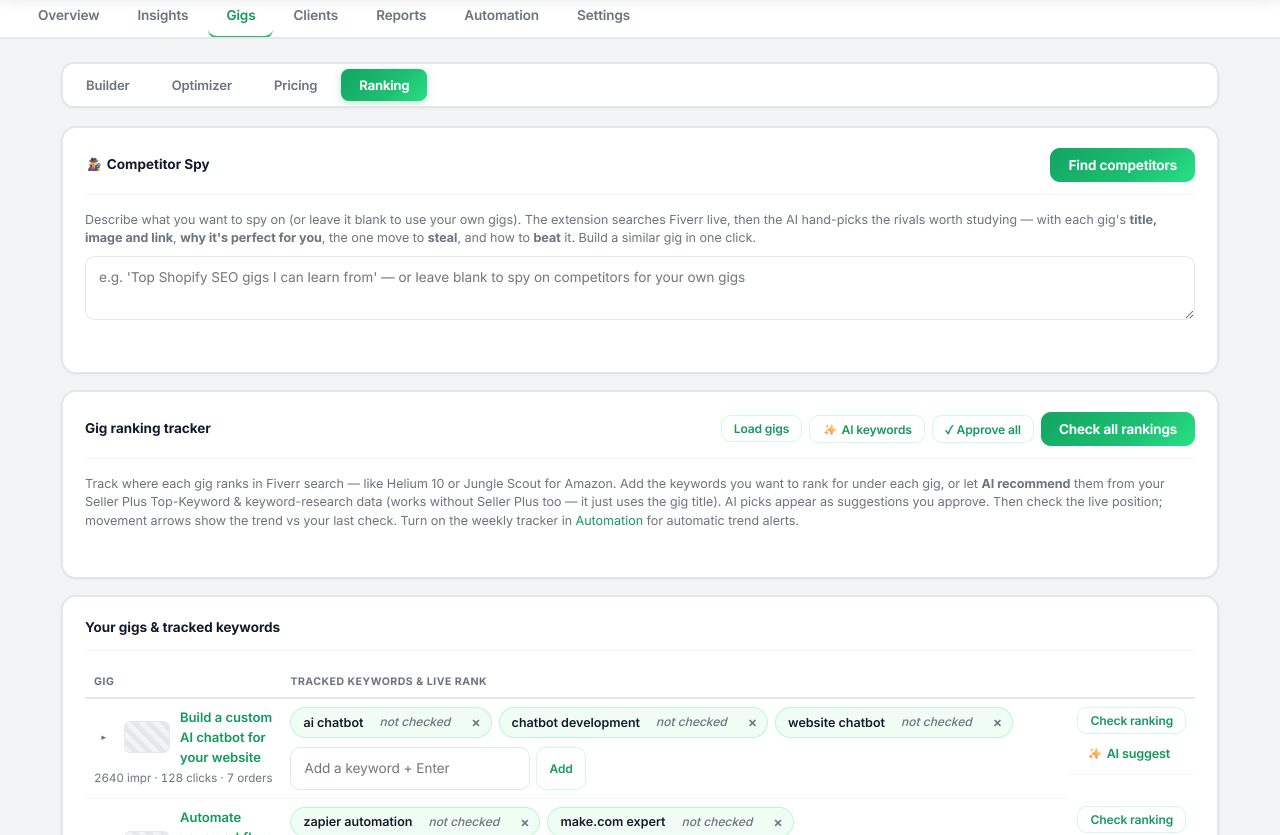
Rank tracking then records where your gigs sit for the phrases you chose over time, which is how you learn whether a title change helped. Drafts, saved keywords, and history stay in Chrome local storage, and a person completes every Save and Publish action.
Profile Title vs Gig Title questions
What is the difference between a Fiverr profile title and a gig title?
The profile title is the tagline shown with your name on your profile, and it describes you. A gig title is the headline of one service and appears in search results. Fiverr pre-fills the gig title with I will, while the profile title has no prefix. One positions a seller; the other sells a service.
Is there a character limit for Fiverr titles?
Fiverr does not publish a character limit for either field, and the often-quoted 80-character figure for gig titles does not appear in the current help articles. The editor's own counter is the practical limit. Keep both titles short anyway, because a long gig title gets trimmed in search result cards.
Does the profile title affect Fiverr search ranking?
Fiverr does not publish that profile fields change search ranking, and search results show gigs rather than profiles. Treat the profile title as conversion wording that works on a buyer who already opened your profile. The gig title, by contrast, is the line buyers see and click in search results.
How do I write a Fiverr title without keyword stuffing?
Write the gig title as a finished sentence after I will, with one primary phrase early and an outcome or buyer after it. Write the profile title as one service, one buyer, and one true qualifier. Skip tool lists, stacked adjectives, and close variants. If a line reads like a list, rewrite it as a sentence.
Give each title field its own job.
Write the gig title for search and the profile title for fit, then stop stuffing either one with phrases.