 Seller OS
Fiverr SEO for Shopify developers: themes, fixes, speed
Shopify buyers arrive with a task and a store already chosen: customize this theme, migrate from another platform, make the site faster, connect an app. The searches name the task — shopify theme customization, migrate to shopify, shopify speed optimization — and the gig that names it is the one that gets opened.
This guide covers task phrases, the difference between migration and setup, proof that respects client data, and why Shopify work packages well as fixed tasks rather than open-ended hours. Keyword examples are illustrative and worth validating in your own subcategory.
Free plan available. Local-first data. Human review on every change.
The task phrases Shopify buyers type
Shopify search intent is specific. Buyers type shopify theme customization, shopify store setup, migrate to shopify, shopify speed optimization, and shopify app integration, usually with a store URL and a deadline behind the message. None of those buyers are comparing platforms; they have committed to Shopify and need the task completed.
Build your gig around one task family and keep adjacent tasks as packages or separate gigs. A store owner whose theme section is broken will not read a full store build offer. The illustrative set below shows how one seller maps a theme customization gig.
| Role | Example keyword | Why it fits |
|---|---|---|
| Primary | shopify theme customization | The task phrase with the clearest intent |
| Supporting | shopify theme setup | Buyers who just bought a premium theme |
| Supporting | shopify website design | Broader phrasing for full store builds |
| Long-tail | shopify dawn theme customization | Theme-qualified; matches one specific buyer |
| Long-tail | fix shopify theme layout | Symptom phrasing with urgent intent |
Migration, setup, and speed are different gigs
A migration buyer comes from WooCommerce, Etsy, Squarespace, or a custom build. They need products, customers, and orders moved, URLs handled, and redirects in place, and they are anxious about losing data or search visibility. A setup buyer has a fresh store and a theme, and needs it shaped. A speed buyer has a live store that feels slow, often after adding apps.
Each intent fails in a different place, so each deserves its own title, description, and requirements. Migration especially rewards specificity: name the platforms you move from, what transfers, and what the buyer must prepare. The WordPress developers guide covers the WooCommerce side; on this page, keep the source platforms explicit in your keywords.
Shopify title patterns that scope the task
Fiverr pre-fills titles with I will and asks for clear, special-character-free language. Shopify titles should carry the platform plus the task, because the platform is fixed for the buyer and the task is the decision. Reach for [task] for [platform] or [platform] [task] with [qualifier].
The example fill-ins below read as sentences and put the exact search phrase near the start. Swap the qualifier to match the store you serve best: a brand, a niche, or a single platform migration.
| Pattern | Example fill-in | Fits when |
|---|---|---|
| [Task] for [platform] | I will customize your Shopify theme and layout | Theme-level design work |
| [Platform] [task] | I will set up your Shopify store from scratch | New store setup |
| [Task] from [source platforms] | I will migrate your Etsy store to Shopify | Migration intent with named sources |
| [Platform] [outcome] for [store type] | I will speed up your Shopify store for mobile shoppers | Speed work on a live store |
Store proof without leaking client data
Store work is public at the storefront and private in the admin. That split sets the proof rule: show what any shopper can see — the homepage, a product page, the theme name, the section you built — and never show admin dashboards, revenue, conversion figures, or customer lists. If you want to reference results, get written permission and keep it qualitative rather than publishing numbers.
A before-and-after pair works well for design and speed work: the same page, the same viewport, the old state and the new. Portfolio projects hold one to five files and a description of 120 to 1,400 characters, which is room to state the store type, the theme, and the task. The portfolio guide covers the fields; on this page the discipline is the point.
Package Shopify work as fixed tasks
Shopify requests arrive as tasks, so the cleanest ladder sells tasks rather than vague hours. Basic: one change, such as a theme section or a product template fix. Standard: a bundle, such as theme setup with three sections and a speed pass. Premium: the project, such as a full store build or a migration with redirects.
Fiverr's package rules allow three tiers per gig, each with its own delivery time, revision count, and price, and the starting price floor is $5 unless the category sets a higher minimum, as Fiverr's gig creation article explains. Name the deliverable in every tier so the offers compare cleanly.
Write what the task does not include, because this category fills up with follow-on asks: app subscriptions, copywriting, product uploads, and ongoing store management. A clear exclusion line turns a scope question into an upsell instead of a dispute. The packages guide covers tier mechanics.
Shopify developer SEO mistakes
The generic ecommerce expert title hides the platform buyers search by. So does burying the theme name and leaving out the source platforms on migration gigs. A third mistake is proving work with admin screenshots, which signals that you would expose the next client's data too.
A fourth is treating speed work as a promise instead of a deliverable: describe what you audit, what you change, and how you report measured results from the tools you use. A fifth is letting one gig sprawl across setup, migration, and maintenance, when each task has its own searcher. The gig SEO checklist covers the pre-publish pass, and the how to rank a gig guide covers testing changes over time.
Where Seller OS helps
Seller OS helps turn a task list into structured gigs and then watch them. The Gig Builder drafts category, title, tags, description, and packages from a one-line idea or a competitor URL, and fills the Fiverr wizard while you handle Save and Publish. The Gig Performance Optimizer reviews a live gig's copy and gallery against its own performance data and proposes changes.
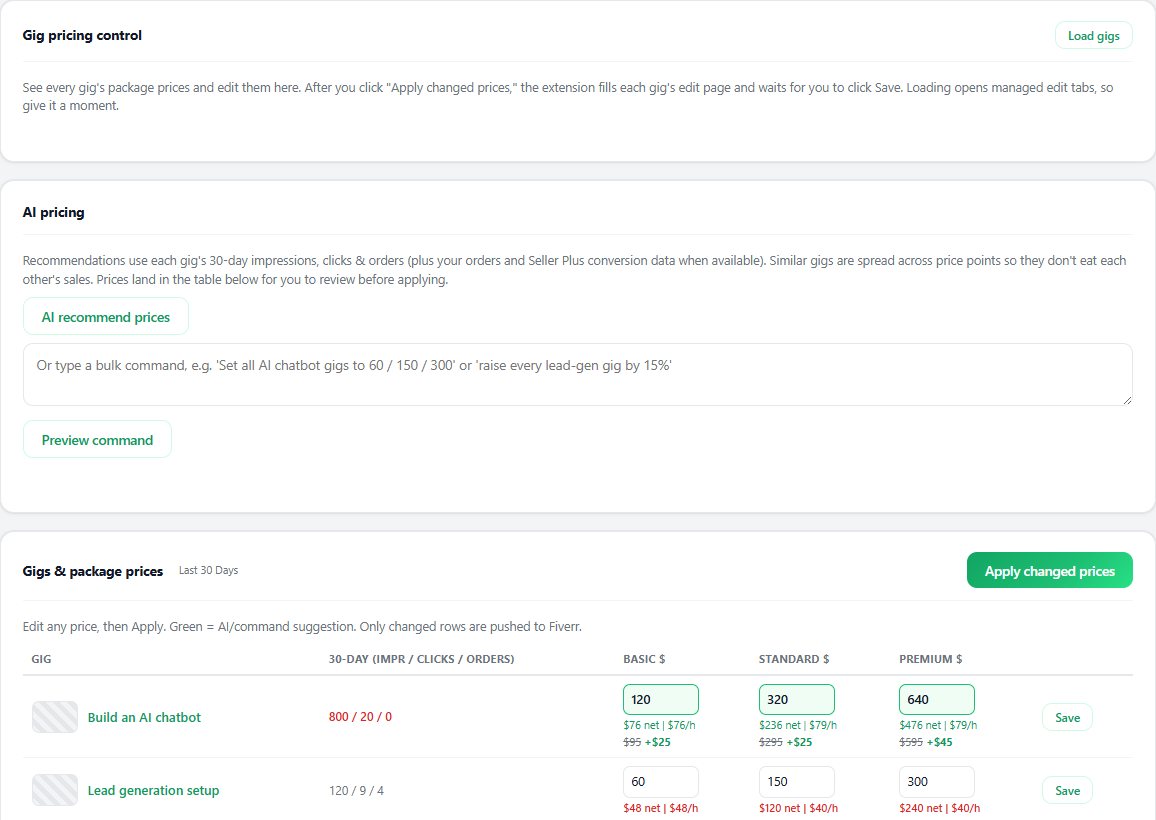
Because Shopify sellers usually price by task, the package review side matters too: Seller OS checks pricing assumptions against recent applied prices with guardrails, so a migration quote does not drift below the work behind it. Drafts and reviews stay in Chrome local storage, and every send or publish remains a human action.
Fiverr SEO for Shopify Developers questions
What should a Shopify gig title include?
The platform and the task. Buyers search shopify theme customization or migrate to shopify, not ecommerce help, so the title should carry both words near the front and read as a sentence after the pre-filled I will. Keep it to one task family, and avoid special characters.
How do I price Shopify work on Fiverr?
Price by task, not by the hour. A common ladder is one change in Basic, a bundle in Standard, and a full project such as a migration in Premium. Fiverr allows three tiers and sets a $5 starting floor unless the category minimum is higher. State exclusions so follow-on asks become paid scope instead of disputes.
Can I show my client's Shopify store in my portfolio?
Show the public storefront: the homepage, a product page, the theme, or the section you built, ideally with permission and a before-and-after pair. Never publish admin dashboards, revenue, conversion figures, or customer lists. Fiverr's portfolio fields allow one to five files and a description of 120 to 1,400 characters for context.
How do I rank for Shopify migration keywords?
Give migration its own gig with a title that names the platforms you move from, such as Etsy to Shopify, and put the task phrase near the front. Describe what transfers and what the buyer prepares in the description and requirements. Then give any keyword change at least 30 days before judging it, as Fiverr's help center advises.
Scope the task, name the platform.
Pick one Shopify task family, put the platform phrase in the title, and build packages that state what is included.