 Seller OS
Fiverr SEO for WordPress developers: fix, speed, build
WordPress buyers search for a task, not a job title: fix a fatal error, speed up a slow site, finish an Elementor page, set up WooCommerce. A gig titled wordpress developer competes in a crowded pool; a gig that names the task enters searches where the buyer is already frustrated and ready to hire.
This guide covers task-first phrases, builder and plugin qualifiers, the proof WordPress buyers accept, and why maintenance work deserves its own gig. Examples are illustrative; validate any phrase in your own subcategory before you build a track list around it.
Free plan available. Local-first data. Human review on every change.
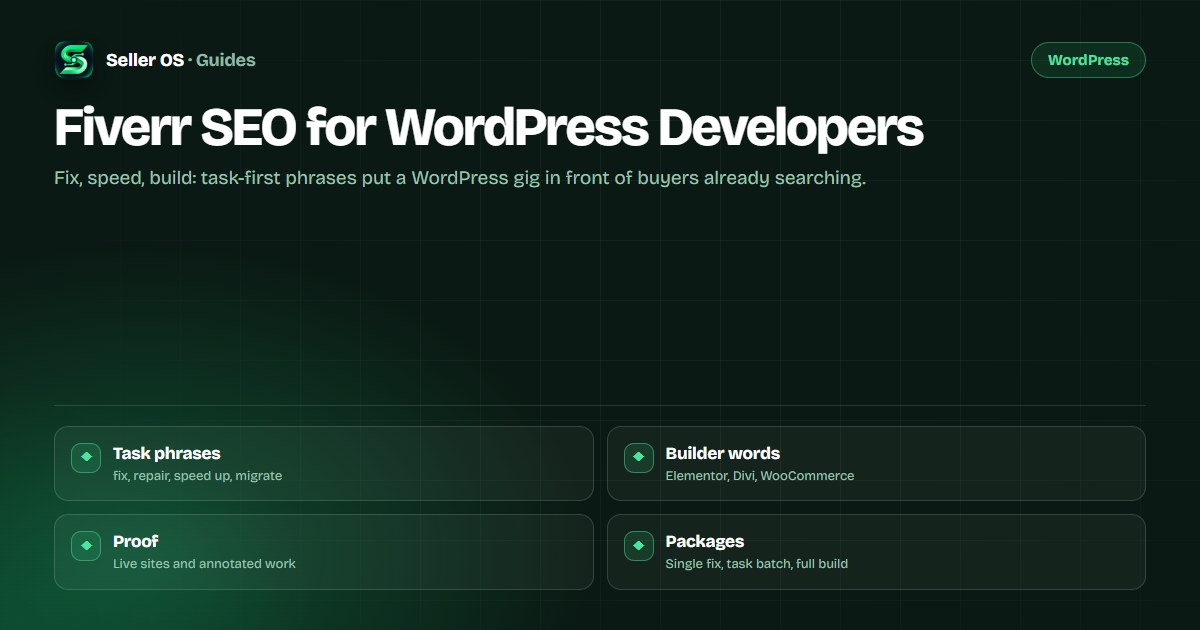
Three buyer intents: fix, speed, build
WordPress searches cluster into three intents. Fix: an error, a white screen, a broken layout, a plugin conflict. Speed: a site that loads slowly, fails audits, or feels heavy on mobile. Build: a new site, a redesign, or a page added to an existing theme. Each intent uses different words and expects a different deliverable.
Group your gigs and keywords by intent instead of by technology. A buyer with a broken checkout is not comparing you to a new-build designer; they want the problem gone today. The table below is an illustrative starting set for one seller who runs a fix gig and a build gig.
| Role | Example keyword | Why it fits |
|---|---|---|
| Primary | fix wordpress error | Task-first phrase with urgent intent |
| Supporting | wordpress bug fix | Same intent, different wording |
| Supporting | wordpress site repair | Buyers who frame the request as repair |
| Long-tail | fix elementor layout issue | Builder plus problem; narrow and specific |
| Long-tail | wordpress white screen fix | Symptom phrasing straight from search |
Builder and plugin phrases that qualify
Builder names are qualification words buyers add themselves: Elementor, Divi, WPBakery, Gutenberg, WooCommerce. A buyer searching elementor website design wants someone fluent in that builder, not a generalist who will fight it. Claim a builder phrase only if your portfolio shows work in it, and keep the claim specific enough to be true.
Plugin and stack phrases work the same way — woocommerce setup, learnpress course site, membership site wordpress — but watch the overlap. WooCommerce is the WordPress route to a store, and its buyers behave differently from Shopify buyers, which is why store work often belongs in its own gig. The Shopify developers guide covers that audience; here, keep WooCommerce phrases tied to store setup and plugin work.
Title patterns for task-first WordPress gigs
Task titles read like the buyer's own sentence. Fiverr's guidance is a short, clear title with no special characters, and the field comes pre-filled with I will. The two productive shapes are [verb] plus [problem] and [platform] plus [deliverable].
Keep one task family per title. Mixing fix language and build language in one sentence confuses both the buyer and the match. If you sell both, give each intent its own listing and let the requirements forms ask different questions.
| Pattern | Example fill-in | Fits when |
|---|---|---|
| [Verb] [problem] | I will fix wordpress errors and broken layouts | Urgent fix intent |
| [Verb] wordpress [outcome] | I will speed up your wordpress website | Performance intent |
| [Builder] [deliverable] | I will build an Elementor website for your business | Builder-qualified build |
| [Deliverable] with [platform stack] | I will set up a WooCommerce store with payments | Store setup intent |
The proof WordPress buyers accept
WordPress proof has a privacy edge: you often work inside a client's site, and the work is invisible in a screenshot unless you think about it. Show the public result — the finished site, the page you built, the before-and-after of a fixed layout — plus a written line on what the problem was and what you changed. Never publish admin screenshots with client data, and never show traffic or sales figures without written permission.
Portfolio projects hold one to five files each, with descriptions running 120 to 1,400 characters, which is room for the problem, the change, and the result. For build work, a live link plus one screenshot of the page at phone width answers the buyer's two questions: does it work, and does it hold up on mobile?
Separate maintenance work from full builds
A fix gig and a build gig attract different buyers, price at different levels, and use different phrases, so combining them in one listing weakens both. Fiverr's gig creation article lists a standardized package minimum of $80 for Full Website Creation in the WordPress category, while smaller task work fits the standard $5 minimum that is higher in some categories.
Run maintenance as its own offer: a defined task such as plugin updates, a security pass, a speed tune-up, or a monthly reason to be inside the account. Keep a clear revision and scope line so an open-ended maintenance ask does not become unpaid work. The packages guide covers tier mechanics, and the gig SEO checklist is the pre-publish pass for whichever gig you build.
WordPress gig mistakes that stall orders
The generic developer title is the first. The second is promising speed without saying what the deliverable is: which tools you measure with, what you change, and what you leave alone. The third is a fix gig with no intake requirements, so the order starts with three days of questions instead of work.
A fourth is ignoring the review timeline specific to development categories. Fiverr's review article states that in Programming and Tech the public review window is 30 days, against 14 days in most other categories. A fifth is judging changes too soon: Fiverr's help center recommends giving new or updated keywords at least 30 days. The how to rank a gig guide covers the test loop, and the web designers guide covers design-led builds.
Where Seller OS helps
Seller OS handles the two repetitive parts of a WordPress practice: starting new gigs and watching existing ones. The Gig Builder turns a task idea or a competitor URL into a structured draft with title, tags, description, and packages, then fills the wizard while you complete Save and Publish. The Gig Performance Optimizer reviews a live gig's copy and gallery against its own performance data.
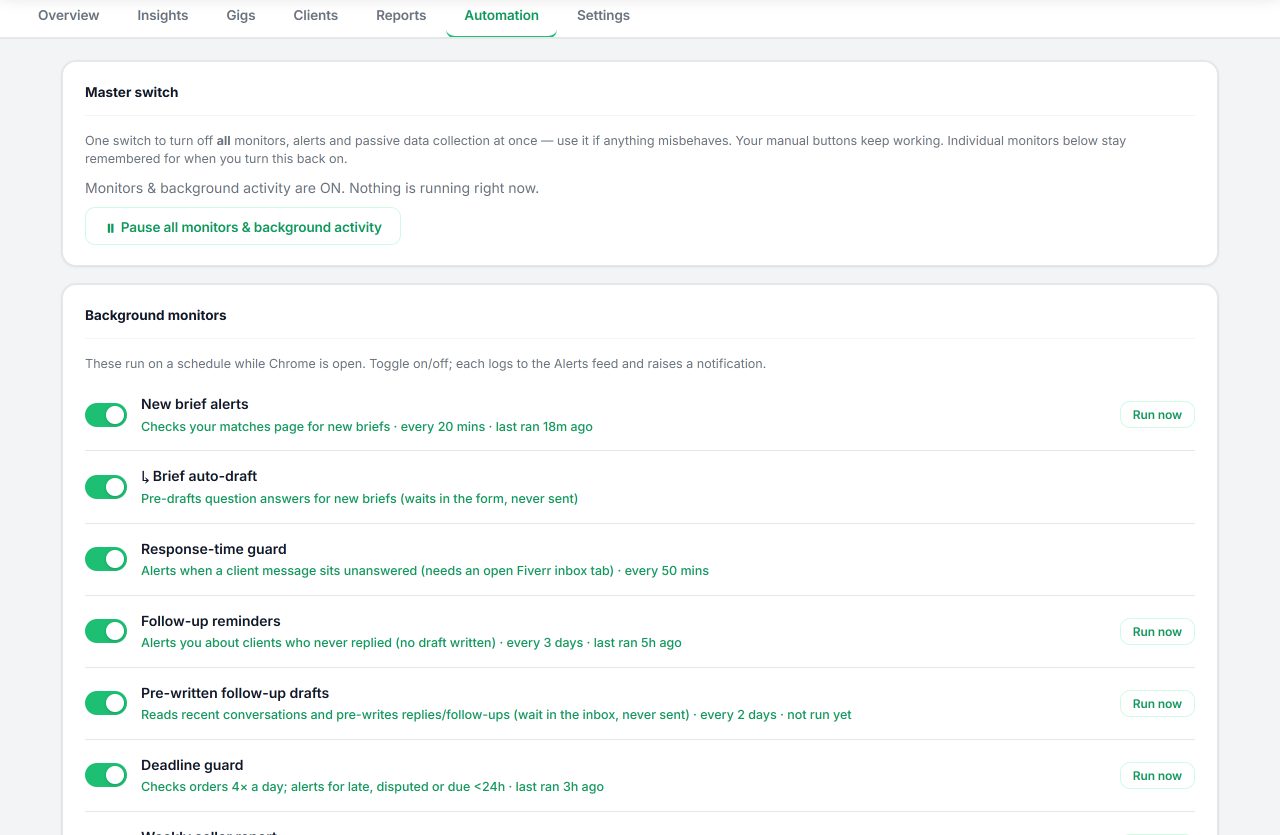
Pro's monitors are the WordPress-relevant piece: a deadline guard when several fix orders overlap, and a keyword monitor that refreshes positions while Chrome is open. Everything stays in Chrome local storage, and no action runs without your review.
Fiverr SEO for WordPress Developers questions
What keywords should a WordPress gig target?
Task and symptom phrases beat the job title. For fix work, phrases like fix wordpress error, white screen fix, and plugin conflict repair match how buyers describe the problem. For build work, pair the builder name with the deliverable. Fiverr reads the title first, so put the strongest task phrase there and validate it locally.
Should I offer WordPress fixes and full builds in one gig?
Keep them separate. They attract different buyers, use different phrases, and price differently; Fiverr lists an $80 standardized package minimum for Full Website Creation in the WordPress category, while small task work fits the standard $5 minimum. One listing that does both reads as neither, and the requirements form cannot serve both intents.
Can I show client websites in my Fiverr portfolio?
Show what any visitor can already see: the finished site, a page you built, or a before-and-after of a fixed layout. Skip admin screenshots, client data, and traffic or sales figures unless you have written permission to reference them. Each portfolio project holds one to five files and a description of 120 to 1,400 characters.
How long before WordPress gig changes show results?
Fiverr's help center recommends giving a new or updated keyword at least 30 days before reviewing its impact, and development categories have a 30-day public review window after an order completes. Change one field at a time, compare equal-length windows, and note that search results are personalized, so single readings prove little on their own.
Sell the task, not the toolkit.
Name the problem in the title, scope the fix in the packages, and keep builds in their own gig.