 Seller OS
Fiverr agencies: requirements and how to apply
Fiverr agencies give established companies a dedicated space on the platform: an agency page, an agency card in search, and eligibility for dedicated sections that surface agency work. Clients can filter sellers by seller type, which means an agency becomes a category of its own rather than another individual profile.
This guide covers what Fiverr publishes about requirements, the invitation-based application path, and the practical preparation that makes an application credible. Thresholds come from Fiverr's help center; the preparation advice is ours, and no acceptance is implied.
Free plan available. Local-first data. Human review on every change.
What a Fiverr agency actually is
Fiverr's agencies article describes agencies as giving established companies a dedicated space on the platform, for a company employing a team of professionals. The visible perks are structural: an agency page, an agency card in search results, and eligibility for dedicated order-from-agencies sections that clients can reach through seller type filters.
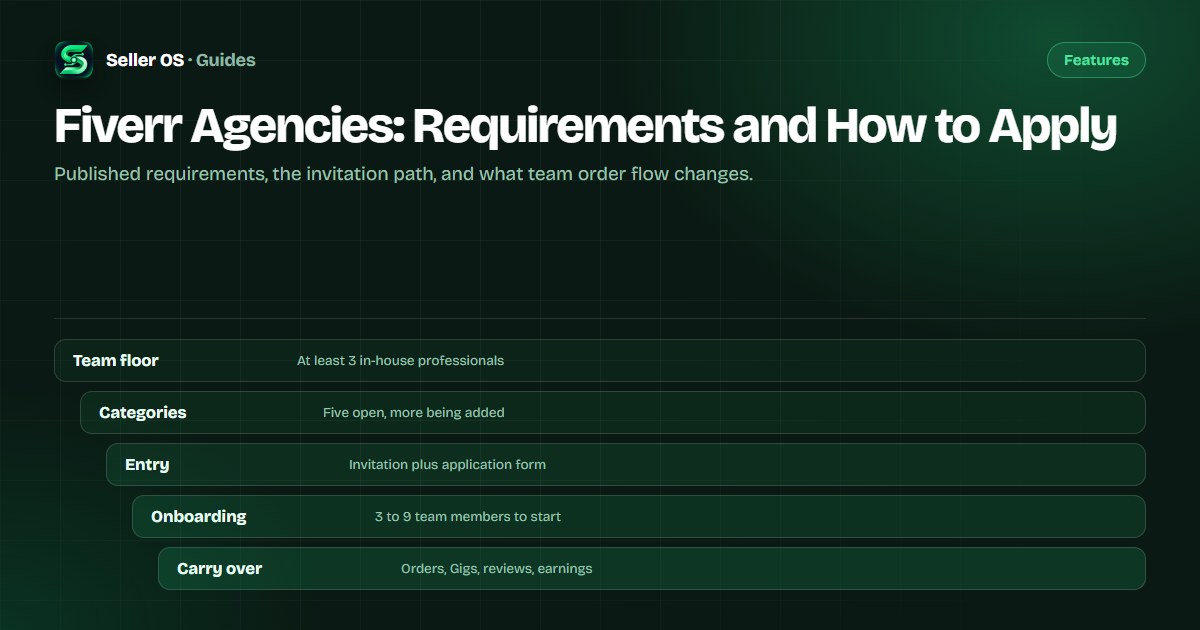
An agency is not a badge bolted onto your freelancer profile. It is a different identity with its own presentation, and it carries your existing work with you. Fiverr's article states that existing orders, Gigs, chats, reviews, and earnings all carry over when you create the agency, so the switch does not reset your history.
- An agency page plus an agency card in search results.
- Eligibility for dedicated order-from-agencies sections.
- Clients filter by seller type when they want a team.
- Orders, Gigs, chats, reviews, and earnings carry over.
- Your level still follows the same performance metrics.
The published requirements
Fiverr's article lists the core requirements: a team of at least three in-house professionals, active presence in an eligible category, a solid online presence, and capacity for high-scale projects. The open categories at the time of checking were Digital Marketing, Programming and Tech, Graphics and Design, Video and Animation, and Business, with more listed as being added.
Read those as published criteria rather than a scorecard. Fiverr does not publish a revenue threshold, an order minimum, or a waiting-list timeline, and inventing one only produces false confidence. What you can control is whether your company genuinely meets the shape of the requirement: three real people, one of the open categories, and a public footprint a reviewer can check.
| Requirement | As published | What to verify first |
|---|---|---|
| Team | At least 3 in-house professionals | Are all three actually in-house? |
| Category | Active in an eligible category | Does your work fit the open list? |
| Presence | Solid online presence | Can a reviewer find your work? |
| Capacity | High-scale project capacity | Can you staff overlapping orders? |
The invitation-based application path
You cannot sign up as an agency from a public form. According to Fiverr's article, the path starts when Fiverr sends an invitation to users who meet the current criteria. The invited applicant fills out the application form, qualified applicants then create the agency from the profile self-view page, and Fiverr reviews the result before it goes live.
For people who do not meet the criteria yet, Fiverr provides a waiting list form. That is the honest state of the process: preparation happens before the invitation, not after it. If you have not received an invitation, the useful work is making your account look like the company Fiverr is inviting, so nothing changes when the email arrives.
Receive the invitation
sent to users meeting current criteria
Fill the application form
company details and the work behind them
Create the agency
from the profile self-view page when qualified
Wait for review
Fiverr approves before the agency page goes live
What onboarding asks for
The onboarding form collects the basics a client would expect: agency name, year established, industry, company size (3 to 9, 10 to 49, 50 to 249, or 250 plus), an about section, a logo, and a cover photo. Fiverr publishes exact cover specs: 1280 by 776 pixels at 72 dpi with text under 30% of the image, plus three to nine team members to start.
A common mistake is treating the about section and cover photo as leftovers. They are the first things a client reads after the search card, and the cover spec fails loudly when it is ignored. Write the about section the way a procurement lead would read it: what the team does, which categories it covers, and the kind of project it takes on without hand-holding.
How agency work changes your order flow
Two changes matter day to day. First, agencies get a free meeting tool, and Fiverr's article notes that if the paid consultation feature is active, it reverts to free for agency meetings, so client conversations start without a booking fee attached. Second, the team structure means orders can be staffed across members rather than routed through one inbox.
Consider an illustrative scenario (not platform data): a five-person agency takes three concurrent website projects. Instead of one seller juggling three delivery dates, each project has an owner and a backup, and the agency card in search makes the team visible before anyone opens a profile. Level rules stay the same: Fiverr's level documentation states that agency freelancers are judged by the same performance metrics as everyone else.
Preparing while you wait for the invitation
Build the evidence an application reviewer would ask for: a portfolio that shows team-scale work, references or case studies a client would recognize, and a clear account of who does what. Make sure your category matches one of the open categories, and keep your public presence consistent across your Fiverr profile and the site a reviewer would visit from it. Illustrative package (not platform data): three named teammates with roles, two case studies a client would recognize, a portfolio matching one open category, and a two-paragraph answer to who handles revisions — the things a reviewer would otherwise have to ask for.
Also decide the exit before you enter. Fiverr's article says you can switch back to a freelancer profile, but becoming an agency again may require full onboarding. If your team might shrink below three people, plan for that reality now rather than discovering the re-onboarding requirement after the fact. For adjacent paths, see Fiverr Pro and the levels system.
Where Seller OS helps
Seller OS runs in Chrome and keeps each person's client context local: notes, order history, and draft messages live in one workspace with a short action queue, which helps when several projects overlap and hand-offs get messy.
It drafts and fills; a person performs every final Send, Save, Continue, or Publish action. It does not apply to the agencies program, staff your team, or manage permissions between agency members.
Fiverr Agencies questions
What are the requirements for a Fiverr agency?
Fiverr's help center lists a team of at least three in-house professionals, active presence in an eligible category, a solid online presence, and capacity for high-scale projects. Open categories at the time of checking were Digital Marketing, Programming and Tech, Graphics and Design, Video and Animation, and Business. Fiverr publishes no revenue or order-count threshold for the program.
How do I create a Fiverr agency account?
The path is invitation-based. Fiverr sends invitations to users who meet the current criteria, the applicant fills out the application form, qualified applicants create the agency from the profile self-view page, and Fiverr reviews before it goes live. There is no public self-serve sign-up; a waiting list form exists for people who do not yet meet the criteria.
Do I lose my orders, Gigs, and reviews when I become an agency?
No. Fiverr's article states that existing orders, Gigs, chats, reviews, and earnings carry over when you create the agency. Your level also stays governed by the same performance metrics that apply to every other freelancer, so the agency identity changes your presentation and team options rather than resetting your track record.
Can an agency use paid consultations?
Fiverr's article says agencies get a free meeting tool, and that if the paid consultation feature is active, it reverts to free for agency meetings. Note that the freelancer-facing consultation article says the paid feature is not available to agencies while the client-facing article lists agencies as eligible, so confirm what your own account shows before promising a paid call.
Build the case before the invite
Line up your team, portfolio, and category fit now so the application is a formality when the invitation arrives.