 Seller OS
Free sample traps on Fiverr: when to walk away
Almost every seller hears it: do a quick sample first, and there will be plenty of paid work after. Sometimes that is true. Often it is a polite machine for extracting free deliverables, one sample at a time, from sellers who are afraid to say no.
This guide draws the line between a reasonable proof and a trap. You will get threshold rules for what a free sample may be, scripts that decline without drama, and paid alternatives that keep genuine buyers moving toward an order.
Free plan available. Local-first data. Human review on every change.
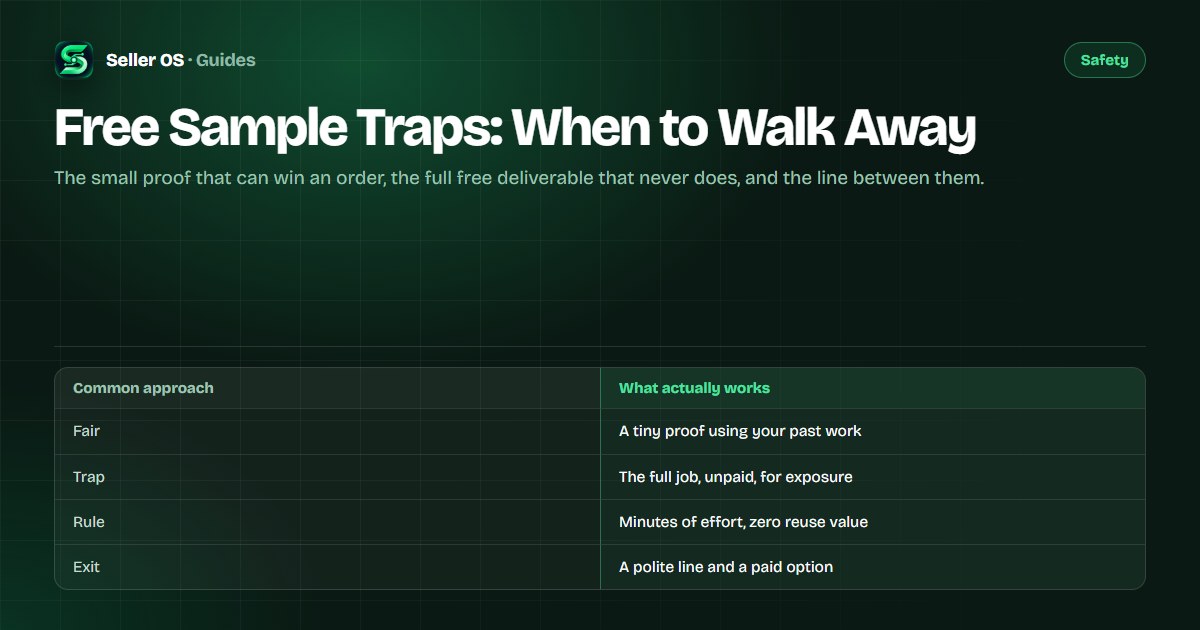
A reasonable proof versus a trap
A reasonable proof answers one question: can this seller do the thing. It is small, generic, and useless to anyone except as evidence of skill. Pointing at portfolio pieces often does the same job with no new work at all.
A trap answers a different question: will this seller do the work for free. It asks for the actual deliverable, the buyer's real files, or round after round of refinements, all before any order exists. The promise of future work is the payment, and future work is not a currency.
| Shape | Reasonable proof | Trap |
|---|---|---|
| Size | Minutes of effort, visibly small | Hours, or the full deliverable |
| Material | Generic or existing portfolio | The buyer's real project files |
| Rounds | One look, no revisions | Endless tests and refinements |
| Payment | Leads to a paid order now | Exposure and promises of later work |
Threshold rules for any free sample
Run every request through these four rules before agreeing to anything. One failure is enough to decline or convert the ask into a paid trial.
Notice what the rules protect: your time, your ownership, and the precedent you set. Free work rarely stays a one-time exception once a buyer learns it works.
- Cap the effort: if it takes more than a few minutes, it is not a sample, it is an order.
- Keep it generic: never build on the buyer's real files or live project for free.
- Remove reuse value: watermark, low resolution, or partial scope so the sample cannot ship.
- One round only: a sample with revision rounds is unpaid project management.
- Tie it to an order: agree what paid step follows before you start the free one.
Decline scripts that keep real buyers
Declining is easier with the words ready. Each line below refuses the free work and offers a paid path in the same breath, so genuine buyers have somewhere to go and harvesters have nowhere.
Send one, then stop negotiating the principle. Buyers who accept a paid trial were serious; buyers who argue were never going to convert.
Portfolio redirect
My portfolio already shows this exact style, so I can point you at the closest pieces instead of a new sample. Which project should we scope as an order?
Paid trial
I do not do free custom work, but I offer a small paid trial at the basic package rate, which I deduct from the full order if you continue.
Scope guard
That request is the deliverable itself, so it needs an order with requirements and revision terms before I start.
Final refusal
Since we cannot agree on paid terms for the work, I will step back. My gig page is there if plans change.
Paid alternatives that move the buyer forward
The goal is not to win an argument but to convert interest into an order. A small paid milestone, a consultation-style basic package, or a clearly scoped first phase all let the buyer test you with money instead of promises.
This is where tight requirements earn their keep. When the paid step has written scope, revision limits, and delivery terms, the trial stays small and the full project has a shape. Loose trials expand; written ones conclude.
When to walk away without a second thought
Some requests are not worth a counteroffer. Walk away when the ask is the whole job, when tests multiply after each delivery, when the buyer invokes exposure or future volume as payment, or when refusal triggers guilt, pressure, or insults.
Walking away is also a metric decision. Time spent on a fifth free revision is time not spent on buyers with orders open. The decline guide covers the mechanics of refusing safely when the thread is already heated.
- The full deliverable is requested before any order exists.
- Each delivered test produces another, larger test.
- Exposure, reviews, or future volume are offered as the payment.
- Pressure or insults follow your first polite refusal.
- Next step: the safe decline guide for heated threads.
Where Seller OS helps
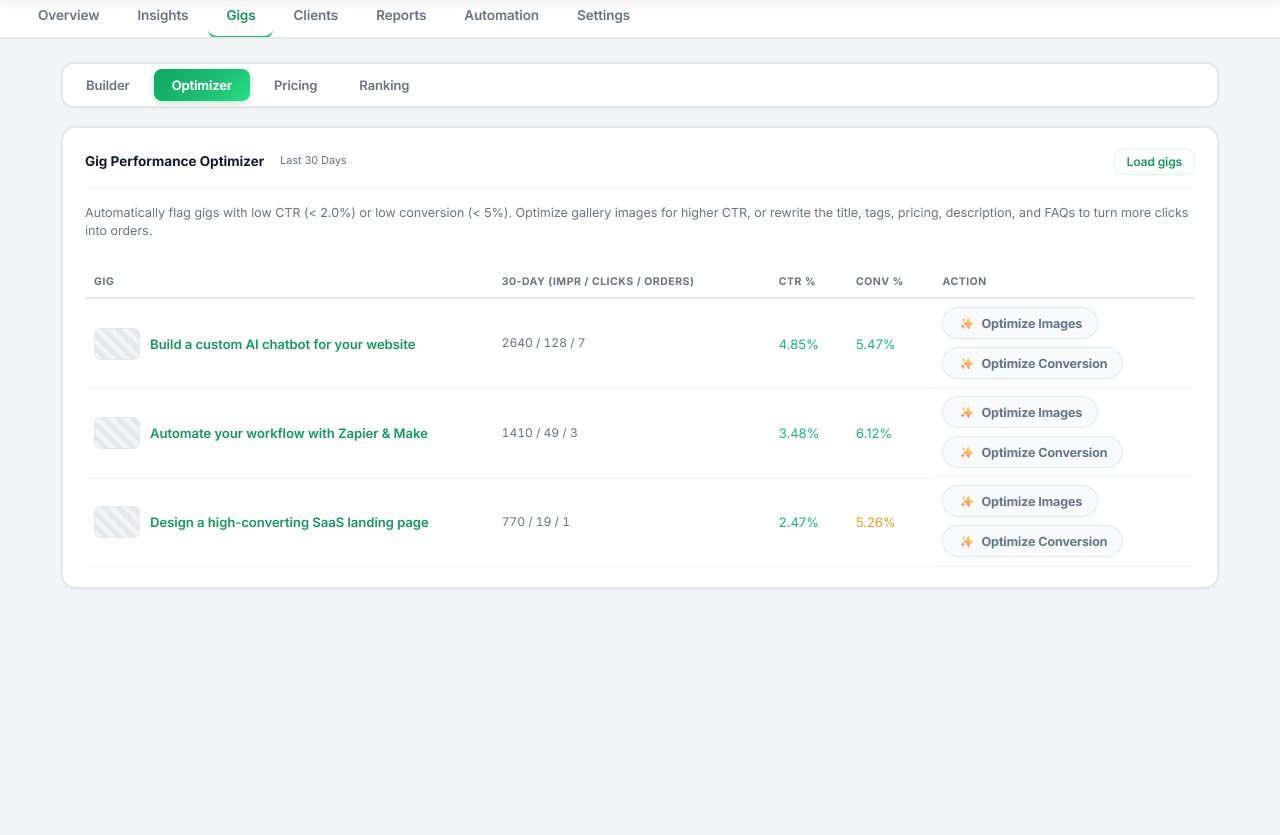
Seller OS cannot judge a buyer's intentions, but it keeps the evidence organized while you decide. Client records hold the thread and the ask in Chrome local storage, the gig optimizer shows which portfolio pieces already prove the skill being questioned, and the inbox assistant drafts the decline you review before sending.
No message leaves without a person. The extension drafts locally, you adjust the tone, and only then does the reply go out.
Free Sample Traps questions
Should new sellers do free samples to get their first orders?
Portfolio pieces and a well-scoped basic package earn first orders more safely than free custom work. A tiny generic proof is acceptable under the threshold rules, but building on a stranger's real files for free teaches buyers to expect it. Price a small paid trial instead and let the first reviews come from real orders.
A buyer promises big future work for one free task. Is that fair?
Treat future work as a story, not a payment. Serious buyers test with a small paid milestone, while harvesters pay in promises across many sellers. Offer the paid trial and watch the response: acceptance signals a real client, while pressure or disappearance tells you the future work never existed.
How do I say no without getting a bad review?
Reviews attach to orders, so declining before any order exists leaves nothing to review. Keep the refusal polite, offer the paid alternative in the same message, and do not argue further. If an order already exists and the buyer demands extras beyond scope, handle it through requirements and the formal decline path instead.
What if I already delivered free work and the buyer vanished?
Finish the lesson rather than chase the buyer. Stop delivering further rounds immediately, keep the thread as a record of the pattern, and tighten your rules for the next request. Watermark or limit future samples so they cannot ship, and route every custom ask into a scoped paid trial from the start.
Sample the skill, charge for the work.
A tiny proof can win an order; a free deliverable only wins the next free request.