 Seller OS
Off-platform payment lures on Fiverr: how to respond
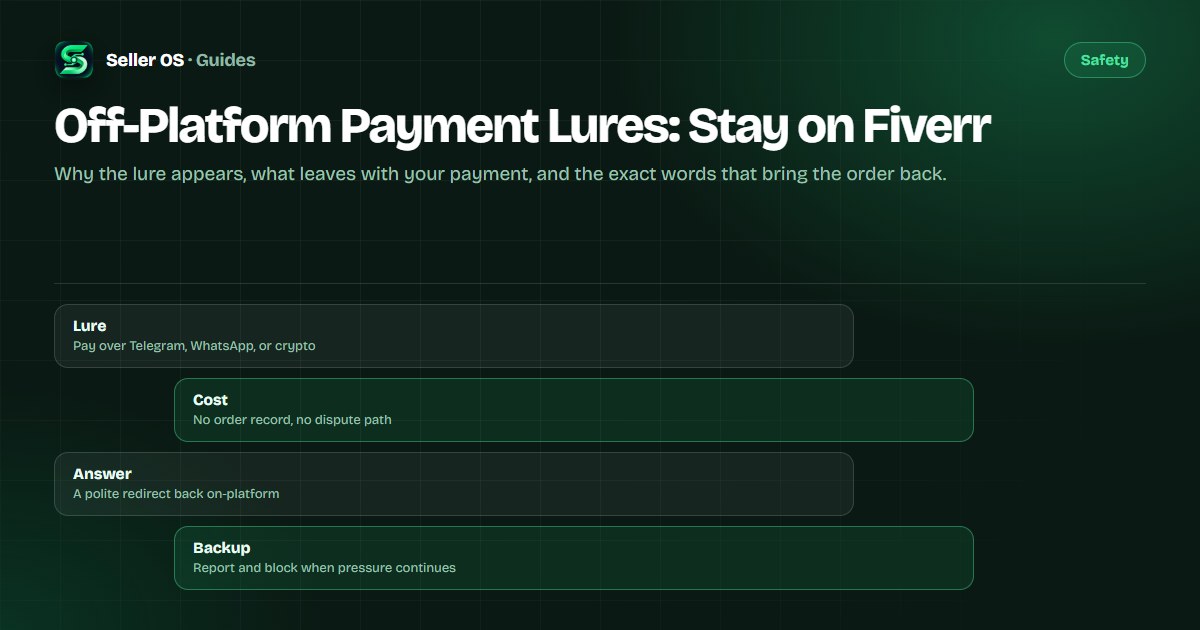
Sooner or later, most sellers meet the buyer who wants to pay somewhere else. It usually arrives as a friendly suggestion: continue over Telegram or WhatsApp, pay in crypto, or skip the platform fee by settling direct. The tone is casual, and the offer can sound like a favor to both sides.
This guide explains why that suggestion appears, what you give up the moment payment leaves Fiverr, and how to steer the buyer back without burning the relationship. Fiverr's own rules on keeping communication and payment on the platform are published in the Help Center, and this article follows that position throughout.
Free plan available. Local-first data. Human review on every change.
Why buyers suggest paying outside Fiverr
The common reason is the fee. Both sides know the platform takes a cut, so paying direct can look like free money. Some buyers genuinely believe it is normal, especially if they have hired freelancers elsewhere under different rules.
The other reason is harder to see: outside the order system there is no delivery record, no message trail tied to payment, and no neutral party to appeal to. A scammer prefers exactly that arrangement, which is why the request itself is a screening signal worth taking seriously.
- Chat apps: a request to continue over Telegram or WhatsApp, where Fiverr cannot see the thread.
- Crypto or wire: payment in a form you cannot reverse and Fiverr cannot verify.
- Fee-saving pitch: splitting the platform fee framed as a win for both sides.
- Urgency add-on: claims the order must start now and the platform is too slow.
What you lose the moment payment leaves the platform
An on-platform order is a contract with a record. Requirements, revisions, delivery, and every message sit in one place, and if the buyer disappears or disputes the work, that record is what a review is based on. Move payment elsewhere and none of that exists.
You also lose the payment mechanics themselves: the held funds, the defined delivery and revision flow, and the review the completed order would have earned. A direct payment that arrives is taxable income with no proof of the agreement behind it, and one that never arrives leaves you with no path to raise it.
| Point | On-platform order | Off-platform payment |
|---|---|---|
| Agreement | Order page with scope and price | Chat promises only |
| Payment | Held and released on delivery | Whatever the buyer sends |
| Disputes | Raised with the full record attached | No record, no review path |
| Outcome | Review and counts toward your history | Invisible work, invisible risk |
Scripts that redirect the buyer back on-platform
Most buyers accept a clear no when it comes with an easy next step. Keep the tone warm, name the reason once, and point at the order button. Save these lines somewhere you can paste them, because the lure usually arrives when you are busy and tempted to improvise.
If the buyer insists after a polite redirect, treat the insistence as the answer. A real client books through the order system; someone who keeps pushing after two refusals is telling you how the rest of the project would go.
First reply
Thanks for thinking of that, but I only take payment through Fiverr orders, so you keep the full buyer protection. Shall I send a custom offer for this?
Fee objection
I understand the fee concern. The order system is also what guarantees your delivery date and revision terms, so I keep every project inside it.
Second push
I am not able to move payment off the platform under any arrangement. Happy to start the moment the order is placed here.
Final line
Since we cannot agree on payment terms, I will step back. Wishing you luck with the project.
When the request is genuine and what to do instead
Not every request comes from a scammer. Some buyers need a call to explain a complex brief, or they assume contact details are fine to exchange. The distinction matters: a buyer who accepts your redirect was likely just unaware, while one who argues was likely never going to order.
For genuine needs, keep the solution inside the platform. Use the order requirements, the inbox, and any call feature Fiverr currently offers rather than a personal number. The contact-sharing rules are covered separately and attributed to the Help Center there.
How to report the lure and protect your account
When a buyer pushes off-platform payment, report the conversation through the reporting tools Fiverr provides in the inbox or on the order, as described in the Help Center. Keep your messages polite throughout, because your side of the thread is part of what gets reviewed.
Then disengage. Do not lecture, do not negotiate a partial arrangement, and do not accept files or links from the account afterward. The companion screening guide helps you spot the next account faster, before any work starts.
- Report the message thread through Fiverr's own reporting path, not by emailing anyone directly.
- Keep two polite refusals on record, then stop replying if the pressure continues.
- Review the pattern in the fake-buyer screening guide so the next lure is faster to spot.
- If a dispute already exists on a real order, use the order dispute path instead of mixing the two issues.
Where Seller OS helps
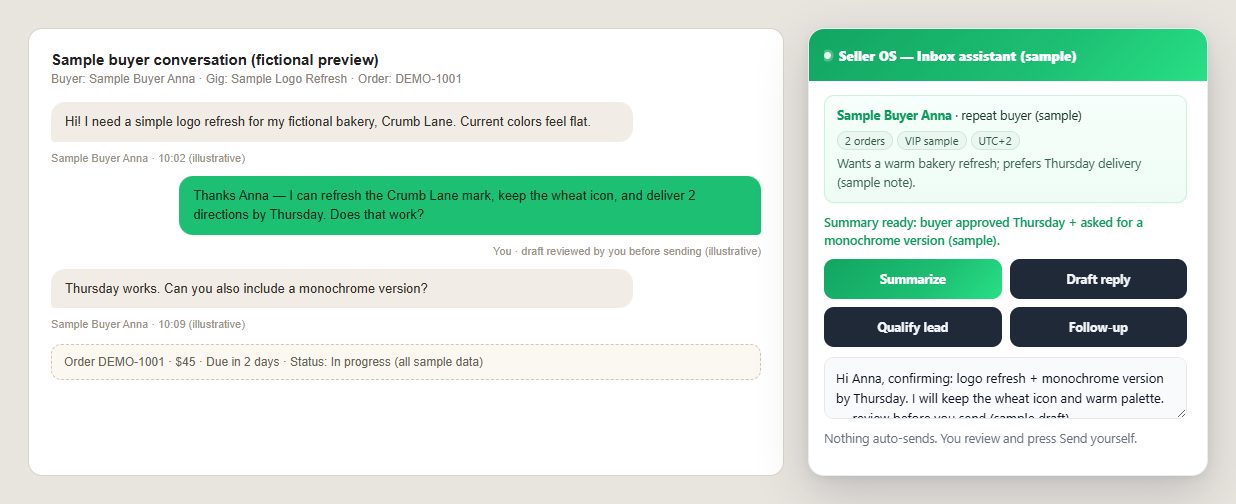
Seller OS does not talk to buyers for you, and it never reports anyone on your behalf. What it does is keep your side organized: the inbox assistant drafts the polite redirect from your own templates, client records keep the thread history in Chrome local storage, and monitors flag order-state changes so a stalled conversation does not sit unseen.
Every message still goes out through your hands. The extension drafts and tracks locally, and a person reviews and sends each reply, which keeps the refusal polite and the record clean.
Off-Platform Payment Lures questions
Is it against the rules to accept payment outside Fiverr?
Yes. Fiverr requires communication and payment to stay on the platform, and circumventing that system can lead to restrictions on your account. The exact wording lives in the Help Center. If a buyer proposes paying over chat apps, crypto, or wire, decline politely and redirect them to an order or custom offer.
What if the buyer says they cannot pay through Fiverr?
Treat that as a reason to walk away, not a problem to solve. Sellers have no way to verify an outside payment method or enforce an off-platform agreement. Offer once to proceed through a standard order, and if the buyer refuses, end the conversation and report the thread through the inbox reporting tools.
The buyer already paid me off-platform. What now?
Do not start work on the basis of an outside payment, and do not mix it into an existing order. Politely explain that you only work through Fiverr orders, return or refuse the funds through the same channel if possible, and keep a record of the exchange. For future contact, keep everything inside the platform thread.
Should I report a buyer who only suggested it once?
A single suggestion from an otherwise normal buyer often comes from ignorance, and one polite redirect usually ends it. Reserve reports for pressure, repeated pushes after refusal, or messages paired with other warning signs like credential requests or suspicious links. When in doubt, the screening guide helps you weigh the pattern.
Keep every payment where the record is.
One polite redirect protects the order, the review, and the account behind them.