 Seller OS
Free Fiverr keyword research stack that works
Fiverr keyword research does not require a paid seat. The search box, the top gigs, the category pages, and buyer questions already show the phrases buyers type, the variants that rank, and the wording that repeats across winning listings.
This guide orders those free sources the way you should use them: collect from autocomplete first, confirm against live gigs and categories, enrich with buyer language, then verify before you place a phrase in your title or tags.
Free plan available. Local-first data. Human review on every change.
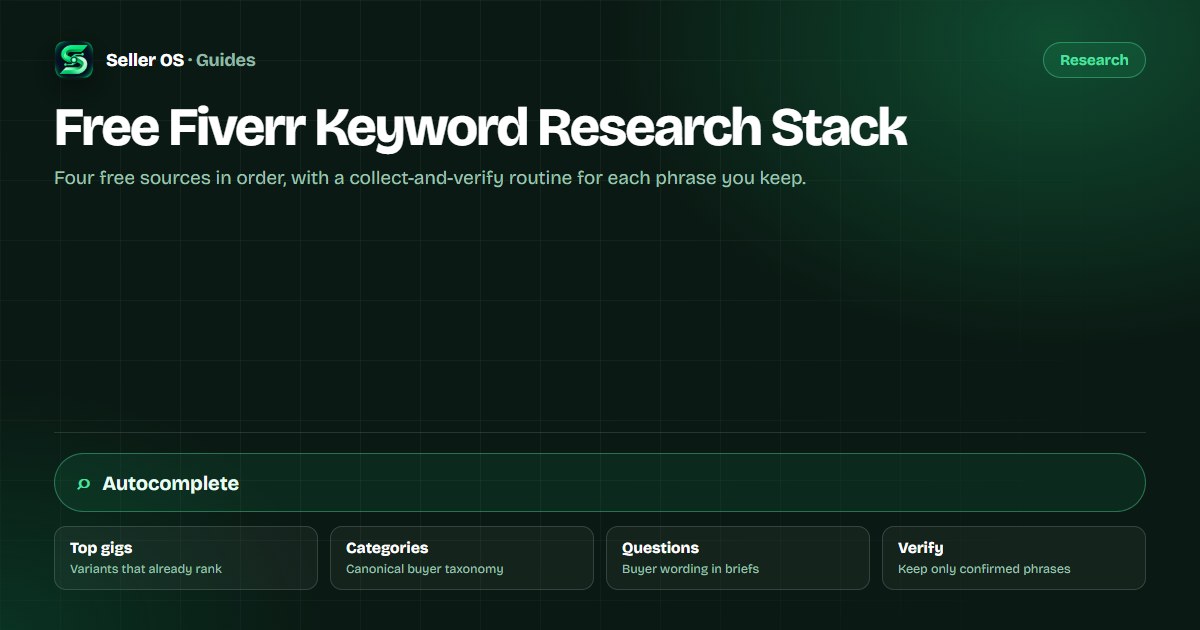
How the four sources fit together
Each source answers a different question. Autocomplete shows demand phrasing, top gigs show which variants search rewards, category pages show the taxonomy Fiverr itself uses, and buyer questions show the informal wording buyers use when they describe the same need.
Use them in that order so each step narrows the last. A phrase that appears in autocomplete, repeats across ranking gigs, and matches a category label is a keeper. A phrase that appears in only one place stays on the maybe list until something else confirms it.
- Autocomplete for discovery: what buyers type most often.
- Top gigs for confirmation: which variants rank on page one.
- Categories for taxonomy: the canonical label Fiverr assigns.
- Buyer questions for voice: how buyers phrase the need themselves.
Start with autocomplete
Type your seed term into the Fiverr search box letter by letter and record every completion, then extend each completion with a second word and record again. Work in a plain sheet with one column for the phrase and one for where you saw it, and avoid filtering too early.
Seed once
type your core service and record all completions.
Extend each hit
add a word after each completion and record round two.
Vary the starter
try verb-first and noun-first seeds for the same service.
Note modifiers
mark price, speed, format, and audience words separately.
Freeze the list
stop near 30 phrases and move to confirmation.
Confirm against top gigs and category pages
Search each candidate phrase and open the top five gigs. Record which words repeat in titles, how the tags overlap, and whether the results match your service or drift into adjacent work. Drift means the phrase belongs to a different intent and should leave your list.
Then open the category and subcategory pages that Fiverr assigns to those gigs. When your phrase matches a category label or a suggested filter, it gains taxonomy weight, which matters because Fiverr search leans on its own structure. The keyword competition guide shows how to weigh that overlap against page-one strength.
| Check | Keep signal | Drop signal |
|---|---|---|
| Title repeats | Same core words in 3 of 5 titles | Every title says it differently |
| Result fit | Results match your service | Results drift to adjacent work |
| Category match | Phrase matches a category label | No category uses the phrase |
| Tag overlap | Tags repeat across gigs | Tags scatter with no pattern |
Add buyer-question language
Buyer requests, briefs, and the questions inside top-gig FAQs carry long-tail phrasing that autocomplete shortens. Phrases like editable source files included or same-day turnaround for reels describe the same service in buyer words, and they make strong FAQ entries and description subheads even when they are too long for the title.
Collect these verbatim into a separate column, then map each one to the closest shortlisted keyword. One candidate keyword can own several buyer phrases, which later become FAQ questions and package clarifications rather than competing titles. The long-tail guide covers how to place those longer variants.
Verify and place each phrase
A phrase earns placement when two independent free sources confirm it: autocomplete plus ranking titles, ranking titles plus category labels, or autocomplete plus buyer-question repeats. Single-source phrases stay in reserve until a second source backs them.
Place one primary phrase in the title, supporting variants in tags and description subheads, and buyer-worded long tails in the FAQ. If you use paid tools later, use them to check volume on this shortlist rather than to restart discovery, as the no-Seller-Plus guide explains.
- Two sources confirm: the phrase earns a title, tag, or FAQ slot.
- One source only: hold in reserve and recheck after a week.
- No source beyond your guess: drop it no matter how much you like it.
- Recheck quarterly: search language shifts as buyer demand shifts.
Where Seller OS helps
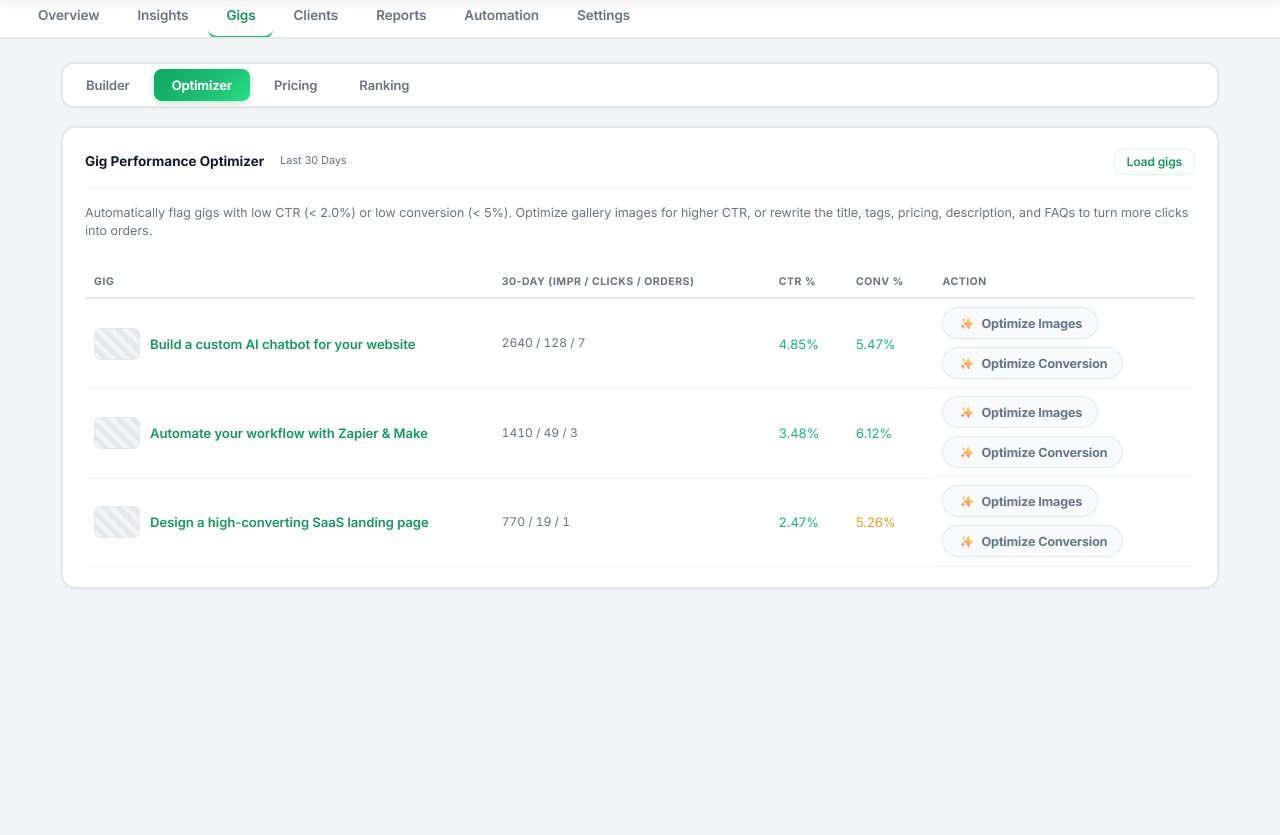
Seller OS fits beside this stack rather than replacing it. Collect phrases with the free sources above, then use the gig optimizer to check whether your title, tags, and description actually use the shortlist consistently across the gig.
Your keyword notes stay local to your browser, and every title or tag change waits for your review. The extension drafts and flags; you decide what goes live.
Free Fiverr Keyword Research Stack questions
Can I do Fiverr keyword research completely free?
Yes. Autocomplete, ranking gig titles and tags, category pages, and buyer questions together reveal demand phrasing, ranking variants, taxonomy labels, and long-tail wording. Keep phrases confirmed by at least two of those sources. Paid tools add convenience and volume estimates, not a different discovery process.
How many keywords should a Fiverr gig target?
Target one primary phrase in the title, three to five supporting variants across tags and subheads, and several buyer-worded long tails in the FAQ. More than that spreads the gig thin and confuses buyers. If two phrases imply different services, they deserve separate gigs rather than one crowded page.
Where do I put long-tail keywords on Fiverr?
Put long-tail buyer phrases in FAQ questions, description subheads, requirements labels, and package clarifications, where they answer real questions. Keep the title to the primary short phrase buyers search. This placement matches search behavior: short phrases retrieve, specific phrases convert the visit.
How often should I redo keyword research?
Recheck the shortlist quarterly or whenever impressions slide without a gig change. Rerun autocomplete, resample the top five titles, and confirm category labels still match. Keep winners, replace drifted phrases, and change one placement at a time so you can read what moved.
Build the shortlist free, then place it.
Collect thirty phrases, keep the twice-confirmed ones, and put each where buyers read it.