 Seller OS
Fiverr business plan writer SEO that wins buyers
Business plan buyers arrive with a deadline and an audience: a lender packet, an investor conversation, a visa submission, a nonprofit board. Each audience wants a different document, and the phrase they search names that audience first — investor ready, loan approval, immigration, five year plan. Your listing has to speak to one of them in a sentence.
This guide covers the subcategories Fiverr publishes, the document stack buyers ask for, the proof conventions that survive scrutiny without exaggeration, and pricing that starts with a scoping interview. The keyword table holds examples to validate locally, not platform data.
Free plan available. Local-first data. Human review on every change.
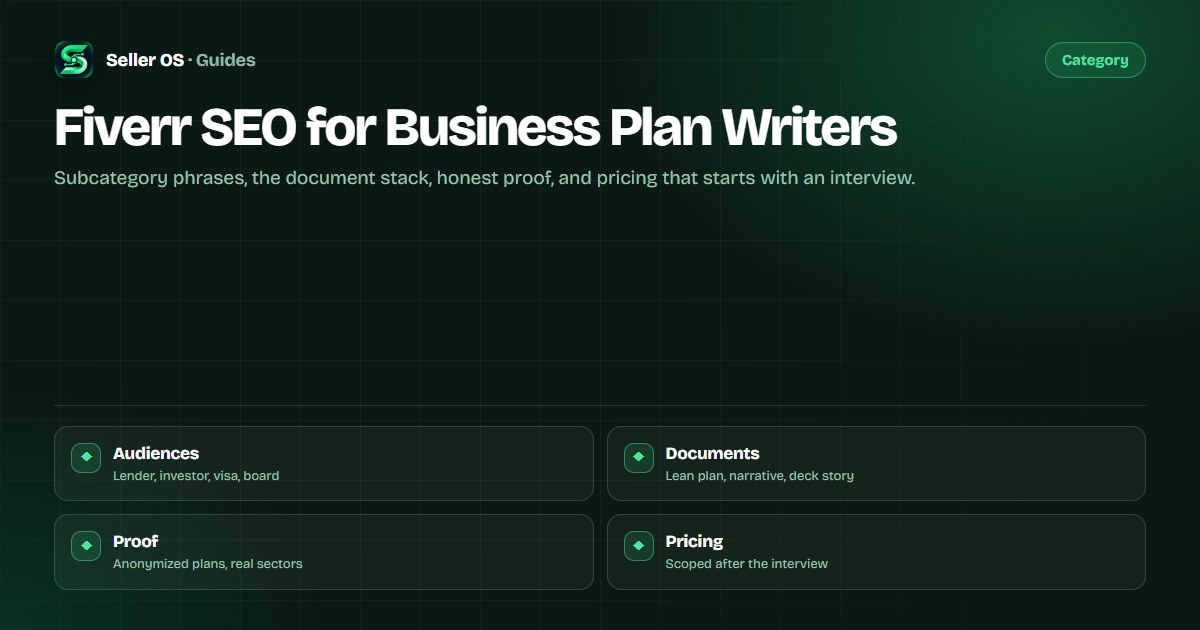
Each subcategory buys a different document
Fiverr's public Business Plans category page, checked October 1, 2026, shows five subcategory labels: Business Plans for Startups, for Loan Approval, for Immigration, for Non-Profits, and for Partnerships. The seller titles on that page name their audience outright, from SBA loan approval to immigration applications to investor-ready startup plans with a financial plan attached.
Read those titles as a map of intent rather than as competition. A lender wants conservative assumptions and a repayment story; an investor wants market sizing and a growth narrative; a visa officer wants a credible, detailed operation plan. One listing cannot serve all five, so pick the audience you have written for before and let the description handle adjacency.
- Loan approval — conservative numbers, use of funds, repayment framing
- Startup and investor — market size, traction, growth assumptions
- Immigration — detailed operations, staffing, and timeline
- Non-profit — program narrative with a budget section
- Partnership — roles, splits, and a shared operating picture
Keyword examples to validate locally
Collect phrases from the plans you have actually written, then check each one on Fiverr: type it, read the autocomplete suggestions, open the gigs ranking for it, and note how deep their stated scope goes. If the top results sell a twenty-page document with financials and you sell a summary, the phrase is not yet yours.
The rows below fit one writer who serves small-business lending and startup clients. Add candidates such as startup plan gig and business plan writing fiverr, then read the whole set as a hypothesis to test against live results, because none of these entries come from Fiverr data and buyer wording shifts by audience.
| Slot | Example phrase | Why a buyer types it |
|---|---|---|
| Primary | business plan writer | Broad service intent, high ambiguity |
| Secondary | investor ready business plan | Audience qualifier with a higher budget |
| Secondary | startup business plan | Stage qualifier that narrows the ask |
| Long-tail | business plan for loan approval | Deadline-driven buyer with a format in mind |
| Long-tail | financial model narrative | The add-on that lifts the project value |
The document stack buyers ask for
Most orders start as one document and reveal a stack. The lean plan is the short, decision-ready version a founder or a small lender reads first. The investor deck narrative is the story arc in slide logic, usually written before anyone designs slides. The financial model narrative explains the assumptions behind the numbers in plain sentences.
Naming all three in your description does two things. It shows buyers you understand what sits behind a plan, and it gives you a natural ladder for packages. A concrete scenario: a founder asks for a plan, then says the deck needs a story in two days; if the narrative was never in scope, that becomes a renegotiation instead of a paid add-on.
| Document | Who reads it | What it contains |
|---|---|---|
| Lean plan | Founder, partner, small lender | Problem, model, milestones, short financial summary |
| Full plan | Lender, board, program officer | Market, operations, team, risk, full sections |
| Financial narrative | Investor, credit analyst | Assumptions explained behind the model's numbers |
| Deck story outline | Founder pitching investors | Slide-by-slide argument before design begins |
Proof that holds up without exaggeration
Buyers in this category check whether you have written in their industry, so sector experience is your first proof. Name the industries you have delivered for, keep any credential claim truthful, and describe your process: interview questions you ask, research sources you use, how many revision rounds the draft includes.
Sample plans carry the same privacy rule as any client document. Rebuild a shortened version with invented company details, label it fictional in the portfolio description, and show the structure rather than the client's numbers. Fiverr's portfolio holds one to five files per project with descriptions between 120 and 1,400 characters, so an anonymized excerpt, a section outline, and a note on your process fit in a single entry.
- State sectors you have written in, without naming the client
- Label every sample as fictional data inside the description
- Claim only credentials you currently hold
- Never present projected numbers as expected results
Price after the scoping interview
A plan's size depends on answers only the buyer has, so quote after a short interview rather than from a fixed menu. Ask four things in your first messages: who reads the plan first, what financial information already exists, the submission deadline, and which documents must arrive together. Each answer changes the work, and all four fit comfortably before an order starts.
The structure below is illustrative only, with example scope variables instead of price figures. Set your own rates from the hours each tier took you, compare gigs ranking for your phrases, and remember that Fiverr's gig article states you can offer up to three packages, each with its own delivery time, revisions, and price.
| Tier | Scope example | Variable that sets the price |
|---|---|---|
| Basic | Lean plan for one named reader | Number of sections confirmed |
| Standard | Full plan with a financial narrative | Months of projections you build |
| Premium | Plan, narrative, and deck story outline | Depth of market research required |
| Add-on | One extra tailored version | Second audience or format |
Plan-writing mistakes that end the relationship
The first mistake is reselling a template. Buyers detect recycled structure quickly, and a document that could belong to any company fails the moment a reader asks a follow-up question. The second is promising funding or approval. No writer controls a lender's or an investor's decision, so any claim about approval odds is a promise you cannot keep and should never appear in your copy.
The third is producing financials beyond your competence. Building forecasts, breakeven analysis, and valuation-style figures is skilled work with real consequences, and it belongs with a qualified accountant when you are not one. Write the narrative around numbers a professional provides, state that projections are assumptions, and pair the project with the grant writers guide if your buyers also chase funding documents.
Where Seller OS helps
Seller OS supports the selling half of a plan-writing practice. The Gig Builder turns a one-line offer or a competitor listing into a structured gig with a title, tags, description, and three packages, then fills Fiverr's wizard while you finish Save, Continue, and Publish. Package pricing review later checks those tiers against your profit assumptions and your recently applied prices.
Local client records keep each buyer's audience, deadline, and document list, so a follow-up order starts from your notes instead of a reread of the thread, and keyword tracking holds position history for the phrases you name. It does not research markets or build financials, and it never publishes by itself: it drafts and fills, and a person performs every final Send, Save, Continue, or Publish action.
Fiverr SEO for Business Plan Writers questions
How do I rank a business plan writing gig on Fiverr?
Name the audience in your title, such as loan approval or investor ready, because that is what a buyer types before anything else. Keep close variants in the five keyword slots and five tags, carry detail into the description, and give any change at least 30 days before judging it, which is the window Fiverr's Advanced Analytics article recommends for new or updated keywords.
What should I ask before quoting a business plan project?
Four answers change the scope: who reads the plan first, what financial information already exists, the submission deadline, and which documents must arrive together. Ask them in your opening messages, repeat the answers in your order requirements, and quote against them. Plans priced without those answers turn into the revisions that erase the margin.
Can I show sample business plans in my portfolio?
Yes, when the sample is yours to show. Rebuild a shortened plan with invented company details, label it fictional in the portfolio description, and reveal structure rather than a client's numbers. Fiverr's portfolio allows one to five files per project, so an excerpt, an outline, and a process note can sit together in one entry.
Should I build the financial model for a client?
Only if forecasting is genuinely your skill. Projections, breakeven figures, and valuation-style analysis carry consequences, and buyers deserve a qualified accountant when you are not one. A safer scope is to write the narrative around numbers a professional supplies, and to state plainly that projections are assumptions rather than outcomes.
Name the audience, then the stack
Pick one reader, list the documents you deliver, and quote only after the four scoping answers arrive.