 Seller OS
Can changing a Fiverr gig hurt its ranking?
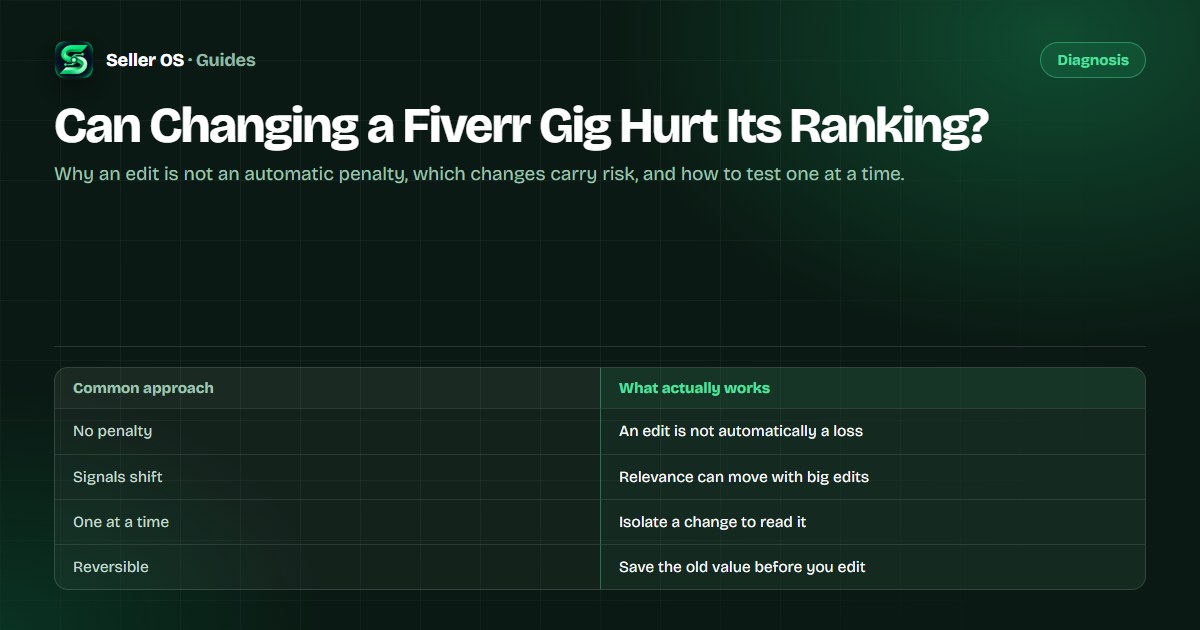
No, changing a Fiverr gig is not an automatic ranking penalty. The risk is narrower and more mechanical: a large edit can change what the listing is relevant for, and it restarts the performance evidence tied to the fields you replaced. Small, targeted changes rarely disturb the rest.
This guide explains what an edit can disturb, sorts common changes by risk, and gives you a safe sequence: one change, one window, and a reversible plan. It also covers when reverting beats editing again.
Free plan available. Local-first data. Human review on every change.
Does editing a Fiverr gig hurt ranking?
No official penalty for editing exists on Fiverr's help pages, and Fiverr does not publish how ordering treats a changed gig. What sellers can observe is more specific: small edits usually pass without a visible change, while a large rewrite changes what the listing is relevant for.
Two things move when a significant change lands. Relevance: the phrases the gig can match shift toward the new text. Performance evidence: clicks and orders that accumulated around the old fields no longer describe the new ones. Neither is a punishment; both are reasons to edit deliberately.
A useful boundary: an edit is significant when it changes what a buyer would expect from the listing, not when it changes the wording around the same offer. Tightening a sentence or fixing a typo keeps the promise intact; changing the promise itself starts a new conversation with the market. If you are still deciding whether an edit is due at all, the update cadence guide covers the triggers.
- Replacing the core promise in the title
- Rewriting the description around a different offer
- Repricing all three packages at once
- Replacing the first gallery image and the title together
What an edit can actually reset
Think in three layers. First, match: does the gig still contain the words a buyer searches? Second, expectation: does the page still describe what the card promised? Third, evidence: how much recent interaction exists for the changed version of the listing?
Fiverr's guidance to Seller Plus members is to give new or updated keywords at least 30 days before reviewing their impact, as the Advanced Analytics help article states. That tells you the platform expects a slow read of keyword edits, not an overnight verdict.
Here is how the three layers interact in practice. Rewrite the description around a different service and match shifts to new phrases, while the clicks the old text earned no longer say much about the new one. Keep the same service and polish the wording, and all three layers stay roughly where they were.
“Give any new or updated keywords at least 30 days before reviewing their impact and analyzing their performance.”
— Fiverr Help Center, Advanced Analytics for Seller Plus, checked September 2026
Which gig changes carry low or high risk
Risk here means how much of the established listing the change replaces. A tweak inside one field is low risk. A rewrite that changes the promise, the price, and the imagery together is high risk, because almost nothing old remains to compare against.
Fiverr's Advanced Analytics article states that the algorithm prioritizes title text first, then the positive keywords field, then the description, which is why the title sits at the top of the table below.
Read the table as a caution order, not a ban. High-risk changes are still allowed; they simply deserve their own window, their own saved values, and a longer read before you decide. The goal is not to avoid edits but to stop stacking them.
| Change | Risk | Why |
|---|---|---|
| Description line edit | Low | One field; the rest of the listing still matches |
| First image swap | Low to medium | The card carries click behavior; keep the layout |
| Tag adjustment | Medium | Five slots; replacing all at once blurs the read |
| Title rewrite | High | Title text carries the strongest matching weight |
| Package restructure | High | Price and scope change what buyers are deciding |
A safe sequence for changing a gig
One rule protects you more than any other: make the edit reversible. Fiverr's editor does not keep a history for you, so the old value exists only if you saved it somewhere before you started. That is the difference between a test and a gamble.
Note also what you cannot undo. Fiverr's help center states that the category cannot be changed after a gig is published, which makes category fit a decision for before publishing, never a fix for after.
One more discipline: no opportunistic edits during the window. If you notice the price feels low two days into a title test, write it down for the next window instead of changing it. Every mid-test edit converts a readable result into a story about nothing.
Save more than you think you need: the old title, the old tags, the old first image file, and the old package text. Copying a live gig into a note costs two minutes and is the only thing that makes a decision to revert possible later.
Record the current values
copy every field you plan to touch into a note before you start
Decide the single change
one field, one reason, one metric you expect to move
Change only that field
leave adjacent fields alone so the test stays readable
Set a check date
and hold yourself to it before making any further edit
Keep or revert
if the metric is worse across two checks, restore the old value
Scenario: a title test that looked like a drop
Hypothetical example. A seller rewrites a gig title from a style-led phrase to a buyer-outcome phrase. Impressions dip slightly for the first week, then return to roughly the old level by week three, while clicks improve by the second reading. The dip was the rebuilt evidence around a new title, not a punishment.
The wrong response would have been to rewrite the tags in week one to fix the dip. Stacking a second change would have destroyed the only clean comparison available. The right response was to wait, compare equal windows, and keep the title when the second reading held.
The useful lesson is not that the new title was magic. It is that a dip during a transition is not evidence of harm, and a recovery is not proof of improvement either. Both readings only mean something against the measurements you took before the edit.
When to revert instead of editing again
Revert when the change makes the listing worse by your own measure and the change itself is the plausible cause. Two consecutive readings down on the metric the edit was meant to move, with everything else steady, is a reasonable trigger.
Wait when the only evidence is a single soft reading, or when the gigs around yours shuffled at the same time. Suppose a tag change produced a flat first reading and a lower second one: that pattern suggests a slow-matching phrase rather than a penalty, and it usually deserves one more window before you decide.
Revert cleanly. Restore the exact old value rather than an improved version of it, log the revert like any other change, and give the restored fields their own observation window. A messy revert leaves you with three half-states and no idea which one the current traffic is responding to. The broader recovery sequence for a real drop lives in what to do when ranking drops.
Where Seller OS helps
Seller OS splits the risk. Before you edit, the Gig Performance Optimizer reviews the live listing against the gig's own performance data and proposes what to change, so the edit you make is the one with the best local evidence behind it. After you edit, keyword rank tracking keeps sampling your phrases, so a dip is visible against a trend line instead of being judged from memory.
Everything runs locally in Chrome, and the tool stops at the suggestion: it fills nothing into Fiverr and publishes nothing. The one-change rule stays a human habit, which is exactly how it should stay.
Can Changing a Fiverr Gig Hurt Its Ranking? questions
Can I edit a gig that is already ranking well?
Small, additive edits usually pass without a visible change, and ignoring a clearly weak field is its own risk. If the gig is converting, change one element per two-week window, keep a copy of the old text, and revert only if clicks or orders fall and stay down.
Which gig changes are riskiest for ranking?
Changes that replace the core promise carry the most risk: a full title rewrite, a complete tag replacement, or a package restructure that changes price and scope together. Fiverr's own guidance names title text as the first priority for matching, so treat title edits as the ones to isolate in their own window.
How long should I wait after editing before judging?
For keyword-related changes, 30 days is the floor Fiverr's Advanced Analytics help gives Seller Plus members. For copy or image tweaks, two to four weeks is a practical minimum. Compare the same metric over equal-length windows before deciding; one soft reading is not a verdict.
Should I revert a change that dropped my ranking?
Only if two consecutive readings are worse on the metric the edit targeted and nothing else moved. If the dip is one reading, or the whole results page shifted, wait. Reverting is also an edit, so restore the exact old value you saved before you started.
Make the edit reversible
Save the old values, change one field, and let tracked phrases tell you whether to keep it.