 Seller OS
Fiverr SEO for mobile app developers: sell the stage, not the stack
Mobile app buyers arrive at a stage, not a shopping list. One has an idea and no code, one has a Figma file and a launch date, one has a crash that only happens on some Android devices. They search flutter app development, mvp app development, react native bug fix, or app store submission, and the gig that names the stage gets the click.
This guide covers the platform and stage phrases that match real briefs, title patterns, a scoping package ladder, and the proof app buyers can actually verify. Every keyword example is illustrative — check demand in your own subcategory before building a gig around it.
Free plan available. Local-first data. Human review on every change.
How app buyers search, stage by stage
Each stage of an app project produces different searches. An idea-stage buyer looks for someone to shape a Flutter MVP or a React Native prototype. A mid-project buyer looks for a fix: a build error, a rejected store submission, a screen that breaks. A live-app buyer looks for updates and maintenance. The stage tells you what to promise and what to charge.
Write your gig around one stage you can serve repeatedly. The table shows an illustrative starting set for a developer who runs an MVP build and pairs it with a separate fix gig.
| Role | Example keyword | Why it fits |
|---|---|---|
| Primary | flutter app development | Platform phrase with the clearest recognition |
| Supporting | mvp app development | Stage phrase: buyers know they want small and fast |
| Supporting | react native app | The second platform your portfolio can prove |
| Long-tail | fix flutter build error | Problem phrasing from buyers mid-project |
| Long-tail | app store submission service | Late-stage task with a clear deliverable |
Title patterns for stage-specific gigs
Fiverr's help center guidance for titles is short, clear, and to the point, with special characters like ampersands and slashes left out; the field already starts with I will. For app work, put the platform or the stage close to the front, because that is what the buyer scanned the results for.
Keep one stage per title. A title that mixes a build promise with a fix promise reads as neither, and the requirements you need to collect differ completely between the two.
| Pattern | Example fill-in | Fits when |
|---|---|---|
| [Platform] [stage] | I will develop a Flutter app MVP for your startup | Idea-to-beta buyers |
| [Verb] [problem] in [platform] | I will fix bugs in your React Native app | Mid-project fix intent |
| [Deliverable] from [source] | I will build an iOS app from your Figma design | Design-ready buyers |
| [Task] for [store] | I will handle your app store submission and release | Launch-ready buyers |
Scope packages by features and screens
App work is the easiest category to under-quote, because an unwritten backlog hides inside the word app. Package by countable things instead: screens, integrations, user roles, and whether the backend is in scope. Fiverr's gig creation article lists a standardized package minimum of $100 for Full App Creation in the Mobile Apps category, so the floor is set and your scoping decides the rest.
The ladder below keeps scope visible at a glance. Fiverr allows up to three packages and requires at least one revision option in each — the packages guide walks through the mechanics — and the description holds up to 1,200 characters, enough room to state what every tier excludes as clearly as what it includes.
| Tier | Scope example | Explicitly out of scope |
|---|---|---|
| Basic | One screen, one integration, prototype build | Backend, store accounts, design |
| Standard | MVP: up to five screens with sign-in | Admin dashboard, payments, ongoing support |
| Premium | Full build with backend and store submission | Content, marketing, third-party fees |
Proof that app buyers can actually verify
A store link is the strongest proof this category has: the buyer can open the listing, read what shipped, and install the app. When a client has not approved a public link, show a redacted screenshot or a short screen recording of the working feature, and state plainly whether you built alone, led a team, or joined an existing codebase.
Fiverr portfolio projects hold one to five files, with a title of 15 to 50 characters and a description of 120 to 1,400 characters, which fits a link, two screenshots, and a caption about the stack and the stage you delivered. Never upload private code, credentials, or client analytics; prove the work with what any store visitor can already see.
- A store link the buyer can open and install today
- Screenshots of the feature actually running, not mockups
- A caption that states your role and the stage you delivered
Bug fixes are a different searcher
A buyer whose app is crashing is not comparing build proposals. They want a diagnosis and a repair, often the same day, and they search with symptoms: app crashes on launch, build error, login fails, payment screen frozen. That is a separate gig with its own phrases, a short delivery window, and a requirements form designed for reproduction.
Keep fixes and builds apart. The buyer profiles differ, the intake questions differ, and a listing that promises both makes the urgent buyer scroll past. A fix gig can also graduate into maintenance work, which is why the notes you collect at intake are worth keeping attached to the client.
Ask for the device, platform version, and exact error text
Reproduction starts from facts, not guesses
Request what changed before the break
A recent release, dependency, or store update narrows the search
Quote the fix as a scoped task
Diagnosis plus repair, with a follow-up window stated
Mobile app SEO mistakes to avoid
The generic title is the first mistake: mobile app developer names no stage, platform, or problem, so it competes with everyone. The second is quoting a full app at a prototype price and discovering the gap mid-order. The third is a gallery of unfinished UI screens that prove nothing about running software.
A fourth is treating store approval as guaranteed; that decision belongs to the stores, not to you or your gig. A fifth is misjudging timing: Fiverr's review article states that in Programming and Tech the public review window is 30 days, so the public result of a change arrives later in this category than in most.
Split what does not belong together: the web designers guide covers site work, and the how to rank a gig guide covers how to test your own changes over time.
Where Seller OS helps
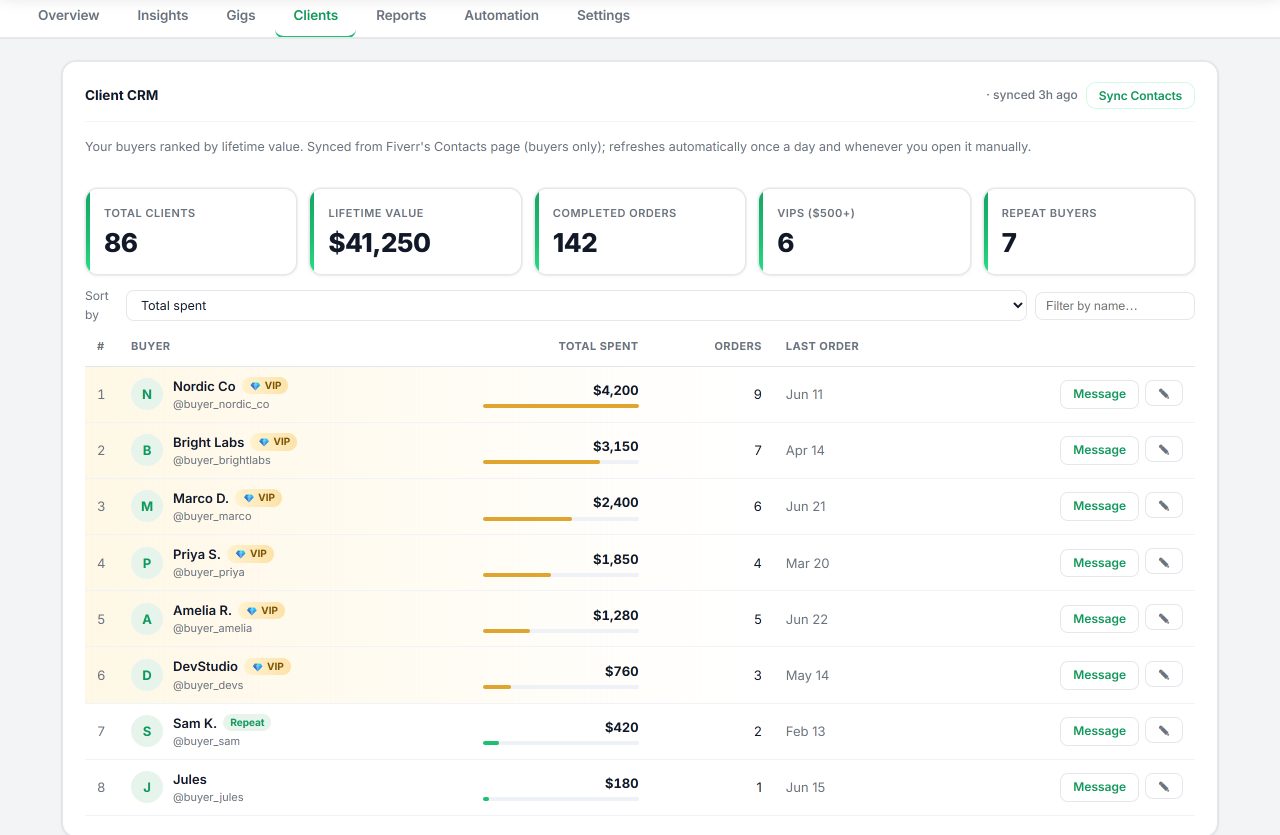
Seller OS suits the two rhythms of app work: long builds and short fixes. The Gig Builder turns a stage and a platform into a draft gig with packages that state what is out of scope, and hands you the filled Fiverr wizard to finish. For the fix side, client records keep reproduction notes and history attached to the buyer, so the second bug report does not start from zero.
The Gig Performance Optimizer reviews a live gig's copy, gallery, and conversion signals against its own performance data and proposes changes, and Pro monitors can watch a deadline when several fix orders overlap. It drafts, records, and flags; every edit and every Fiverr action stays with you.
Fiverr SEO for Mobile App Developers questions
What keywords should a mobile app gig target?
Stage and platform phrases: flutter app development, mvp app development, react native bug fix, app store submission. Write them the way a buyer at that stage would, put the strongest one in the title, and keep supporting phrases in the keyword field and tags. Validate each phrase in your subcategory before judging it.
Should bug fixes and app builds be separate gigs?
Almost always. A crash fix is an urgent, small, diagnose-and-repair order; a build is a scoped project with milestones. They use different phrases, delivery times, and requirements forms, and one listing forces both buyers to misread the offer. Split them and let each gig collect the reviews that fit it.
How do I prove app work if the client will not share a store link?
Show what can be shown: a redacted screenshot of the working feature, a short screen recording, and a caption that states your role and the stage you delivered. Portfolio projects hold one to five files and a description of up to 1,400 characters. Never upload private code or client analytics.
Does the Mobile Apps category have a minimum price?
Fiverr's published package guidance lists a standardized minimum of $100 for Full App Creation in the Mobile Apps category, while the platform-wide minimum starting price is $5 and some categories set it higher. The floor is not a price recommendation: scope the screens, integrations, and backend first, then price the package.
Sell the stage, not the stack
Scope the build, split the fixes, and show a store link the buyer can open and install.