 Seller OS
Fiverr cash advance: should sellers use it
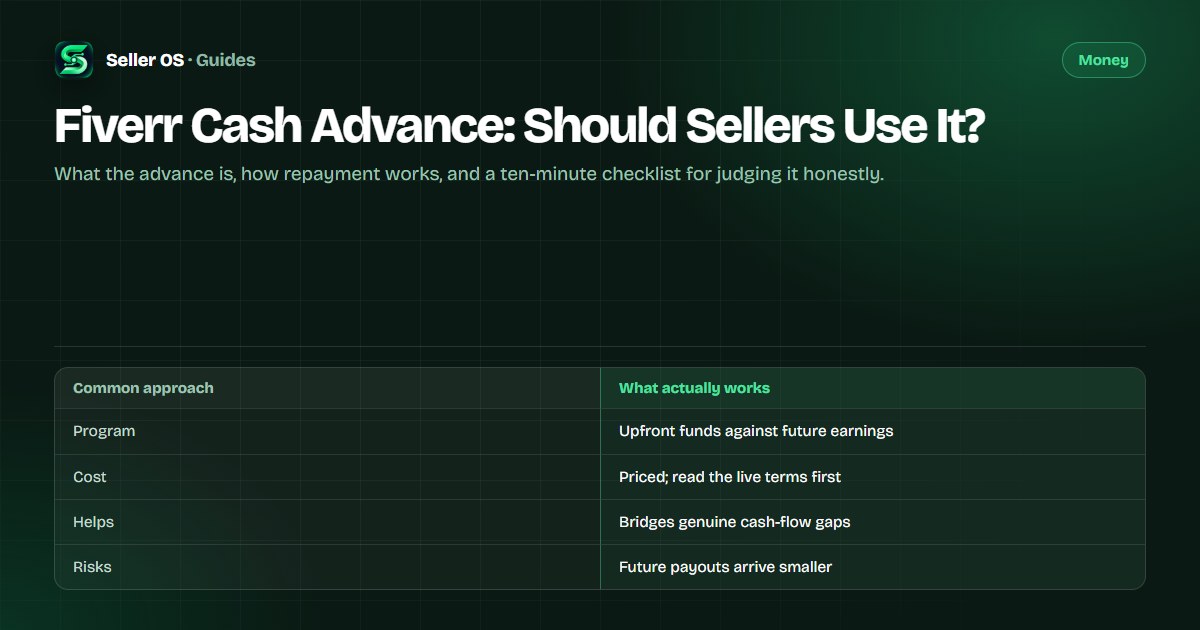
The Fiverr cash advance offers eligible sellers money upfront against future earnings, repaid from later payouts. It is neither free money nor a trap by default; it is a priced cash-flow tool, and its value depends entirely on what you do with the advance and whether you could have waited.
This guide stays neutral on purpose. It explains what the program is, how cost and repayment work, when an advance helps, and when it adds risk. It ends with a decision checklist you can run in ten minutes. No recommendation follows, because the right call differs by seller.
Free plan available. Local-first data. Human review on every change.
What the cash advance is
As Fiverr describes it in the Fiverr Help Center, the cash advance makes a lump sum available to eligible sellers, with repayment collected from subsequent earnings. Qualification, amounts, and timing are Fiverr's to set, and the offer appears only where the program is available to you.
The key distinction is against early payout. Early payout releases money you already earned; an advance puts expected future money in your hands now. That difference is why the decision needs more care: you are spending earnings that later orders must then replace.
How cost and repayment work
The advance carries a cost, and repayment happens automatically from later payouts, which arrive smaller until the balance clears. Read the live terms for the exact pricing, the repayment share, and the schedule before you accept anything. Screenshots of the offer screen belong in your records.
Model the lean weeks before you agree. List the payouts due during repayment, subtract the expected deductions, and check that the remainder covers your fixed costs. If the math only works when every order arrives on time, the advance is adding fragility rather than removing it.
When an advance helps cash flow
An advance helps when a short, specific gap blocks earning: materials for a confirmed order, a tool repair without which gigs pause, or a bill whose late charge exceeds the advance cost. The common thread is a named use with a priced alternative and a clear end date.
It also helps when the repayment period overlaps known incoming work rather than hoped-for work. Confirmed orders in the queue mean the lean weeks are survivable; an empty queue means you are borrowing against orders you have not won yet.
- The gap is short, named, and priced against an alternative.
- Confirmed orders cover the repayment weeks.
- The advance cost is smaller than the cost of waiting.
When it adds risk instead
Risk rises when advances stack or recur. Using a second advance to cover the lean weeks created by the first is a cycle, not a bridge. The same applies when the money funds spending unrelated to earning: the repayment still comes from future gigs either way.
Risk also rises when income is uneven. A seller with two quiet weeks ahead repays from a smaller base, which stretches the lean period and tempts another advance. If your order flow varies widely month to month, treat any advance as a last resort rather than a routine option.
A ten-minute decision checklist
Run these questions in order and stop at the first no. Each one targets a failure mode from the sections above, and together they separate a bridge from a cycle. Write the answers down; advances decided in your head always look better than they are.
If every answer is yes, the advance is a defensible tool for this specific gap. If any answer is no, fix that item first: wait, raise the next custom offer, or cut the expense. The pricing guide and the early payout guide cover the two gentler alternatives.
Name the use
one specific gap with a priced alternative
Model repayment
lean-week payouts minus deductions cover costs
Check the queue
confirmed orders overlap the repayment weeks
Compare alternatives
waiting or repricing costs less
Accept once
record terms and refuse to stack
Where Seller OS helps
Seller OS informs the checklist without joining the decision. Local order history and client records show whether your queue truly covers the repayment weeks, and past earnings rhythm shows how wide your quiet spells run.
The extension offers no credit, recommends no financial product, and takes no position on the advance. It keeps your data on your device and leaves the judgment, as it should, entirely with you.
Fiverr Cash Advance questions
What is the Fiverr cash advance?
It is a program offering eligible sellers a lump sum against future earnings, repaid automatically from later payouts. Fiverr sets qualification, amounts, and terms, and the offer appears only where available. Unlike early payout, which releases money already earned, an advance spends earnings that later orders must replace.
How do sellers repay a cash advance?
Repayment comes from subsequent payouts, which arrive reduced until the advance balance clears. The exact share and schedule sit in the live offer terms, so read and screenshot them before accepting. Model the repayment weeks against your fixed costs first: if the remainder only works when every order lands on time, the plan is fragile.
When is a cash advance a reasonable choice?
It is most defensible for a short, named gap that blocks earning, where confirmed orders overlap the repayment weeks and the advance cost undercuts the cost of waiting. Materials for a confirmed order are the classic case. Recurring gaps, empty queues, or non-earning spending point the other way.
What are the risks of taking an advance?
Later payouts arrive smaller, so lean weeks get leaner, and stacking advances turns a bridge into a cycle. Uneven order flow stretches repayment further and tempts another draw. Advances also commit un-won orders to past spending. Weigh these against the priced alternative, and prefer waiting or repricing whenever the comparison is close.
Judge the tool, skip the hype.
Run the checklist with real numbers before you accept any advance.