 Seller OS
Fiverr gig removed: how to respond
A removed gig is not denied and not paused. Fiverr's enforcement page says a gig may be removed when the services offered are not allowed under its Community Standards and Terms of Service, that the owner is notified, and that the content can no longer be accessed or reused for future gigs. That last clause changes the plan.
This guide separates removal from its lookalike states, shows the warning risk Fiverr attaches to repeat removals, and walks the evidence-first appeal and compliant rebuild, with no promises about either.
Free plan available. Local-first data. Human review on every change.
Removed, denied, or paused: tell them apart
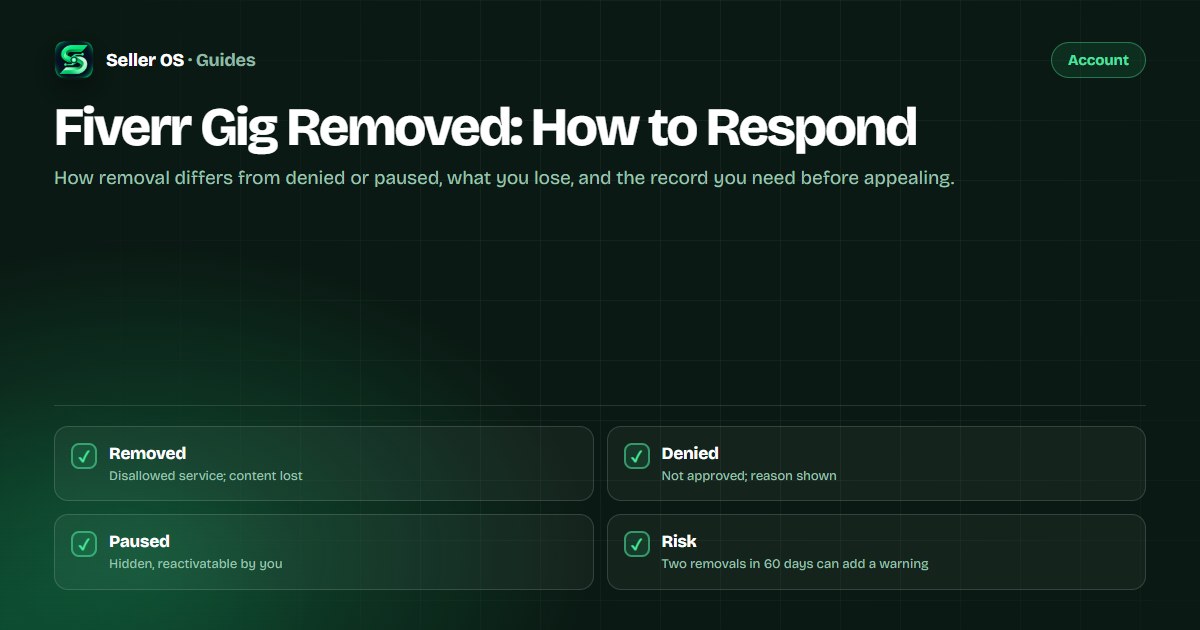
These three states sound similar and behave differently. Denied means the gig was not approved, and Fiverr shows the reason on the gig management page plus a Denied Gigs section. Paused means the listing is not visible to clients but you can reactivate it. Removal is enforcement: the service itself was judged not allowed.
The management page only lists Active, Pending Approval, Requires Modification, Draft, Denied, and Paused as statuses, so a removal may arrive as a notification rather than a dashboard row. Read the message, the cited policy, and whether the wording is about the service or about something inside the listing.
| State | What it means | Can you reuse the content? |
|---|---|---|
| Denied | Not approved; reason is shown to you | Yes; fix the listed issues and resubmit |
| Paused | Hidden from clients; reactivatable | Yes; the listing is unchanged |
| Removed | Service not allowed under policy | No; content can no longer be accessed |
Why Fiverr removes a gig, per its policy pages
Fiverr's published criterion is the service, not the writing: a gig may be removed when the services offered are not allowed under the Community Standards and Terms of Service. That framing matters. If the offer itself crosses a line, polishing the description is not the fix; the offer has to change or go.
You are notified when a gig is removed, and the enforcement page states the content can no longer be accessed or used to create future gigs. Treat the notice as the authoritative record, and compare what you sold against the policy it cites before you draft anything. The Gig Policies page is the place to start.
The account warning risk to watch
A single removal is heavy enough on its own; two are heavier. Fiverr states that if an account receives two gig removals within 60 days, with at least 24 hours between them, the account may also receive an account warning. Warnings are sent by email and expire after 90 days.
The warning ladder is worth understanding now, not later: a first warning does not limit activity, but a second warning for the same violation, or three warnings for different violations, leads to suspension. The account warning or ban guide covers that escalation. If the account itself is disabled rather than just the listing, the account disabled guide is the right page instead.
Collect this evidence before you appeal
Appeals through Customer Support are decided on facts, and after a removal you lose easy access to the listing. Gather what still exists and store it outside the gig: the notice itself, the policy text, and proof of what you actually offered or delivered.
Be honest about what the file shows before you send it. If the service was disallowed, the strongest appeal is not a denial; it is a short explanation of the change you made so the same issue cannot recur.
- The removal notice, unedited, with the date and cited policy.
- A screenshot of the gig management page or the notification.
- The gig's title, description, packages, and images from your copies.
- Licenses, receipts, or written permissions for gallery assets.
- Order numbers and delivered files connected to the service.
- Notes on how you described the service to buyers, in messages.
Write one appeal that stands on facts
Fiverr's enforcement page grants the right to appeal a decision as a complaint with Customer Support, and says it must be made within 6 months from the receipt of the notification. There is no separate gig-removal appeal form, so the complaint is the path. The How we enforce policies page is the reference to cite.
Send it once, from the registered email, and keep a copy. Repeated tickets and rewritten versions do not create a stronger case, and Fiverr publishes no appeal timeline or outcome rates, so plan for silence rather than a date.
Subject
Complaint: gig removal on [date], account [username]
The decision
one sentence naming the removal and the cited policy
The record
a dated list of what the gig offered and to whom
The response
what you changed, removed, or replaced, specifically
The request
a review of the removal decision, stated once
Attachments
notice, listing copies, permissions, and the timeline
Rebuilding after a removed gig
Since the removed content cannot be accessed or reused, a rebuild is a ground-up listing, not an edit. If the disallowed part was narrow, such as an asset, a bonus, or a guarantee, the discipline you already sell can often be offered in a trimmed, compliant form. If the service itself is not allowed, the offer has to change.
Write the new gig from the policy outward: check the Gig Policies and Community Standards for your category, describe only what you will actually deliver, and leave guarantees and unverifiable claims out. A new listing can be reviewed before it goes live, so a slower start is not a second rejection; the gig under review guide covers that wait.
Where Seller OS helps
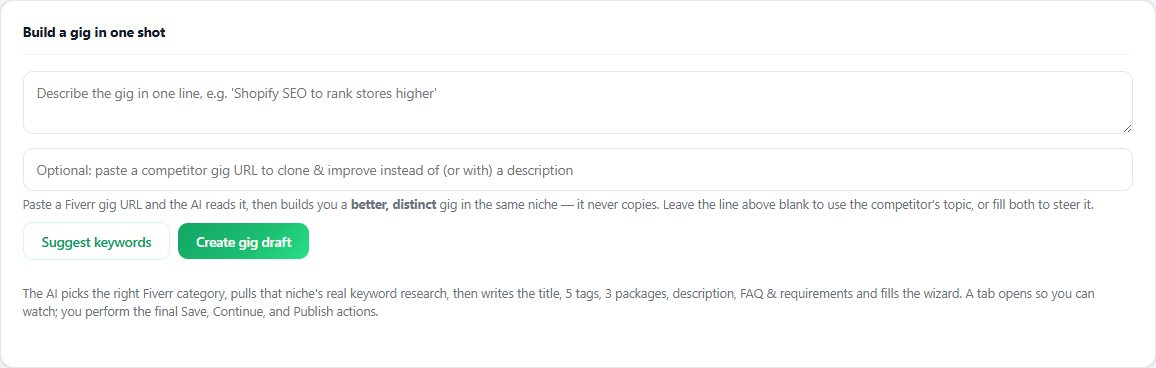
Rebuilding starts with the rules, and Seller OS keeps them close to the work: the Gig Builder turns a one-line idea or a competitor URL into a structured gig draft and fills the Fiverr wizard with your approved fields, leaving every Save, Continue, and Publish click to you.
Before publishing, the Gig Performance Optimizer reviews a draft or live gig's copy, gallery, and signals against its own performance data and proposes changes as drafts you approve. It cannot tell you whether Fiverr will approve a listing, and it never publishes anything by itself.
Fiverr Gig Removed questions
What is the difference between a removed and a denied gig?
Denied means the gig was not approved and Fiverr shows the reason on the gig management page, in the Denied Gigs section. Removed is enforcement: the services offered were judged not allowed under the Community Standards and Terms of Service. Denied content can be fixed and resubmitted; removed content can no longer be accessed or reused.
Can I appeal a removed Fiverr gig?
Yes, through the general enforcement appeal path. Fiverr states you have the right to appeal a decision as a complaint with Customer Support, and that it must be made within 6 months from the receipt of the notification. There is no separate gig appeal form and no published timeline or outcome.
Why was my gig removed without a warning first?
Removal is not the last rung of a ladder you have to climb; it is one of the enforcement actions Fiverr applies when it determines the services offered are not allowed. An account warning is a separate action that may follow two gig removals within 60 days. The notice should name the policy it cites.
Can I upload the same gig content again?
No. Fiverr states that once a gig is removed, its content can no longer be accessed or reused to create future gigs. Start from a new draft, drop anything the cited policy prohibits, and describe only what you can deliver. If the service itself is disallowed, change the offer rather than the wording.
Appeal once, rebuild by the rules
Save the notice, check the cited policy, and build any replacement listing from scratch and inside it.